
Time for rework: IHC design rejected for ‘not being Islamic enough’
CDWP suggests modelling design on LHC or Supreme Court, also cites lack of seating for litigants.
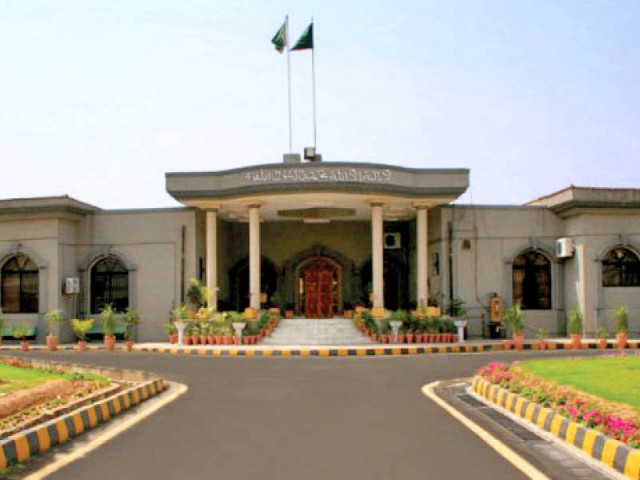
Time for rework: IHC design rejected for ‘not being Islamic enough’
The Central Development Working Party (CDWP) Wednesday rejected design of proposed Islamabad High Court building at Constitution Avenue on two major counts.
The first was a somewhat unusual opinion that the design does not reflect Islamic architecture and mirrors western styles, while the second was that the six-storey building does not properly facilitate visitors.
The CDWP has directed a review of the design.
Headed by Planning and Development Minister Ahsan Iqbal, Wednesday’s CDWP meeting discussed the project for nearly an hour, as the Ministry of Law and Justice, which is the sponsoring agency for the project, briefed the meeting.
On November 5, 2013, former Supreme Court chief justice Iftikhar Mohammad Chaudhry had performed the groundbreaking ceremony for the building, which is estimated to cost Rs 3.56 billion and will be built on five acres on Constitution Avenue next to the Radio Pakistan building.
The judiciary has vigorously been following the project, but the CDWP rejected any pressure and took its own decision, said a Capital Development Authority planning wing official.
The meeting was also informed that the PC-I of the project had not even been finalised yet.
Despite this, the federal government has allocated Rs722.325 million for the project in the financial year 2014-15.
Also of note is the fact that in PSDP documents, the cost of the project has been listed as Rs3.1 billion, while the document submitted to the CDWP on Wednesday put the cost at Rs3.6 billion.
The IHC is housed currently housed in the judicial complex in Sector G-10/1, a building meant for the city district courts.
On August 21, 2013, a jury headed by IHC Justice Shaukat Aziz Siddiqui and consisting of six other members including the IHC registrar and professional architects from the Pakistan Council of Architects and Town Planners (PCATP) finalised the design of the project.
A total of 26 architects had shown interest in designing the building. Later, 19 firms were shortlisted and 14 of them submitted designs by the August 20, 2013 deadline. A design submitted by Karachi-based architect Tariq Hassan was finally accepted.
The jury had also announced three prizes for the three best designs. The first prize of Rs300,000 went to Hassan, Rs200,000 for second place went to architect Iftikhar Azam, and the third prize of Rs100,000 went to Jahangir Sherpao.
“Tariq Hassan’s design was finalised after due deliberations by the jury,” said IHC Registrar Meeran Jan Kakar, who was also one of the jury members.
He did not comment further over the development.
The IHC, through the Ministry of Works, commissioned the Pakistan Council of Architects and Town Planners to organise and conduct a single stage nationwide limited architectural competition for the design of the new high court building.
PCATP website says the design of the public court is marked by twelve filigree light columns which create a poetic and impactful public interface. Furthermore, the court sets itself as an appropriate premise for the journey through a ‘Garden of Justice’ that leads to the high court.
It further reads that the judges entrance is marked by a grand concrete and marble staircase, while a central opening permits the lobby to be infused with focused and powerful light quality. “Such an atmosphere serves as a constant reminder of the universal justice of God,” it concludes.
The CDWP, however, observed that the proposed design of the court did not have sufficient seating arrangements for visitors and litigants, which would force them to wait outside the building until their turn.
The committee also directed that design be made more Islamic and cited the example of the Lahore High Court and Supreme Court buildings.
The committee also observed that stakeholders including lawyers and judges were consulted, but no representative for litigants was taken on board while finalising the design, which they said was inappropriate.
Published in The Express Tribune, June 26th, 2014.


MOST READ
Iran Parliament Speaker Ghalibaf, FM Araghchi land in Pakistan for high-stakes peace talks with US

Gold prices in Pakistan fall amid decline in global market

Trump says Israel will be 'scaling back' attacks on Lebanon after appeal to Netanyahu

Stage set for high-stakes Iran-US talks
Sindh announces early closure of markets, malls under austerity measures






COMMENTS
Comments are moderated and generally will be posted if they are on-topic and not abusive.
For more information, please see our Comments FAQ