Strong turnout as Spain votes with far right close to power
Updated 1 hour ago

Turnout reached 45.7% by 2pm, up from 40.5% in 2023, as Sanchez mobilised left-wing voters
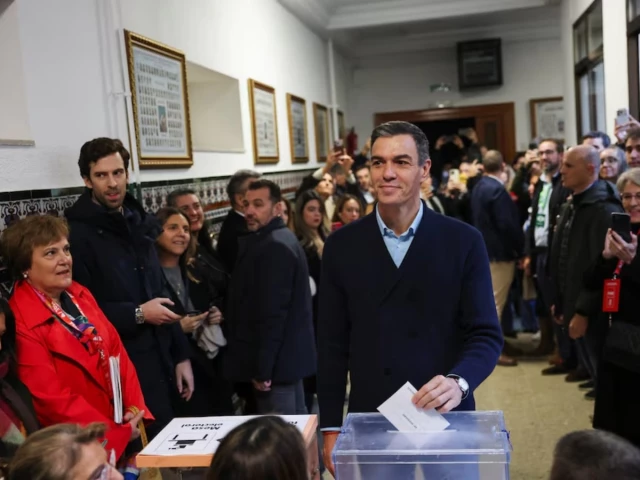
Spaniards turned out in large numbers on Sunday to vote in an election that could bring the far right into Spain's national government for the first time since the return of democracy, ending Socialist Prime Minister Pedro Sanchez's eight years in power.
Turnout reached 45.7% by 2 p.m. (1300 GMT), according to interior ministry data, up from 40.5% at the same stage of the previous national ballot in 2023. Sanchez, who has tried to mobilise left-wing voters, has said a turnout of 75% or more would favour the left.
Opinion polls point to a victory for the centre-right People's Party (PP), but suggest it would likely need support from the far-right Vox party to secure a governing majority in the 350-seat parliament.
Vox backs tougher immigration controls and lower taxes while opposing climate policies and expanded LGBTQ rights.
The vote is the first in a series of European elections that could see far-right parties make further gains.
Voting closes at 8 p.m. (1900 GMT), when a poll taken in the final week of the campaign will be released. The first official results are expected around an hour later.
Voting in Barcelona, Pena Loren, 77, voiced concerns about a possible shift to the right: “We risk being thrown back a few decades, and I think it’s important that we all vote."
Others headed to the polls hoping for change. "I can see quite a turnout, and I hope that the change we all need will come about," said Monica Chastel, a voter in Madrid.
Early election called amid housing crisis
Sanchez, who has governed with fragile minority coalitions since 2018, called an early election saying he needed a majority after parliament rejected decrees he proposed to address a mounting housing crisis.
The campaign has been marked by a debate over sharply different solutions to address rising rents and evictions.
Sanchez insisted on Friday that internal data showed he could secure a majority with smaller left-wing parties even though most polls point to a victory for the PP when combined with Vox.
Some recent polls showed the Socialist Party (PSOE) closing the gap with the PP, but at the expense of a disillusioned far left, whose support Sanchez would need to form a government.
Carmen Sanchez, 27, predicted that Sanchez could pull off another victory as she cast her vote in the same Madrid polling station as the Spanish premier.
"I think they're going to manage again - with more votes for the Socialists. As a young person, that makes me a little afraid of the future. They haven't solved much,” she said.
Sanchez was met by a crowd of supporters when he voted, while a smaller group of opponents shouted "out!" from nearby. "The only thing I can say is there's an epic mobilisation. That's what I'm seeing and smelling," he told reporters.
Coalition possibilities
The winning party needs 176 seats for a majority.
A coalition between the PP and Vox is seen as the most likely outcome, although it would involve hard bargaining over the share of government posts. Analysts say that Vox could opt to support a PP minority government from outside the government.
Coalition talks face no formal deadline before the first investiture vote, but if no candidate wins parliament's confidence within two months of that attempt, fresh elections are automatically triggered.
Sanchez has described the prospect of a PP-Vox coalition as a "regression." The PP and Vox already govern in coalition in four regions.
He has pointed to his record of overseeing one of the fastest-growing economies in the EU, bolstered by a rise in the minimum wage and a labour reform that has pushed unemployment to its lowest level in almost two decades.
Read More: Spain heads for snap vote amid right-wing surge
But some Spaniards say they are not feeling the effects of those headline gains due to rising prices for housing, energy and consumer goods.
Immigration issues, tarnished image
The boost to the economy has been fuelled by migrants, and economists fear that anti-immigration policies of a potential right-wing government could stifle growth.
Sanchez has rowed against the tide by promoting immigration as an economic benefit even as most of Europe is seeking to tighten its borders.
The PP says it would prohibit mass amnesties, allow for returns to third countries and introduce a points system for legal immigrants. Vox wants to deport convicted foreigners and give priority to Spaniards in the queue for housing.
Defeat for Sanchez would leave only three countries in the European Union – Denmark, Lithuania and Malta – with centre-left leaders.
Sanchez's image has been tarnished by a slew of corruption scandals involving his inner circle and family as well as his handling of crises including two deadly train crashes, a migrant surge in the North African enclave of Ceuta and a nationwide power outage.
While Sanchez faces accusations of poor management, his main rival, the PP's Alberto Nunez Feijoo, has sought to sell himself as a technocrat with his eye on the details.
Sanchez has also faced criticism for granting an amnesty to leaders of an attempt to separate Catalonia from Spain in exchange for their support in securing another term in 2023, when the PP won the most votes but fell short of a majority.
















This material may not be published, broadcast, rewritten, redistributed or derived from. Unless otherwise stated, all content is copyrighted © 2026 The Express Tribune.





COMMENTS
Comments are moderated and generally will be posted if they are on-topic and not abusive.
For more information, please see our Comments FAQ