Saudi-led coalition says it intercepted three Houthi missiles, vows response
Updated 14 minutes ago

Oil tanker catches fire after hitting mine in Strait of Hormuz: Iranian army
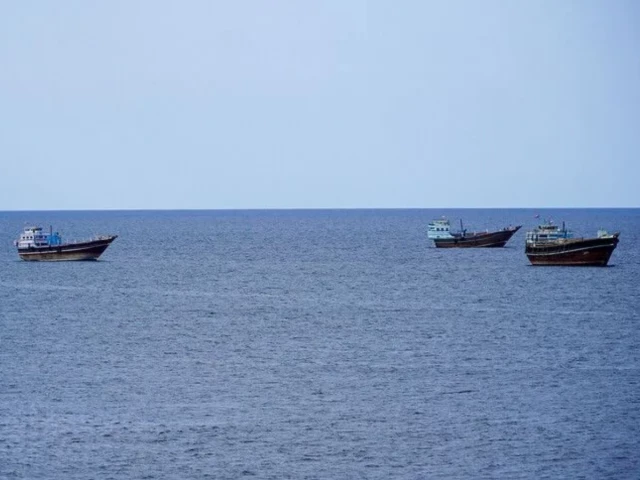
Iran’s army said on Sunday that a US drone struck a fishing boat carrying three people off the southern coast of Sirik, leaving one person missing.
In a statement carried by state-run broadcaster IRIB, the army's public relations department said two passengers were rescued and taken to hospital, while the search for the third person, the boat’s owner, was underway.
No further details on the incident were given.
Earlier, the Iranian army said early on Sunday that an oil tanker caught fire after hitting a naval mine in the Strait of Hormuz.
The army’s naval forces said three oil tankers entered a restricted area east of the strait after switching off their identification and navigation systems.
One of the tankers caught fire and was left immobilised, forcing the other two to turn back toward the Gulf.
The navy reiterated that the Strait of Hormuz would remain closed until “Iran’s demands are met” in negotiations with the US.
The statement did not identify the tankers or provide information on possible casualties.
Iran used Starlink in attacks on US forces, Washington Post reports
Iran used SpaceX's Starlink satellite internet services in attacks on US forces after the United States and Israel launched strikes against Iran, the Washington Post said in a report on Saturday, citing sources.
SpaceX CEO Elon Musk became enraged upon learning of two unauthorised uses of Starlink that his team concluded were related to Iran's efforts against US forces, the report said, citing two people familiar with internal company discussions.
Musk was also informed that the US military flew one-way drones on the militarised version of Starlink, called Starshield, but on a cheaper plan meant for ground operations, one of the people told the Post.
SpaceX and the Iranian Foreign Ministry did not immediately respond to Reuters' requests for comment.
A classified report to Defence Secretary Pete Hegseth described the Iranian military's use of Starlink, according to the Post.
The US Defence Department said in a statement to Reuters that it "is not aware of the report to the (office of the defense secretary) pertaining to this subject.”
The use of Starlink in regions of geopolitical conflict, its control by the US government as well as its illicit use by sanctioned entities have drawn scrutiny amid the wars in Ukraine and in Iran.
Starlink is not licensed to operate in Iran, but Musk has previously said the service is active there.
Iranian authorities have cut public access to the internet during periods of unrest, including during deadly nationwide protests in January, after which the US government smuggled thousands of Starlink terminals into Iran, according to the Wall Street Journal.
Iran rial hits record low near 3 million per dollar as inflation, sanctions bite
Iran's currency plunged to a record low on Saturday, approaching the psychological threshold of 3 million rials to the US dollar, amid rising inflation, hardening US sanctions and a widening embargo.
The US dollar was sold at around 2.992 million rials, up from 2.938 million on Friday, according to free-market tracking website bon-bast.com, while alanchand.com reported 2.999 million rials per dollar, up 1.83%.
Iran is facing one of its worst inflation surges in decades, driven by the nine-month-old Iran war, with a particularly sharp rise in food prices.
The US reimposed its naval blockade on Iranian ports in July, and earlier this month announced Task Force Iron Gate to restrict the movement of weapons and sanctioned materials across Iran's land borders and the Caspian Sea.
“Iran’s economy is underwater, and its leaders are panicking,” US Treasury Secretary Scott Bessent said in a statement earlier this week after imposing new sanctions aimed at isolating Iran from the global economy and disrupting its shadow banking networks.
Iranian Central Bank Governor Abdolnaser Hemmati said on Saturday that Iran had sufficient hard currency to pay for basic goods and medicine for months to come, but added that the foreign exchange market was affected not only by economic fundamentals but also by psychological factors.
"Foreign exchange is affected by many factors such as the economy, expectations and politics ... We are trying to stabilise the market as much as we can," Hemmati told state television.
Many Iranians seeking safe havens for their savings have been buying dollars, other hard currencies or gold.
Consumer prices in Iran in October were 88.7% higher than a year earlier, while annual average inflation accelerated to 76.8%, according to the Statistical Centre of Iran. Food and beverage prices rose 112.6% year-on-year.
Iran’s currency plunged to a record low in August, crossing the threshold of 2 million rials to the US dollar, while annual inflation reached 66% in July.












This material may not be published, broadcast, rewritten, redistributed or derived from. Unless otherwise stated, all content is copyrighted © 2026 The Express Tribune.





COMMENTS
Comments are moderated and generally will be posted if they are on-topic and not abusive.
For more information, please see our Comments FAQ