Seven 'terrorists' eliminated in Bannu
Updated 8 minutes ago

FCC and IHC cancel judicial work due to Makkah pact moot but SC hears cases
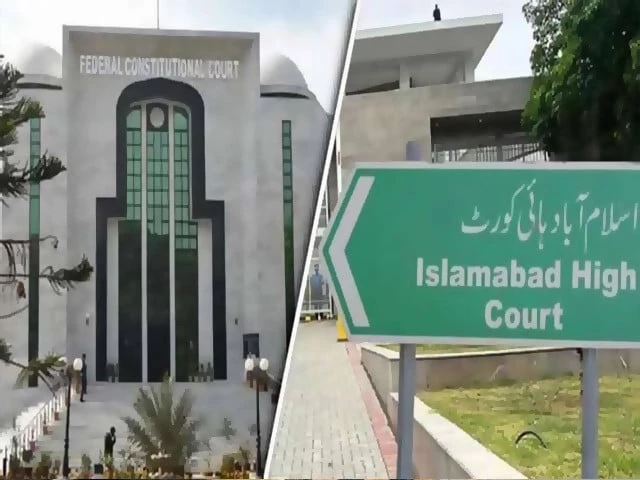
Three superior courts are situated on Islamabad's key Constitution Avenue. However, they adopted different policies when the Islamabad Capital Territory (ICT) administration announced an "unforeseen holiday" due to high-profile visits by foreign dignitaries in the federal capital.
On Friday, the Islamabad administration took strict security measures around the red zone due to a meeting of the Makka Joint Defence Agreement's top decision-making body.
Citing the "closure of the red zone" and the "difficulties to be faced by lawyers, litigants and the officers/officials to attend the court," the Federal Constitutional Court (FCC) and the Islamabad High Court (IHC) announced the suspension of all judicial work and cancelled cause lists.
According to the notification, the FCC chief justice "in exercise of powers conferred under Rule 5(2) of Order II of the FCC (Practice and Procedure) Rules, 2026," ordered that no judicial work shall be conducted on 27th November, 2026 (Friday) at the Principal Seat of the Court in Islamabad.
However, all officers and staff worked from home. Besides, all four branch registries of the court remained open for judicial and administrative work.
However, the Supreme Court did not cancel cause lists and heard cases at its principal seat in Islamabad, even though the buildings of the FCC and Supreme Court are almost opposite each other on Constitution Avenue. The IHC building is also situated on the same thoroughfare.
Interestingly, the Supreme Court also issued a press statement, disclosing that it continued judicial work. "In pursuance of the SOPs regarding unforeseen holidays issued on April 21, the administrative and judicial business was carried out at Supreme Court Principal Seat in Islamabad," the statement said.
At the Principal Seat, four benches conducted judicial proceedings with minimal staff arrangements, disposing of 21 cases, while 74 petitions and 11 applications were presented before the Public Facilitation Centre and processed accordingly.
The statement said through flexible administrative arrangements and technology-enabled hearings, the court remained functional and continued to facilitate litigants and members of the legal fraternity despite difficulties in physical access to the court.
"The continued functioning of the Supreme Court under challenging circumstances reflects its institutional preparedness, operational resilience, and commitment to ensuring that temporary disruptions do not become barriers to accessing justice," it said.
Some lawyers questioned why these three superior courts could not evolve a joint policy regarding judicial functioning in the prevailing situation. They also wondered why Chief Justice of Pakistan Yahya Afridias head of the institutioncould not evolve joint SOPs.












This material may not be published, broadcast, rewritten, redistributed or derived from. Unless otherwise stated, all content is copyrighted © 2026 The Express Tribune.




COMMENTS
Comments are moderated and generally will be posted if they are on-topic and not abusive.
For more information, please see our Comments FAQ