Khawaja Asif optimistic about referendum on creation of new provinces early next year
Updated 1 hour ago

Campaign calls for teaching boys consent, equality and shared responsibilities to change attitudes perpetuating abuse
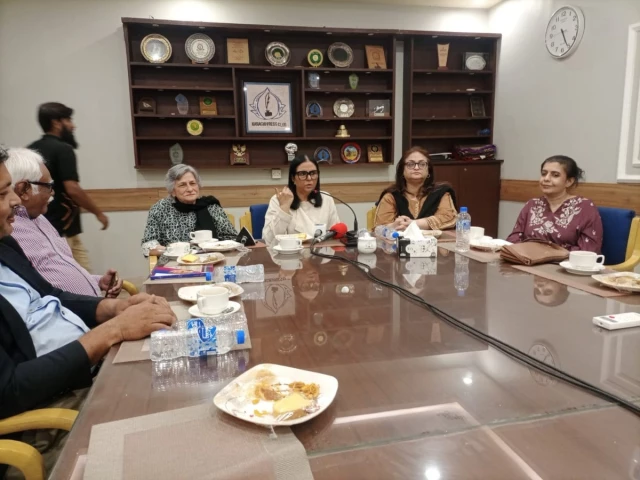
An awareness campaign urging parents to focus on raising boys to respect women rather than restricting girls' behaviour was launched at the Karachi Press Club on Tuesday by the Uks Research Centre as part of the global 16 Days of Activism against Gender-Based Violence campaign.
Titled “Baita sudharo, baiti bachao”, the initiative was launched through a panel discussion highlighting the need to address gender discrimination, challenge attitudes towards women and promote the respectful upbringing of boys.
Uks Research Centre launches its 16 Days of Activism campaign (Nov 25 – Dec 10), aligned with the UN’s 2026 theme: “UNiTE to End Violence Against Women and Girls: Ensure Justice, Protect Survivors, End Impunity.”
— Uks Research Centre (@CenterUks) November 23, 2026
Join us in standing for justice, protection, and accountability. pic.twitter.com/NgmJp4mwtA
Observed globally from November 25 to December 10, the 16-day campaign seeks to raise awareness about violence against women and girls through panel discussions, social media outreach and messages from prominent personalities.
Speaking at the event, Uks Research Centre head Tasneem Ahmer said the campaign's theme highlighted society's tendency to place the responsibility for preventing harassment and violence on girls rather than addressing the way boys were raised.
She said girls were routinely advised to change their behaviour, remain cautious and take precautions to protect themselves, while comparatively little attention was paid to teaching boys to respect women.
Through this year's campaign, the centre aimed to focus on boys' upbringing, challenge harmful social attitudes and address mindsets that contributed to violence against women, she added.
Former Aurat Foundation head Mehnaz Rahman welcomed the initiative, describing it as an important step towards addressing gender-based violence.
She said men and women should be given their due rights rather than being viewed as competitors, adding that the attitudes and mindsets underlying violence needed to change.
Stop locking daughters away while letting sons run wild unchecked. Childhood shapes who we become; redefine manhood with empathy, teach respect early, and end entitlement.
— Uks Research Centre (@CenterUks) November 24, 2026
- Tasneem Ahmar, Uks Research Centre#BaitaSudharoBaitiBachao pic.twitter.com/7lISYLv86i
Mehnaz stressed the importance of teaching boys to treat their wives as equals, share household responsibilities and contribute to domestic work, saying such values should be instilled at home.
She also challenged misconceptions surrounding men's emotional expression, saying men experienced pain and should have the freedom to cry and express their feelings. Emotions, she added, were not exclusive to any one gender but were shared by all human beings.
Karachi Union of Journalists General Secretary Lubna Jarrar said women continued to struggle for their fundamental rights despite these being guaranteed under the Constitution of Pakistan. She added that women still often felt compelled to seek permission to make decisions about their lives and exercise their basic freedoms.
Lubna stressed that boys should be raised to respect the autonomy of their future wives and sisters rather than impose their choices on them. Children needed to understand that men and women were equal human beings, despite their different genders, she added.
She further said empowering women required a broader transformation of societal attitudes and behaviours.
Read More: Gender violence extends beyond physical abuse
Senior journalist Dr Tauseef Ahmed emphasised the importance of women's economic independence, while Dr Irfan Aziz also participated in the discussion.
Participants also highlighted the gap between existing legal protections for women and their implementation, observing that although laws were in place, ensuring their effective enforcement remained a major challenge.
They stressed that parents needed to teach boys respect for women, consent, equality, shared domestic responsibilities and the rejection of violence.
The discussion produced recommendations for strengthening institutional and legislative efforts to address gender-based violence. Participants proposed regular consultations with members of parliament to improve legal protections for women and called for greater awareness among lawmakers, effective legislation and stronger implementation of existing laws.
They also called for closer coordination with government institutions working on women's rights, women members of the Sindh Assembly and other relevant forums.
Participants further proposed preparing an annual report to assess progress in protecting women's rights and ensuring their safety.
Also Read: Gender-based violence against women surges 25% in Pakistan
On December 2, 2025, Sahil, an organisation monitoring gender-based violence, reported a significant rise in crimes against women across Pakistan during the first eleven months of 2025 in its annual report.
The report was compiled from data published in 81 national newspapers spanning all four provinces and showed that 6,543 incidents were reported in 2025, compared with 5,253 cases in 2024, reflecting an increase of nearly twenty-five percent over one year.
The incidents documented between January and November 2025 included 1,414 cases of murder, 1,144 of abduction, 1,060 of physical assault, 649 suicide cases, and 585 cases of rape.
The findings highlighted that a majority of gender-based violence took place within victims' homes, accounting for 60 percent of the recorded cases, whereas 13 percent occurred at the perpetrator's own premises.
Sahil's latest assessment warned that the actual scale of gender-based violence may be far higher, as many incidents go unreported due to social barriers, lack of access, and safety concerns.








This material may not be published, broadcast, rewritten, redistributed or derived from. Unless otherwise stated, all content is copyrighted © 2026 The Express Tribune.











COMMENTS
Comments are moderated and generally will be posted if they are on-topic and not abusive.
For more information, please see our Comments FAQ