Call to raise rice exports to Uganda
Updated 16 minutes ago

Senate panel reveals Punjab holds 66% of grade-22 federal posts against quota
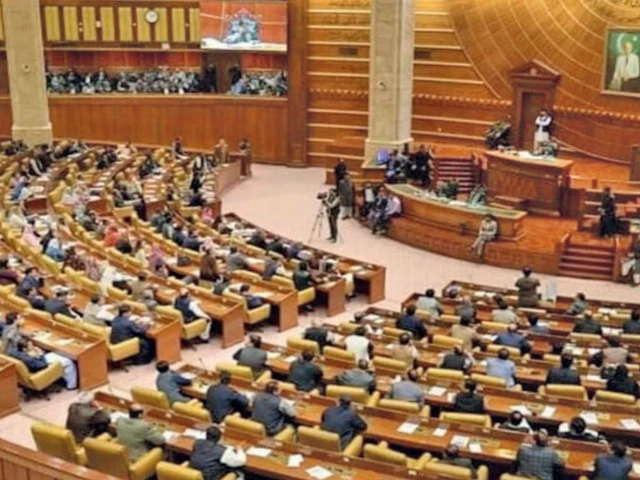
The federal government did not transfer Rs1.8 trillion in profits of four oil and gas sector companies to the provinces in breach of the Constitution, and also promoted two out of every three Grade-22 officers from Punjab, revealed proceedings of a Senate panel working to enforce the Constitution.
Out of the 53 bureaucrats holding the highest Grade-22, as many as 35 belonged to Punjab, 10 to Khyber-Pakhtunkhwa (K-P), only six to Sindh, and one each from Balochistan and Gilgit-Baltistan (G-B), revealed details shared by the Establishment Division on Monday.
The two glaring findings that the federal government shared with the subcommittee of the Senate Functional Committee on Devolution pointed towards deprivations that caused resentment among the smaller federating units against the Centre. PPP Senator Zamir Hussain Ghumro chaired the meeting to review the implementation of constitutional Article 172(3), which deals with equal ownership of the oil and gas sector, and Article 38(g), which ensures the due share of the provinces in federal government jobs.
Since 2011, only four companies - Pakistan Petroleum Limited (PPL), Oil and Gas Development Company (OGDCL), Mari Petroleum and Pakistan Oil Fields Limited (POL) - earned Rs3.6 trillion in profits after the 18th amendment, and not a single penny has been paid to the provinces against their Rs1.8 trillion share, said Ghumro. According to these details, the federal government did not transfer half of the shares, which came to Rs978 billion in the case of OGDCL, Rs462 billion of PPL, Rs225 billion of Mari and Rs144 billion of POL.
Article 172(3) ensures joint and equal ownership and sharing of resources, which has not been implemented in letter and spirit, said the chairman, while emphasising that the provinces are constitutionally entitled to an equal share in revenues generated from oil and gas resources produced within their territories. Expressing serious concern over the non-implementation of Article 172(3), Senator Ghumro termed the situation a violation of the Constitution and stated that the continued deprivation of provinces of their legitimate financial share is unacceptable.
The continued revelations made in various meetings of the committee highlight the reasons fuelling resentment among provinces like Balochistan and Sindh and also show the dominance of Punjab-origin bureaucrats in the federal government. The federal government has also spent Rs8.5 trillion on provincial matters since 2011, including Rs3.5 trillion on the Benazir Income Support Programme (BISP), despite these matters relating to provinces.
Ghumro directed the Petroleum Division to share a framework for transferring half of the total profits of the oil and gas sector companies with the provinces. The total amount may exceed Rs6 trillion when the details of other companies are received, said the chairman of the committee. He directed the Petroleum Division to place the framework before the federal cabinet for approval on an urgent basis and share the relevant summary with the subcommittee. He warned that failure to comply with constitutional requirements could lead to referral of the matter to the auditing authorities of Pakistan for further examination.
"All the chief ministers of the provinces and the federal ministers for finance and petroleum shall be called in the meeting if the matter remains unresolved," according to the decision by the subcommittee.
The committee asked the Auditor General to comply with Article 172(3) while auditing the profits of the oil and gas corporations.
Provincial share in jobs
The Establishment Division shared details of provincial shares in federal government jobs, which showed that Punjab and K-P had higher than constitutional shares at the expense of Sindh and Balochistan.
Article 38(g) of the Constitution states: "Ensure that the shares of the provinces in all federal services, including autonomous bodies and corporations established by, or under the control of, the federal government shall be secured and any omission in the allocation of the shares of the provinces in the past shall be rectified."
According to the formula, in the case of direct recruitment, 7.5% of positions will be filled on merit. As much as 50% will be the share of Punjab, including Islamabad Capital Territory (ICT), 19% for Sindh, 11.5% for K-P, 6% for Balochistan, 1% for G-B, 3% for erstwhile Federally Administered Tribal Areas (FATA) and 2% for Azad Jammu and Kashmir (AJK).
However, according to the Establishment Division, there were 53 positions of Grade-22 in the federal secretariat and 35, or 66%, were occupied by bureaucrats from Punjab. Sindh got only six positions, K-P 10, Balochistan one and G-B one, but there were no bureaucrats in Grade-22 from AJK and erstwhile FATA. There seems to be an error in the data, as Inter-Provincial Coordination Secretary Mohyuddin Wani belongs to AJK.
The functional committee's interpretation is that appointments are direct induction, through transfers and promotion to the next grade, saying that provincial shares should be observed in all three cases. The Establishment Division informed the committee that in March this year, it had issued instructions to all ministries, divisions and concerned organisations to ensure "strict observance of the prescribed provincial shares".
"Based on the detailed grade-wise analysis conducted by the Establishment Division, the representation of all provinces and regions in the federal government services is generally consistent with the prescribed allocated shares and remains broadly balanced across various grades, except in the case of Balochistan," according to the Establishment Division.
The chairman of the subcommittee said the rural-urban divide of Sindh was against the provision of Article 38(g), which envisages shares of provinces, and directed that the urban-rural divide be done away with, maintaining only the share of the whole province like other provinces.
As against its 50% share, overall Punjab has 60.17% of positions in the federal secretariat and K-P 16%, well above its share of 11.5%.
But Sindh got only 14.5% of total jobs as against its share of 19% and Balochistan 4% compared to its 6% share. The Establishment Division informed the subcommittee that 5,136 posts in BPS 1-15 had recently been advertised for Balochistan to address its employment needs.
The division also apprised the subcommittee of various exemptions granted by the federal cabinet to facilitate applicants from Balochistan and its plan to create 200,000 employment opportunities for the province. The convener emphasised that recruitment arrangements must ensure fair opportunities for candidates from deserving households and regions.
The convener expressed displeasure over the Establishment Division's failure to submit the rectification plan for Sindh, as directed in earlier meetings.












This material may not be published, broadcast, rewritten, redistributed or derived from. Unless otherwise stated, all content is copyrighted © 2026 The Express Tribune.







COMMENTS
Comments are moderated and generally will be posted if they are on-topic and not abusive.
For more information, please see our Comments FAQ