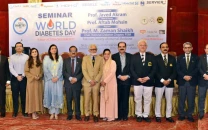
‘Pakistan among most diabetic states’
Updated 36 minutes ago

Inquiry finds ex-SHO Kamran Qureshi did not call crime scene unit to collect evidence as per established procedures

Former Gulistan-e-Jauhar Station House Officer (SHO) Sub-Inspector Kamran Qureshi was dismissed from service on Saturday for failing to secure the crime scene and summon the crime scene unit in the murder case of Mir Raza.
Karachi Range Additional Inspector General (AIG) of Police Azad Khan issued the final dismissal order after a departmental inquiry found the former SHO guilty of negligence, unprofessional conduct, and failure to discharge his official responsibilities.
According to the departmental order, Qureshi was serving as SHO at Gulistan-e-Jauhar Police Station in District East when the incident occurred on July 29, 2026.
میر رضا کیس میں اہم پیشرفت!
— Express News (@ExpressNewsPK) November 14, 2026
Disclaimer: For news reporting and informational purposes only. Views or actions expressed by subjects do not imply endorsement by Express News. Shared in the public interest in compliance with community guidelines.#ExpressNews #BreakingNews… pic.twitter.com/FdSxWJKp9b
Raza's body was found with bullet wounds in bushes near Shadi Qila Ground in Block 1, Gulistan-e-Jauhar. The body was reportedly two days old.
Read: Mir Raza’s final hours: A trail of calls, a Rs30m plea and a vanishing act
The inquiry found that Qureshi had failed to secure the crime scene and call the relevant crime scene unit to collect evidence in accordance with established procedures. His negligence allegedly delayed forensic examination and raised the risk of important evidence being lost.
The departmental inquiry was conducted by Central Senior Superintendent of Police (SSP) Dr Muhammad Imran Khan, who submitted his report on September 21, 2026, recommending a major departmental penalty against Qureshi.
A show-cause notice was subsequently issued to the former SHO, but he did not submit a written reply. He was also summoned to the Orderly Room on November 13 to present his position in person. However, his verbal explanation was found unsatisfactory.
Agreeing with the inquiry officer's recommendations, AIG Khan ordered Qureshi's dismissal under the Sindh Police Efficiency and Discipline Rules, 1988. The order also directed the completion of accounts relating to government property and outstanding dues.
In a separate statement, Karachi Police said the action had been taken in light of the findings and recommendations of the inquiry commission in the Raza case.
The case findings
The 25-year-old owner of dessert brand Wafflix, Raza, went missing from Karachi’s PECHS on July 28, 2026. The next day, his body was found near the bushes alongside a wedding hall in Gulistan-e-Johar.
Police initially treated the death as a possible suicide, but the court ordered a second post-mortem exam to conclusively determine the cause of death after the first post-mortem report failed to give detailed insight into the victim’s demise. The second autopsy conducted after Raza’s exhumation found a firearm entry wound, multiple ante-mortem injuries and signs of internal bleeding, leading investigators to treat the case as murder.
The initial post-mortem had faced several objections, with the Karachi police surgeon identifying 14 deficiencies, including the absence of an X-ray, failure to collect hand swabs for gunshot-residue analysis and the lack of chemical examination of gunpowder marks around the bullet wound.
Also Read: Mir Raza judicial commission’s term extended until October 15
The investigation subsequently came under scrutiny from Raza’s family, who alleged serious lapses in the handling of evidence and CCTV footage and sought the formation of a joint investigation team. The Sindh High Court later rejected the family’s plea for a JIT but directed the relevant authorities to conduct the investigation impartially, fairly and expeditiously.
Police told a Senate committee in September that they had recorded statements from 78 people but had not found evidence linking anyone to Raza’s alleged murder. Investigators nevertheless continued to treat the case as murder, while reviewing medical, chemical, forensic and digital evidence.
The Sindh government had meanwhile established a judicial commission headed by Sindh High Court Justice Umar Sial to examine the circumstances surrounding Raza’s death, the conduct of the investigation and any possible negligence or concealment of evidence by police or other officials.
The judicial commission has so far examined police records, witness statements and the circumstances surrounding Raza's death, with its proceedings raising discrepancies in witness accounts, the handling of evidence and the initial post-mortem. The commission also questioned senior police and health officials over the investigation, including the handling of CCTV footage, Raza’s phone and smartwatch, and the initial focus on a possible suicide.
On October 16, a Judicial Commission investigating Raza's death submitted its report to the Sindh government after conducting 15 hearings to examine the circumstances surrounding his death and possible lapses in the police investigation.
On November 14, a Judicial Magistrate East court granted a Joint Investigation Team (JIT) an additional 10 days to complete its investigation into the Mir Raza case and submit its report.









This material may not be published, broadcast, rewritten, redistributed or derived from. Unless otherwise stated, all content is copyrighted © 2026 The Express Tribune.






COMMENTS
Comments are moderated and generally will be posted if they are on-topic and not abusive.
For more information, please see our Comments FAQ