IHC suspends Islamabad LG elections
Updated 24 minutes ago

Pakistan seals 13 mineral deals
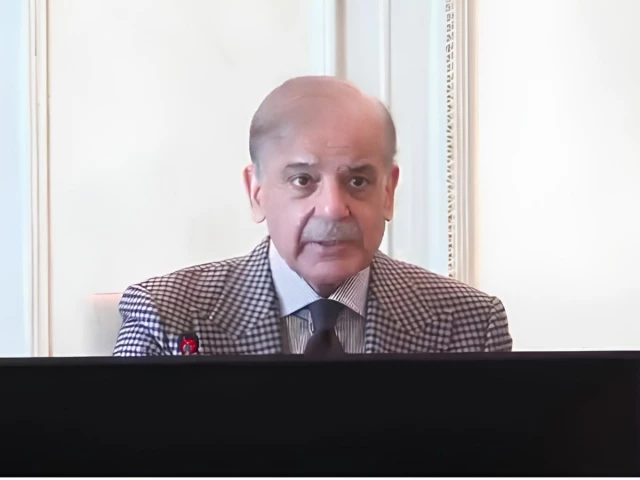
Pakistan on Friday announced over a dozen mineral cooperation deals with foreign companies and nations and proclaimed that it would no more encourage export of raw materials or minerals, setting the tone for the country's future development goals.
At the concluding day of Pakistan Mineral Investment Forum, both Prime Minister Shehbaz Sharif and Chief of Defense Forces Syed Asim Munir emphasized that the country would want the investors to build complete value chains, starting from exploration to finished products, instead of just exporting the raw materials.
While also clearing clouds over the future of the Reko-Diq project, the executive chairman of Barrick Gold, which owns 50% stakes in the project, John Thornton said that his company "intends to continue to be a long-term partner of Pakistan".
The country also entered into two memorandum of understanding with Ivanhoe Atlantic the US firm that possesses modern technology to unearth minerals.
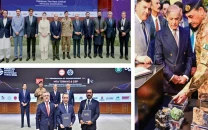
Pakistani companies finalized 13 joint ventures, memorandum of understanding and agreements with foreign companies on the last day of the mineral conference.
A joint venture agreement was signed between Lidiya Mining of Turkiye and Mari Minerals (Private) Limited for the exploration and development of mineral opportunities in Chagai, Balochistan. A Joint Venture Agreement was announced between MSALABS Limited, UK, a subsidiary of Capital Limited and Mari MSA Labs (Private) Limited to establish a state-of-the-art mineral assay commercial laboratory in Pakistan.
The third joint venture strategic framework between MTA International Company (MTAIC), Türkiy and Mari Minerals (Private) Limited was announced to undertake mineral exploration, development of mining projects in Chagai, Balochistan.
One of the major announcements was an MOU between FWO and Ivanhoe Mines for a joint collaboration for mineral exploration and mining projects in Chagai, Balochistan. Robert Freiland Founder and Co-Chairman Ivanhoe Mines and Engineer Abdul Sami, CEO Frontier Works Organization signed the deal.
Japan and Pakistan exchanged the Statement of Intent to further strengthen support for the Geological Survey of Pakistan. In addition, the Geological Survey of Pakistan and the General Directorate of Mineral Research and Exploration of Türkiye (MTA) reached a deal.
The Geological Survey of Pakistan and Germany signed an MOU for geo-science .
A Joint Venture agreement was signed between MTA International Company (MTAIC), Türkiye and the Pakistan Mineral Development Corporation (PMDC) for the exploration of antimony, copper, gold, silver, molybdenum and other critical minerals in Pishin, Balochistan.
Likewise, the Geological Survey of Pakistan and the British Geological Survey signed an MOU on cooperation in geosciences.
A Joint Venture deal was announced between International Geosciences Services and the Pakistan Mineral Development Corporation (PMDC) for JORC-compliant gemstones resource assessment - GRE and the development of a replicable model mine.
Two agreements were also signed at the conclusion. An agreement was signed between Shift Geophysics and Southern Geosciences for an airborne geophysical survey. The second agreement was signed between Fleet Space ANT for ambient noise tomography.
In his speech, Prime Minister Shehbaz Sharif called for Pakistan's mineral resources to be developed alongside environmental protection, stressing that mining projects must follow international standards and use modern technology to safeguard water resources and workers' health and safety.
Shehbaz urged foreign investors to mine, process and manufacture minerals in Pakistan rather than export them in raw form, saying the country needed to develop its entire mineral value chain to generate greater economic opportunities.
He said Pakistan wanted to establish downstream industries, including refineries, smelters and cable and conductor factories, to ensure its mineral wealth generated greater economic value.
"Mine in Pakistan, process in Pakistan, manufacture in Pakistan and then export to the rest of the world", said Sharif describing the approach as the government's philosophy and mission.
Shehbaz said Pakistan wanted investment partnerships extending beyond extraction to processing and manufacturing. He described such arrangements as the foundation of fair and equitable partnerships that would create value for Pakistan while offering significant opportunities to investors.
The prime minister said Reko Diq production was expected to begin in 2028, adding that a project which had remained stalled for two decades was now moving towards operational execution. However, the deadline seems challenging, as the project is at halt due to security concerns.
Also addressing the forum earlier, Chief of Defence Forces and Chief of Army Staff Field Marshal Asim Munir pledged to ensure security across Pakistan's mining sector as part of efforts to attract long-term mineral investment and make the country a competitive destination for international investors.
The field marshal said every possible measure was being taken to ensure the security of the entire mining sector. He assured that mines, miners, investments, industries, projects and people associated with the sector would be provided protection.
CDF Munir said Pakistan aimed to become a competitive destination for long-term mineral investment, stressing the importance of creating a secure environment for mining activities and related industries.
He said unlocking Pakistan's mineral wealth was a collective national objective and emphasised that the country needed to move beyond exporting raw materials.
The army chief said the objective was to develop the entire mineral value chain, including refining and manufacturing, to generate greater economic benefits. He added that Pakistan wanted to establish long-term partnerships that would create sustainable economic value for the country and its international partners.
Field Marshal Munir also stressed that mineral development must benefit local communities, particularly those living in mineral-rich areas. He said people in these regions should see tangible improvements in their lives as a result of mining activities.
In his opening speech, Minister for Petroleum Ali Pervaiz Malik said that Pakistan wanted to move "Beyond Reko Diq. The Reko Diq is indeed showing the world that a long-term mining partnership of real scale is possible in Pakistan. Our task now, together, is to show that it is not an exception but the beginning of a new normal", said the Petroleum Minister.
He said that Pakistan was looking for credible partnerships with domestic and international investors who are willing to explore, develop and operate projects, who bring patient capital, technology, value addition, expertise and access to global markets.
Ali said that more than 40 mineral exploration licenses have been granted in the Chagai and Khuzdar districts of Baluchistan, reflecting growing private-sector participation in strategic and critical minerals. He said that Pakistan was developing road connectivity between Chagai's mineral-rich belt and Gwadar Port and Thar coal to power plants to facilitate mineral transportation and link Pakistan's mineral resources with international markets.







This material may not be published, broadcast, rewritten, redistributed or derived from. Unless otherwise stated, all content is copyrighted © 2026 The Express Tribune.





COMMENTS
Comments are moderated and generally will be posted if they are on-topic and not abusive.
For more information, please see our Comments FAQ