Govt to levy up to 10% ADL on ICE vehicles
Updated 56 minutes ago

NEVs retain lower sales tax, while SBP may raise vehicle financing limit to Rs10m
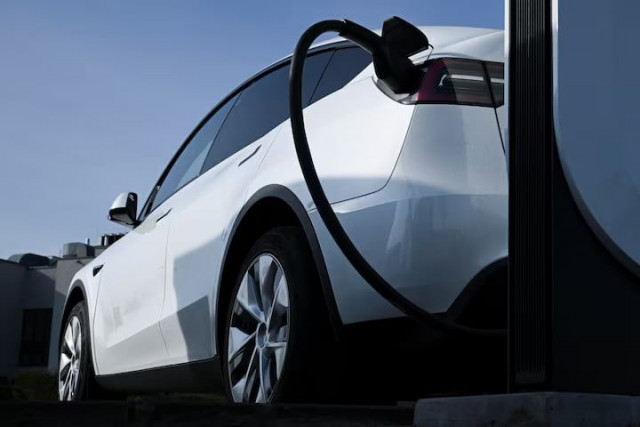
The government has decided to impose an Automotive Development Levy (ADL) of 2% to 10% on imported and locally manufactured internal combustion engine (ICE) vehicles to speed up electric vehicle adoption, with a clear vehicle classification and the minimum levy on public service vehicles and vehicles up to 2000cc. ICE refers to conventional petrol- or diesel-powered vehicles that use an engine to burn fuel and generate power. The levy will not apply to imported and locally manufactured 2/3-wheelers, tractors and vehicles with engine capacity up to 1000cc, and it will carry a sunset clause while remaining enforced during the policy period.
Production of electric bikes and rickshaws rose from 21,656 units in FY24 to 226,106 units in FY26, while production of NEV cars and SUVs rose from 42 units to 16,126 units. NEV prices remained affordable mainly because of the lower 1% sales tax under the last automobile policy. Therefore, 1% sales tax on BEVs will continue, while REEVs and PHEVs will attract 6% and 9% respectively. To qualify, an NEV must have an external source of charging and a minimum range of 50km under normal conditions on a single battery charge.
The policy proposes a smooth transition from PHEVs to BEVs, with different rates based on hydrocarbon fuel use and pure battery range. PHEVs with a minimum battery range of 50km in a single charge, as per NEV Policy 2025-30, will attract 9% sales tax; REEVs using a generator to charge batteries and having an external source of charging will attract 6%; and pure BEVs will attract 1%. However, this concession will not apply to an imported or locally manufactured NEV (car, SUV, double cabin, 2/3-wheeler) valued above $50,000, for which standard sales tax will apply; the value for imported NEV CBU will be CIF value inclusive of customs duty, while locally assembled or manufactured NEV value will be factory gate value.
A major impediment to quick NEV adoption is higher upfront cost vis-à-vis a comparable ICE vehicle. Federal Excise Duty (FED) and Special Excise Duty (SED) on automobiles shall be levied to eliminate the price disparity between ICE and NEV and to make cars or SUVs above 2000cc expensive. Any change in FED or SED shall be initiated by the Federal Board of Revenue (FBR) after consultation with the Ministry of Industries & Production. It is proposed to eliminate FED on small ICE motor vehicles having engine capacity of 1000cc or less, falling under PCT 8703. Further, no FED, SED, Capital Value Tax (CVT) or Withholding Tax (WHT) will be levied on NEVs except those valued above $50,000.
Lowering sales tax and other taxes alone will not sufficiently reduce NEV prices, so ADL will be imposed on ICE vehicles only. The proposed sales tax rate will be the same on imported and locally manufactured motor vehicles, and the ADL rate on imported and locally manufactured ICE vehicles will also be the same. The levy will fund DLTL reimbursement, R&D support, vendor development, third-party audit and the Pakistan Automotive Testing Institute.
To foster quick adoption of BEVs, especially smaller cars, BEVs in CBU condition valued up to $15,000 will be charged a customs duty (CD) of 5% in FY27 and FY28, rising to 20% in FY29 and becoming 15% in the last year of the policy. The concessional 5% CD will only be available on execution of a surety bond and provision of an irrevocable and unconditional bank guarantee of a scheduled bank for the 20% CD differential for FY27 and 17% differential for FY28, with commitment to install an assembly or manufacturing plant for the imported BEV variant and start commercial production on or before September 30, 2028. BEVs valued $15,000 and above in CBU condition will be charged a CD of 25%, which will become 15% in the last year of the policy, 2030-31.
Under State Bank of Pakistan (SBP) regulations, the maximum automobile credit limit is restricted to Rs3 million and tenor to three years; the SBP will favourably consider enhancing NEV credit limits to Rs10 million and tenor to five years to address higher upfront cost. The existing 0% customs duty on import of charging stations in CBU condition will continue, though the arrangement will be reviewed in the second year of the policy. The Ministry of Industries & Production, EDB and NEECA will work jointly with charging service providers and manufacturers to introduce battery swapping and rental regimes, as a good battery could constitute around 40% of the total price; battery swapping will be incentivised under the New Energy Vehicles Policy 2025-30.









This material may not be published, broadcast, rewritten, redistributed or derived from. Unless otherwise stated, all content is copyrighted © 2026 The Express Tribune.





COMMENTS
Comments are moderated and generally will be posted if they are on-topic and not abusive.
For more information, please see our Comments FAQ