Punjab's AQI dashboard masks extent of extreme air pollution
Updated 9 minutes ago

An AQI of 500 is not the limit of pollution, but the limit of the index
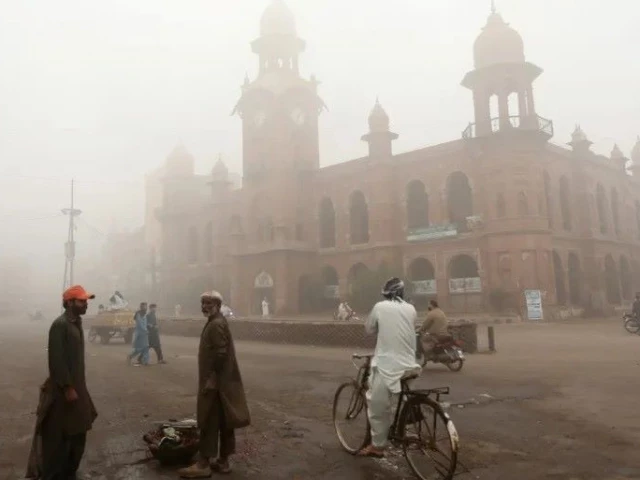
At 500, Punjab's air pollution figures hit a ceiling, but the smog does not. Whether the actual AQI climbs to 600, 700 or beyond, the government's official dashboard continues to display the same number, leaving citizens unable to gauge just how toxic the air has become. The practice has raised questions over transparency and whether the limits of the index are also becoming limits on public information.
The Punjab Environmental Protection Agency's (EPA) dashboard measures air quality on a scale of zero to 500, divided into seven categories ranging from good and satisfactory to moderate, unhealthy for sensitive groups, unhealthy, very unhealthy and hazardous. However, once pollution exceeds 500, the dashboard continues to display the same figure, making it impossible for users to distinguish between readings of 600, 700 or higher.
According to the United States Environmental Protection Agency (US EPA), 500 represents the upper limit of the standard AQI scale, not the maximum measurable level of pollution. Higher readings can be communicated through a system known as 'Beyond the AQI', allowing the public to understand when air quality deteriorates beyond the index's conventional range.
Environmental lawyer Altamash Saeed said making real-time data from the government's monitoring network publicly available was an important step, but displaying a single index did not provide a complete picture of air pollution.
He argued that citizens, researchers and policymakers needed access to the actual concentrations of different pollutants and their distribution across neighbourhoods. Compressing all readings above 500 into one figure, he said, obscured differences between highly polluted areas and made it difficult to assess whether pollution was worsening or improving.
For researchers, the missing information also has practical consequences. Nosheen Fatima, an environmental sciences student at the University of Punjab, said accurate readings from individual areas were essential for research and academic studies, as a capped index did not allow meaningful comparisons of pollution levels across different locations.
Some residents have also questioned whether limiting the displayed figures creates an overly favourable impression of air quality. Abdul Rehman, a resident of Gulberg, alleged that the government was controlling the actual AQI figures to suggest that its efforts had improved air quality.
However, Mariam Shah, an expert associated with the Pakistan Air Quality Initiative (PAQI), said capping the AQI at 500 did not necessarily mean pollution data was being concealed. She maintained that an AQI of 500 already represented extremely hazardous conditions, in which people should avoid all outdoor activities.
Shah also pointed out that AQI calculation methods vary across countries and depend on the dominant pollutant in a particular area. For Pakistan and other South Asian countries, she argued, the actual concentration of fine particulate matter (PM2.5) was a more useful indicator of air pollution than the AQI alone. "Publicly available PM2.5 readings on government portals could help citizens understand the actual severity of pollution," said Shah.
Commenting on the matter, Senior Minister Marriyum Aurangzeb claimed that the AQI (Air Quality Index) is capped at 500 in several countries, including the United States. She clarified that the government does not intend to hide any data, explaining that 500 is the maximum limit, beyond which the situation is simply considered hazardous.
On the contrary, WWF Pakistan Director General Hammad Naqi believed that every citizen has a fundamental right to access accurate information and data about air quality, enabling them to take measures to protect themselves and their families based on the air quality situation in their respective areas and cities. "If the government has capped the data at 500, this should not be the case," argued Naqi.













This material may not be published, broadcast, rewritten, redistributed or derived from. Unless otherwise stated, all content is copyrighted © 2026 The Express Tribune.






COMMENTS
Comments are moderated and generally will be posted if they are on-topic and not abusive.
For more information, please see our Comments FAQ