Naqvi makes surprise dash to Nawabshah with ‘important message’ for Zardari
Updated 52 minutes ago

Nearly hour-long meeting reportedly discusses new provinces, a possible referendum and developments involving JUI-F
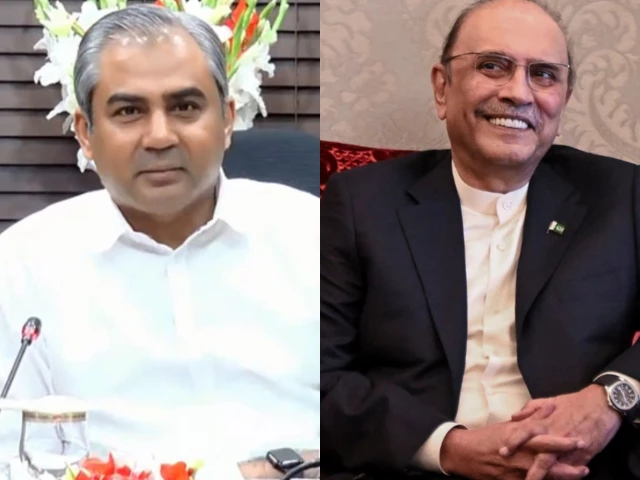
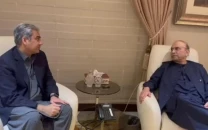
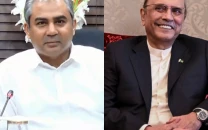
Interior Minister Mohsin Naqvi made an unscheduled visit to Nawabshah on Thursday night and held a nearly hour-long meeting with President Asif Ali Zardari at Zardari House, amid speculation over discussions on key political developments.
According to sources, the meeting focused on proposals for the creation of new provinces, the possibility of holding a referendum on the issue and potential action against the Jamiat Ulema-e-Islam-Fazl (JUI-F).
Sources claimed that Naqvi had travelled to Nawabshah on an urgent basis carrying an important message from a senior national figure and sought to take the president into confidence over the matters discussed.
Read: Bilawal and I 'almost' on same page over 'system reset': Naqvi
Naqvi arrived at Nawabshah airport from Islamabad aboard a special aircraft, where he was received by Sindh Home Minister Zia Ul Hassan Lanjar, Minister for Works and Services and Prisons Haji Ali Hassan Zardari, Deputy Commissioner Abdul Samad Nizamani and SSP Dr Sameer Noor Channa.
He was escorted to Zardari House under tight security. The meeting reportedly lasted around 59 minutes, after which the interior minister departed for Islamabad aboard his special aircraft.
The visit has drawn attention in political circles given the reported agenda and the involvement of senior political figures. However, no official statement has yet been issued regarding the meeting or the alleged message.
The meeting came hours after Interior Minister Mohsin Naqvi said he and Pakistan Peoples Party (PPP) Chairman Bilawal Bhutto-Zardari were largely on the same page regarding a reset of the system, referring to the latter’s remarks a day earlier.
On Wednesday, Bilawal said there was indeed a need to “reset” the system, but argued that the country should be run by the people “instead of traders and businessmen” and through greater unity.
He reiterated that Pakistan, like the rest of the world, was facing an economic crisis and that the country’s politics needed to be reset to address the challenge.
Also Read: Bilawal calls for ‘system reset’ through unity
Addressing a press conference at the National Cyber Crime Investigation Agency (NCCIA) earlier on Thursday, Naqvi said Bilawal had spoken about resetting the “political system”, whereas his own proposal concerned an “overall reset”.
The interior minister maintained that “no decision would be taken without the consent of the parties concerned”. He also dismissed suggestions circulating on social media that differences could emerge among coalition partners.
On the question of creating new provinces, Naqvi urged political parties to seek public opinion through a referendum.
Recent reports have suggested that a proposal to reorganise Pakistan into 12 provinces was under consideration, with a nationwide referendum envisaged ahead of a possible 28th Constitutional Amendment.
Debate over new provinces
The debate over creating new provinces as part of a broader restructuring of the system gained momentum on July 31, when Naqvi called for additional administrative units or provinces to overhaul what he described as the country's outdated governance system.
Addressing the Pakistan Economic Summit 2026 in Islamabad, he argued that the existing governance model had effectively “collapsed” after decades of failing to deliver. He said decentralisation was essential to improving public services, ensuring timely justice and creating opportunities for young people.
His remarks drew a mixed response, with several PML-N leaders criticising him and describing him as one of the beneficiaries of the existing system.
Among them was PML-N leader and Prime Minister's aide Rana Sanaullah, who questioned how Naqvi could criticise the political system after rising to the office of interior minister through the same system in just three and a half years.
Defence Minister Khawaja Asif, however, differed with his party colleague, saying he largely agreed with the interior minister's assessment.
Also Read: PML-N's Asif backs twelve new provinces
On September 4, the Sindh Assembly passed a resolution rejecting attempts to divide the province or create new administrative units. Chief Minister Syed Murad Ali Shah declared that “there will be no compromise on Sindh's geographical unity”.
Two days later, Naqvi renewed his call for a “reset” of the country's governance system, stressing the need to restructure its administrative framework.
The proposal has also drawn interest from Muttahida Qaumi Movement-Pakistan (MQM-P) leader Mustafa Kamal, who heads the federal health ministry and has repeatedly advocated carving out new provinces from Sindh.
Even before Naqvi's July 31 remarks, Kamal had floated the idea of dividing Sindh, drawing strong opposition. He remains a prominent advocate of the demand.
However, the creation of new provinces would require a demanding constitutional process. Legal experts cited by The Express Tribune have pointed out that a public vote alone cannot lead to the creation of a new province. Any change to provincial boundaries must follow the constitutional amendment procedure, including approval by the relevant provincial assembly.
A referendum could potentially provide democratic legitimacy to such a move, but would not replace the constitutional requirements.
The debate over new provinces, therefore, extends beyond administrative restructuring to questions about the distribution of powers between the federation, provinces and local governments, as well as the role of citizens in decisions affecting governance and public service delivery.






This material may not be published, broadcast, rewritten, redistributed or derived from. Unless otherwise stated, all content is copyrighted © 2026 The Express Tribune.




COMMENTS
Comments are moderated and generally will be posted if they are on-topic and not abusive.
For more information, please see our Comments FAQ