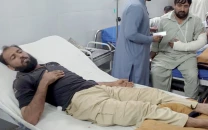
Kohat raid on gold miners ambushed
Updated 36 minutes ago

Khosa says founder's blood pressure at 'frightening level'

PTI leader and lawyer Sardar Latif Khosa said on Wednesday that party' founder Imran Khan's blood pressure was at a "frightening level" but the ex-premier was still "alert and strong".
He made the remarks after meeting the former premier in the conference room at Adiala jail.
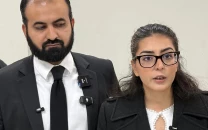
Khosa and Barrister Salman Safdar met with Imran for three to four hours in accordance with the Islamabad High Court's (IHC) order.
On Tuesday, the IHC ordered a one-hour jail meeting between Imran and his wife, Bushra Bibi, and their lawyers in the £190 million case, directing counsel to begin arguments on the appeals at the next hearing.
Earlier in the day, the lawyers were allowed to proceed to Adiala jail from the Dahgal checkpoint to meet the former prime minister, as directed by the court.
In a short video interaction after the meeting, Khosa said: "The meeting was for three to four hours," adding that Bushra Bibi was also present.
He said they discussed the couple's health and legal cases, adding that the party would provide further details on Thursday (today) on what the two lawyers saw and what the couple told them.
On Imran's health, he said: "His blood pressure and eye issues are still present and the fluctuation in blood pressure is obviously to a frightening level, but as for what you are asking, he (Imran) was completely alert and his spirit was strong."
Khosa said the possible 28th constitutional amendment was also discussed but did not divulge further details. He said the prison officials should be questioned about why the meeting stretched so long.
"The meeting with Imran Khan was very productive; all matters were discussed."
Separately, Safdar said on X that the legal and medical issues of the couple were discussed in detail and comprehensive legal instructions were given by both.
The permission for the meeting was granted after Safdar and Khosa had argued that they could not proceed with arguments in the ongoing appeals in the £190 million case without first meeting their clients.
Speaking briefly to the media at the checkpoint before proceeding, Safdar said the meeting would be limited to discussions about Imran's legal cases.
"We have a meeting today. Khosa sahib and I are going," he said, adding that Salman Akram Raja would remain at the checkpoint. "You have read the court's order," Safdar told reporters.
He said the lawyers would seek instructions from Imran only in connection with his cases. "We will not discuss politics."
Khosa also confirmed the meeting, saying, "We have a meeting today. My younger brother has also come with me."
Check-up at PIMS
Imran was administered his sixth intravitreal anti-VEGF injection at the Pakistan Institute of Medical Sciences (PIMS) in Islamabad during the early hours of Wednesday, according to a statement issued by PIMS.
"After obtaining informed consent and adopting standard monitoring, precautionary measures and clinical protocols, he [Imran Khan] was administered an intravitreal anti-VEGF injection by the ophthalmology team," the statement said.
Imran has received a series of anti-VEGF intravitreal injections in his right eye as part of treatment for right central retinal vein occlusion (CRVO), a condition diagnosed after he reported reduced vision. He received his first injection at the PIMS on January 24. The hospital initially diagnosed him with right central retinal vein occlusion (CRVO), a condition affecting blood flow through the retina, after he reported reduced vision in his right eye.
According to PIMS, Imran was brought from Central Jail Adiala in Rawalpindi during the intervening night of Tuesday and Wednesday for a medical check-up and follow-up eye treatment, as advised by his treating ophthalmologist.
"Prior to the procedure, he underwent a medical examination, including ocular assessment. His vital parameters were found to be normal. He was clinically stable, and his general physical examination was normal," the statement said.
"During his stay at PIMS, he remained vitally stable before, during, and after the procedure," adding that he was discharged at approximately 2:30am, with necessary instructions for further care and follow-up.
The statement said that Imran remained at PIMS for around 40 to 50 minutes before being transferred back to Adiala Jail after his condition was found to be satisfactory.
The development came a day after Imran's sister, Uzma Khan, moved the Supreme Court seeking an early hearing of the case concerning his transfer from Adiala Jail to Shifa International Hospital for medical treatment.
The issue of Imran's transfer dates back to August 18, when the Supreme Court ordered authorities to transfer Imran from Adiala Jail to Shifa International Hospital for specialised medical treatment. However, he was taken to PIMS instead and returned to jail after a medical examination. The PTI subsequently filed a contempt petition, alleging that the authorities had failed to implement the court's order.
PTI spokesperson Waqas Akram slammed the "secretive midnight transfer" and demanded that Imran be immediately taken to Shifa International Hospital, along with unrestricted access for his family and personal doctors, and full transparency regarding his medical condition.
"Waqas questioned why a former prime minister's hospital transfer and medical status are being shrouded in secrecy while his family, legal representatives, and personal physicians continue to be denied access. He emphasised that Khan's health cannot be treated as a state secret, warning that keeping his family in the dark and blocking his doctors from examining him or reviewing his medical reports raises serious questions about the government's motives," said a statement posted by the PTI on X.
Akram pointed to an affidavit submitted by Barrister Safdar after meeting Imran that disclosed repeated, severe blood pressure spikes reaching 160, 170, and 192, raising fears of "life-threatening complications" such as a heart attack or stroke.
He stressed that these alarming readings required immediate specialist attention, transparent evaluation and continuous care supervised by Imran's personal doctors.








This material may not be published, broadcast, rewritten, redistributed or derived from. Unless otherwise stated, all content is copyrighted © 2026 The Express Tribune.






COMMENTS
Comments are moderated and generally will be posted if they are on-topic and not abusive.
For more information, please see our Comments FAQ