Govt to issue 'smart syllabus' for Classes 9 to 12
Updated 21 minutes ago

Around 10,000 vehicles transport sugarcane daily
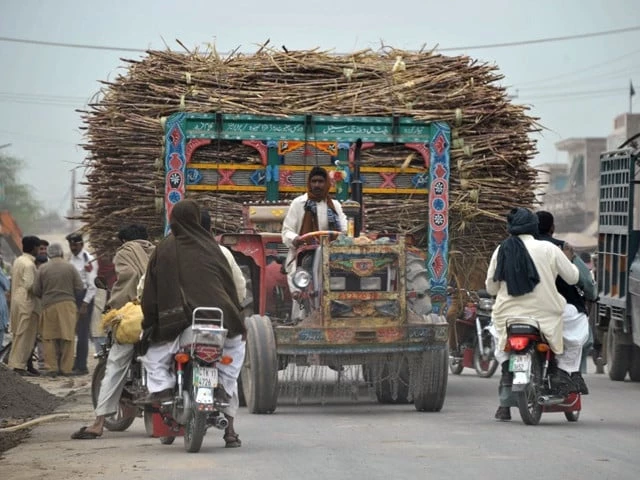
Traffic Police has called for stricter safety measures for government-operated vehicles and heavy transport on public roads following a fatal accident allegedly involving a Parks and Horticulture Authority (PHA) water bowser, and ahead of increased traffic risks during the sugarcane-crushing season.
In a letter to the PHA director general, Chief Traffic Officer (CTO) Lahore Abdul Rahim Shirazi expressed concern over water being spilled onto main roads during roadside watering operations, creating slippery conditions for motorists, particularly motorcyclists.
According to the letter, a motorcyclist died in an accident at around 8:06am on November 4 near the Data Darbar Flyover, within the jurisdiction of the Railway Station Traffic Sector.
The correspondence stated that a PHA water bowser was reversing without its hazard warning lights switched on while water was spilling onto the road, causing the motorcyclist to lose control and fall.
The CTO urged the PHA to introduce comprehensive standard operating procedures (SOPs) to prevent similar incidents.
He recommended that road-cleaning, washing and water-sprinkling operations be completed before sunrise, wherever possible, to minimise disruption during peak traffic hours.
The authority was also asked to ensure that its water bowsers were equipped with functional hazard and revolving warning lights, reflective markings, reverse alarms and other essential safety equipment.
The letter stressed that only trained and experienced drivers, accompanied by trained attendants, should operate the vehicles.
Regular medical and eyesight examinations, proper mechanical maintenance, the mandatory use of high-visibility reflective jackets by field staff and effective supervision of roadside operations were also recommended.
The CTO further sought a complete record of PHA drivers, including their names, CNIC numbers, contact details and driving licence particulars.
Separately, Deputy Inspector General (DIG) Traffic Punjab Muhammad Waqas Nazir has directed traffic police and highway patrol formations to introduce additional safety arrangements ahead of the sugarcane-crushing season, when thousands of heavily loaded tractor-trolleys and trucks take to provincial roads.
According to the directives, around 10,000 tractor-trolleys and trucks transport sugarcane to mills across Punjab every day during the harvesting season.
The movement of these vehicles, coupled with overloading and roadside parking, poses additional risks to motorists, particularly at night.
The DIG has directed district traffic officers to coordinate with the Punjab Highway Patrol, identify accident-prone locations, particularly connecting roads joining major highways, and submit reports on measures needed to prevent crashes.
Speed breakers, warning signboards and other safety arrangements are planned at vulnerable locations.
In Lahore, particular attention is being given to Kahna, Raiwind Road, Band Road and other suburban areas where vehicles enter major highways through connecting roads.
Traffic police have also been directed to ensure the installation of reflectors on sugarcane-laden tractor-trolleys and at roadside parking points to improve visibility and reduce the risk of collisions, particularly during smog and fog.
The DIG has called for coordinated monitoring and preventive enforcement by traffic police and the Punjab Highway Patrol to regulate heavy-vehicle movement and protect road users throughout the crushing season.
The need for these measures is underscored by Rescue 1122 figures, which show that Punjab recorded 44,797 road accidents in October 2026, resulting in 464 deaths and 23,543 serious injuries.
Lahore reported the highest number of accidents, with 7,874 incidents and 35 fatalities. Motorcycles were involved in nearly three-quarters of the accidents across the province, according to Rescue 1122.











This material may not be published, broadcast, rewritten, redistributed or derived from. Unless otherwise stated, all content is copyrighted © 2026 The Express Tribune.






COMMENTS
Comments are moderated and generally will be posted if they are on-topic and not abusive.
For more information, please see our Comments FAQ