Saudi strikes target Houthi 'resources'
Updated 1 hour ago

Reiterates that Supreme Court judgements are not binding on it
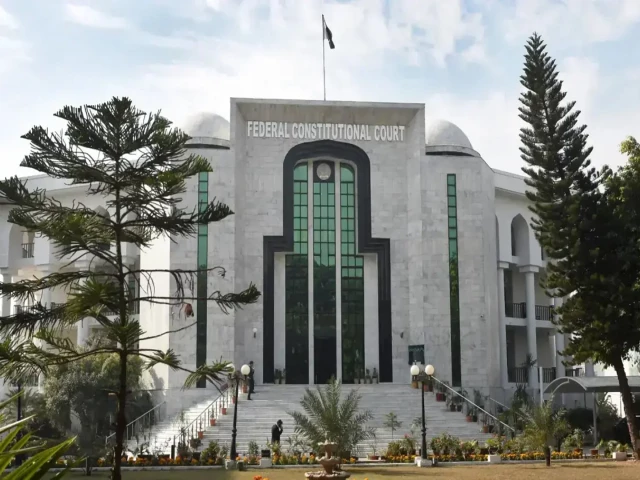
In a judgement that elaborates the scope of review as well as its appellate jurisdiction, the newly established Federal Constitutional Court (FCC) has again asserted its superiority, stating that Supreme Court judgements are not binding on it, although they can carry "persuasive value".
"The judgments of the Supreme Court are not binding on us, but carry persuasive value and where the jurisprudence laid down by it appeals or seems to be in consonance with the law and the Constitution, may be followed," said an 8-page judgement authored by Justice Aamer Farooq.
A three-member bench led by Justice Farooq while hearing a review petition also said that Supreme Court jurisprudence evolved for leave to appeal from the decisions/orders of the high court under Article 199 of the Constitution is also not binding on it.
However, the FCC noted that it can draw wisdom from Supreme Court jurisprudence.
The judgement also noted that the crux of the jurisprudence on the subject is that the review jurisdiction of this court is quite limited and is circumscribed; being confined to the errors apparent on the face of the record or mistakes/shortcomings which would result in the miscarriage of justice.
"Recent trends show that litigants/lawyers treat review jurisdiction as another opportunity to reargue the case; by no means while hearing a review application the bench is rehearing the matter, it is only to see if there is an apparent error/mistake on the face of the record.
"Rule 4 of Order XXVII of the Rules clearly provides that the Advocate-on-Record (AOR) or the party, along with the review application shall append a certificate, in the form of a reasoned opinion, stating that, in the opinion of the AOR or the party, as the case may be, the application is maintainable and that a review is justified in accordance with the law and the practice of the court."
The order said that the party or the AOR should exercise utmost care in handing down the certificate or opining on the issue as wrong certificate can have grave repercussions.
It reiterated that the practice to file a review application as a matter of course, wherein the ground(s) for review are not attracted, does not find favour with this court and is deprecated inasmuch as mostly the review applications are nothing but a rehearing of the matter.
The FCC expected the litigants and legal community to exercise caution and file review applications only in cases where it is genuinely felt that the grounds are attracted.
"The reason we are expressing in lucid manner the caution which the party and AOR is to exercise is because of the ramifications provided in the Rules with respect to frivolous and vexatious review applications.
"In this behalf, under the Rules where the court comes to the conclusion that review application is frivolous or vexatious, it can impose costs of not less than Rupees 25,000 or the AOR can be susceptible to disciplinary proceedings, as well (Rule 5(a) of the Rules)"
Likewise, the judgement said that where there is no legal representation and the court comes to the conclusion that the application is vexatious or frivolous, the party shall be liable to costs of not less than Rs25,000.
"No application for review is to be entertained, as per Rule 6 of the Rules, unless the applicant deposits a sum of Rupees 50,000/- as security in the designated account of the court.
"Rule 6(2) empowers the court to forfeit the sum deposited as security, if the review application is dismissed or found to be frivolous or vexatious.
"Since review is an extraordinary jurisdiction in the sense that the grounds on which it can be filed are too restricted, this court, in appropriate cases, may dispose of a review application by circulation without oral hearing, unless it considers that a hearing is essential."
The court notes that the sole purpose of citing all the relevant rules pertaining to the review jurisdiction of this court is only to sensitize the litigants and the legal fraternity about its constricted scope and the consequences provided in the rules for frivolous and vexatious applications.
Regarding the concept of the jurisdiction under Article 175F(1)(c), the order said that the party has to obtain permission or leave of the court for its appeal to be heard.
"Prior to the incorporation of Article 175F(1)(c) in the Constitution through the 27th (Constitutional Amendment) Act, 2025, this jurisdiction was exercised by the Supreme Court under Article 185(3) of the Constitution.
"After the abovementioned constitutional amendment, this court was created and its appellate jurisdiction, inter alia, included hearing petitions for leave to appeal from the decisions/orders of the High Court under Article 199 of the Constitution.
"The jurisprudence which the Supreme Court of Pakistan evolved, in this regard, which is not binding on us but wisdom can be drawn from it, is that leave can only be allowed if there is any question of law in the matter or indulgence is required to prevent miscarriage of justice."
Comparing with Indian SC jurisprudence, the judgement noted that the jurisprudence evolved with respect to adjudicating the petitions for leave to appeal is perhaps different in Pakistan and definitely has parameters.
"By no means is a petition for leave to appeal an appeal as of right and only if leave is allowed then the petition acquires the status of appeal and is to be heard like one.
"When the court dismisses the application/petition for leave to appeal, it does not necessarily endorse the order against which leave is sought.
"While adjudicating a leave application, the court is not required to give reasons for its decision. If the court is of the view that no case for grant of leave is made out, it can hold so simply through a non-speaking order.
"Like-wise, while allowing leave to appeal the same can be done without a speaking order," the FCC stated.









This material may not be published, broadcast, rewritten, redistributed or derived from. Unless otherwise stated, all content is copyrighted © 2026 The Express Tribune.












COMMENTS
Comments are moderated and generally will be posted if they are on-topic and not abusive.
For more information, please see our Comments FAQ