Pakistan calls for abolition or severe restrictions on UNSC veto power
Updated 57 minutes ago

President Zardari, PM Shehbaz urge international community to play meaningful role in resolving longstanding dispute
President Asif Ali Zardari and Prime Minister Shehbaz Sharif on Tuesday reaffirmed Pakistan's stance on the Kashmir dispute, calling for a peaceful resolution in line with UN Security Council resolutions and urging the international community to address human rights concerns in Indian Illegally Occupied Jammu and Kashmir (IIOJK).
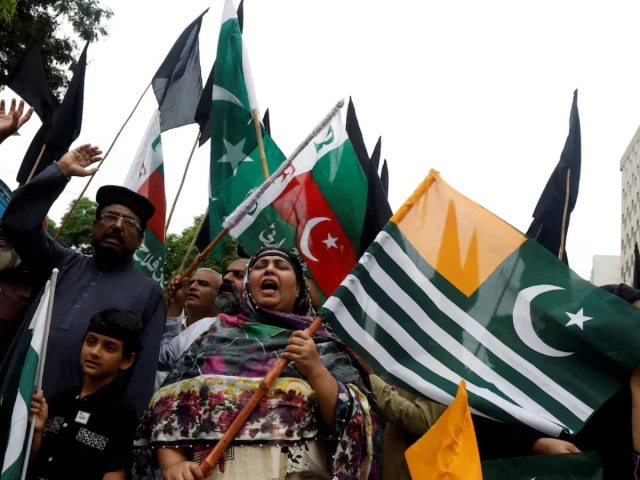
Kashmiris on both sides of the Line of Control (LoC) and across the world are observing Black Day to mark the 79th anniversary of the arrival of Indian troops in Srinagar in 1947 and renew their demand for the right to self-determination.
In his message, President Zardari called upon the international community, particularly the UN and international human rights organisations, to take due cognisance of the human rights situation in the IIOJK, support efforts for the protection of the fundamental rights of the Kashmiri people and contribute meaningfully towards a just, peaceful and lasting resolution of the Jammu and Kashmir dispute.
He reiterated that Pakistan would continue to extend its unwavering moral, diplomatic and political support to the people of IIOJK.
"Since 27 October 1947, the people of IIOJK have endured decades of conflict, restrictions and denial of their fundamental rights. The continuing restrictions on fundamental freedoms, heightened militarisation, arrests and reports of human rights violations remain a matter of… pic.twitter.com/J500vyG6Rl
— The President of Pakistan (@PresOfPakistan) October 27, 2026
“We will continue to raise their voice at every appropriate international forum and to advocate the realisation of their legitimate aspirations,” the president said in a message.
The president said Jammu and Kashmir Black Day is, therefore, not merely a day of remembrance. It is also an occasion to reaffirm their commitment to a peaceful and just resolution of the Jammu and Kashmir dispute.
Lasting peace, stability and prosperity in South Asia remain closely linked to the resolution of this longstanding dispute, in accordance with the relevant United Nations Security Council resolutions and the aspirations of the Kashmiri people, he emphasised.
Today, the president said they paid tribute to the countless sacrifices of the Kashmiri people and reaffirmed their solidarity with the Kashmiri brothers and sisters, adding Pakistan stands with them in the pursuit of justice, peace, dignity and the realisation of the legitimate right to self-determination.
“The day is not far off when the people of Jammu and Kashmir will be able to determine their own future in accordance with their aspirations and the Jammu and Kashmir dispute will move towards a just and peaceful resolution,” he added.
On Jammu and Kashmir Black Day, the president said they solemnly remembered 27 October 1947, when Indian forces landed in Srinagar, marking the beginning of a prolonged and tragic chapter in the history of Jammu and Kashmir.
This day reaffirmed their recognition of the longstanding aspirations of the Kashmiri people and the continued pursuit of the fundamental and inalienable right to self-determination, he added.
The president observed that for the past eight decades, the people of IIOJK had endured profound sufferings, marked by violence, repression and serious violations of fundamental rights.
Generations of Kashmiris have made immense sacrifices in their pursuit of justice, dignity and freedom. Their resilience and determination in the face of adversity remained a testament to the enduring strength of their cause, he added.
President Zardari further said that since 27 October 1947, the people of IIOJK had endured decades of conflict, restrictions and denial of their fundamental rights. The continuing restrictions on fundamental freedoms, heightened militarisation, arrests and reports of human rights violations remain a matter of serious concern and underscore the need for sustained international attention.
The situation had further deteriorated since August 5, 2019, when India unilaterally attempted to alter the constitutional and legal status of Jammu and Kashmir, he added.
PM Shehbaz reiterated that Pakistan’s position on Jammu and Kashmir remained clear, consistent and principled, emphasising that lasting peace and stability in South Asia cannot be achieved without a just and peaceful resolution of the Jammu and Kashmir dispute, in accordance with the relevant United Nations Security Council resolutions and the aspirations of the Kashmiri people.
“On this Jammu & Kashmir Black Day, the government and people of Pakistan reaffirm their unwavering solidarity with the people of IIOJK,” he said.
Prime Minister Muhammad Shehbaz Sharif's Message on Jammu & Kashmir Black Day
— Government of Pakistan (@GovtofPakistan) October 27, 2026
"The people of Indian Illegally Occupied Jammu and Kashmir (IIOJK) have endured immense hardship, suffering and repression. Yet their courage, resilience and unwavering resolve to secure their… pic.twitter.com/ObedS74k32
The prime minister reaffirmed that Pakistan would continue to extend its moral, diplomatic and political support to the Kashmiri people, and to advocate for their legitimate rights at every national and international forum.
Seventy-nine years ago, he said Indian forces landed in Srinagar, marking the beginning of a tragic chapter in the history of Jammu and Kashmir, one that continues to cast its long shadow over the region to this day.
Since then, the people of Jammu and Kashmir have been denied the realisation of their inalienable right to self-determination, as affirmed in the relevant United Nations Security Council resolutions, he added.
The prime minister observed that the people of IIOJK had endured immense hardship, suffering and repression. Yet their courage, resilience and unwavering resolve to secure their fundamental rights remain undiminished.
The sacrifices of successive generations stood as a powerful testament to their enduring commitment to freedom, dignity and justice, he added.
“India has continued its efforts to suppress legitimate political expression and silence the voices that represent the aspirations of the Kashmiri people. The prolonged incarceration of Kashmiri political leaders, activists and human rights defenders remains deeply concerning. It underscores the need for due process, respect for basic liberties, and greater international attention to the situation in Jammu and Kashmir,” PM Office Media Wing, in a press release, quoted the prime minister as saying.
Read More: COAS assures AJK premier of full support to Kashmir cause
Since 5 August 2019, he said India had taken a series of unilateral measures in IIOJK, accompanied by sweeping restrictions on fundamental freedoms. These measures, affecting the political, legal and demographic character of the territory, had drawn serious international attention.
“Pakistan has consistently called for these developments to be addressed in accordance with international law and the applicable United Nations Security Council resolutions,” he emphasised.
On the solemn occasion, the prime minister also paid tribute to the countless Kashmiri men, women and children who had offered immense sacrifices in pursuit of their rights, adding that their memory would always be honoured. The aspirations of the Kashmiri people cannot be extinguished through coercion or repression.
He prayed for the people of Jammu and Kashmir to realise a future of lasting peace, dignity and security, and the fulfilment of their aspirations, including the right to self-determination.
Deputy Prime Minister and Foreign Minister Ishaq Dar noted that the people of IIOJK "continue to bear the consequences of an unresolved dispute," calling on the international community to "play its due role" in addressing the suffering of the people of IIOJK.
"We recall with deep sorrow the events of October 27, 1947, when Indian forces landed in Srinagar, marking the beginning of a prolonged and tragic chapter in the history of Jammu and Kashmir," he said.
FM Dar added that nearly eight decades later, the people of IIOJK continue to "be denied their inalienable right to self-determination, as affirmed in the relevant resolutions of the UN Security Council."
According to the foreign minister, the UNSC had adopted a number of resolutions pertaining to Jammu and Kashmir, "envisaging a peaceful settlement in accordance with the will of the people." With this, he said, "Pakistan has consistently maintained that these resolutions remain central to the resolution of the dispute," arguing that Islamabad had "emphasised the important role of the international community in facilitating a just, peaceful, and lasting settlement" of the dispute.
🔊 PR No. 3️⃣1️⃣1️⃣/2️⃣0️⃣2️⃣6️⃣
— Ministry of Foreign Affairs - Pakistan (@ForeignOfficePk) October 27, 2026
Message of Deputy Prime Minister/Foreign Minister of the Islamic Republic of Pakistan, Senator Mohammad Ishaq Dar @MIshaqDar50 on Jammu and Kashmir Black Day – 27 October 2026
🔗⬇️ pic.twitter.com/nQfSSJ7b0T
Regarding the human rights situation in IIOJK, FM Dar noted that the issue had "drawn greater international attention following India's unilateral actions of August 5, 2019." The subsequent legislative and administrative measures, he said, along with restrictions on fundamental freedoms, demographic and political changes, as well as the continued detention of Kashmiri political leaders and activists "have further deepened the sense of insecurity and alienation among the people of the occupied territory."
These developments, FM Dar said, "have also raised serious questions under international law and relevant international humanitarian and human rights standards." He noted that the international community, including relevant bodies of the UN and other human rights organisations, had "documented concerns regarding the treatment of civilians and the broader human rights environment in IIOJK."
"These concerns underscore the need for continued international attention and engagement," FM Dar said.
Read: ‘We are Pakistanis first, then Kashmiris,’ says AJK chief justice
Despite this, the foreign minister noted that the people of IIOJK "remain undeterred by such adversity." He added that their "continued struggle for their fundamental rights serves as a reminder that the aspirations of a people cannot be suppressed through force or repression." He highlighted the "sacrifices and the quest for dignity and self-determination" of the people of IIOJK, which he said "deserve the serious attention of the international community."
FM Dar concluded with reiterating Pakistan's call for the international community to play its due role in addressing the suffering of the people of IIOJK and "promoting respect for their fundamental rights."
He underscored that "meaningful and sustained international engagement remains essential for a peaceful resolution of the Jammu and Kashmir dispute," reaffirming Pakistan's "unwavering political, moral, and diplomatic support for the people of IIOJK."
"We will continue to raise their voice at every appropriate international forum and to advocate for a peaceful and just resolution of the Jammu and Kashmir dispute," the foreign minister said.
Resolution of Kashmir issue essential for lasting regional peace: Ayaz Sadiq
National Assembly Speaker Ayaz Sadiq, in a statement on the occasion, termed October 27, 1947 "the darkest in the history of Kashmir," noting that the resolution of the Kashmir issue "in accordance with UN resolutions is essential for lasting peace in the region."
He stated that "the right to self-determination is the fundamental right of the Kashmiri people," adding that they had been "making sacrifices since 1947 to achieve this right."
The speaker said, according to a post on X by the National Assembly, that "the courage, steadfastness and sacrifices of the Kashmiri people are commendable."
اسپیکر قومی اسمبلی سردار ایاز صادق کا یومِ سیاہ کشمیر کے موقع پر پیغام
— National Assembly 🇵🇰 (@NAofPakistan) October 27, 2026
اسپیکر قومی اسمبلی کا کشمیری عوام کیلئے پاکستان کی غیر متزلزل حمایت کا اعادہ
مسئلہ کشمیر کا اقوامِ متحدہ کی قراردادوں کے مطابق حل خطے میں پائیدار امن کے لیے ناگزیر ہے،اسپیکر سردار ایاز صادق
27 اکتوبر…
Sadiq also highlighted India's actions on August 5, which he said had affected the political, legal, and demographic status of Kashmir. Calling the implementation of UN resolutions essential, he urged the international community to "play its role for the peaceful and just resolution of the Kashmir issue."
Referring to the violations of human rights in the occupied territory, the speaker noted that protection of human rights remained a "collective responsibility of the international community."
He noted that "parliamentary diplomacy can play an important role in raising global awareness about the Kashmir issue," adding, "We will continue to raise our voice for the rights of the Kashmiri people on every forum."
Sadiq further reaffirmed that Pakistan would "continue its political, diplomatic, and moral support for the Kashmiri people."
With additional input from Web Desk









This material may not be published, broadcast, rewritten, redistributed or derived from. Unless otherwise stated, all content is copyrighted © 2026 The Express Tribune.





COMMENTS
Comments are moderated and generally will be posted if they are on-topic and not abusive.
For more information, please see our Comments FAQ