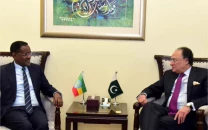
Banking links sought with Ethiopia
Updated 1 hour ago

Public debt now at 68.3% of GDP with total debt and liabilities reaching Rs100tr

The government has approved taking $750 million, or Rs209 billion, in foreign loans for finalising a framework to reduce pension liabilities, improving engagement with employees to bring them into the scheme and encouraging private partnership for public infrastructure projects.
The stated objectives of the two loans, which are being negotiated with the Asian Development Bank (ADB), suggest that none of these goals requires foreign lending, only the political will to expand the scope of the contributory pension scheme to all employees, including the armed forces.
The sources said the loans were taken for budget support, as the government of Prime Minister Shehbaz Sharif remains unable to enhance foreign exchange reserves on the back of non-debt-creating inflows, and revenues remain lower than budget requirements due to growing expenses.
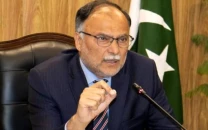
A concept clearance committee, headed by Deputy Chairman Planning Commission Ahsan Iqbal, recently approved finalising these loans with the ADB, according to officials privy to the meeting proceedings.
After the formal minutes of the committee were issued this month, the government would now finalise the procedural details with the Manila-based lender.
The officials said a $500 million loan, or Rs139 billion, will be taken in the name of pension reforms and another $250 million, or Rs70 billion, for "promoting sustainable public-private partnerships programme".
It is not the first time that the government is taking non-project policy loans for purposes that only require the political will to take tough decisions. Billions of dollars have also been taken in the name of tax reforms. Yet last week the government discussed the idea of setting up a new tax agency at the level of the prime minister, but the plan was shelved.
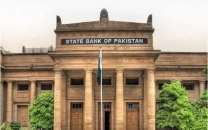
According to the central bank, Pakistan's total debt and liabilities have increased to nearly Rs100 trillion as of June this year, including Rs86.7 trillion worth of public debt. The public debt is equal to 68.3% of the size of the nation's economy, far higher than the sustainable limit prescribed under the Fiscal Responsibility and Debt Limitation Act.
Due to mounting debt, Pakistan's gross financing requirements are estimated at over 20% of the size of the economy, according to the finance ministry's annual borrowing plan.
The documents showed the $500 million programme aims to strengthen fiscal sustainability, governance, administration and service delivery of the federal pension system by reducing legacy pension liabilities, operationalising a Defined Contribution pension scheme and "improving employee engagement".
The Planning Commission had inquired about the status of past loans taken for pension reforms, which the finance ministry promised to provide later.
Iqbal directed that tangible outcomes achieved under the previous pension reforms project should be linked with the objectives of the new programme. He desired that fiscal stabilisation achieved through borrowed budgetary support may also enhance the size of Public Sector Development Programme funding to ensure sustainable economic growth and employment generation.
The concept clearance committee directed the Finance Division to submit a report to the Planning Commission on specific outcomes achieved under the erstwhile pension reforms project implemented in the past.
The finance ministry informed the committee that pension expenditure and long-term liabilities continue to rise, reducing fiscal space for priority public spending in health, education, infrastructure, climate resilience and social protection.
However, the budget support loan would further reduce the space for spending on the social sector due to the consequent increase in the cost of interest payments.
PPP loan
The concept clearance committee also approved a $250 million loan for promoting a sustainable public-private partnerships (PPP) programme in Pakistan, yet another objective that cannot be met with foreign lending.
The committee was informed that the objective of the $250 million loan was to strengthen the governance framework and enabling environment for PPP at the federal level by strengthening legal and institutional frameworks for public investment management and public financial management (PFM).
Out of the $250 million, $200 million will be relatively expensive financing, while the remaining amount will carry concessional rates.
The government had also taken a $250 million foreign loan for the same purpose, officially for establishing the foundational laws, policies and institutional capacity for an enabling PPP environment, including amendments to the Public Private Partnership Act, 2017.
The Planning Commission had recommended undertaking an impact assessment of the previous loan. It had also sought to increase the share of concessional lending from $50 million.
However, the finance ministry was of the view that approximately 50% of Pakistan's ADB portfolio is financed through relatively expensive financing, while the available concessional financing has already been allocated to other projects.
It stated that increasing the concessional share of the proposed loan would therefore affect financing available for those projects.










This material may not be published, broadcast, rewritten, redistributed or derived from. Unless otherwise stated, all content is copyrighted © 2026 The Express Tribune.








COMMENTS
Comments are moderated and generally will be posted if they are on-topic and not abusive.
For more information, please see our Comments FAQ