Study in Switzerland finds over half of participants see fake news as 'major' social issue
Updated 59 minutes ago

Opponents see election as an opportunity to hold Netanyahu responsible for the worst security failure in generations
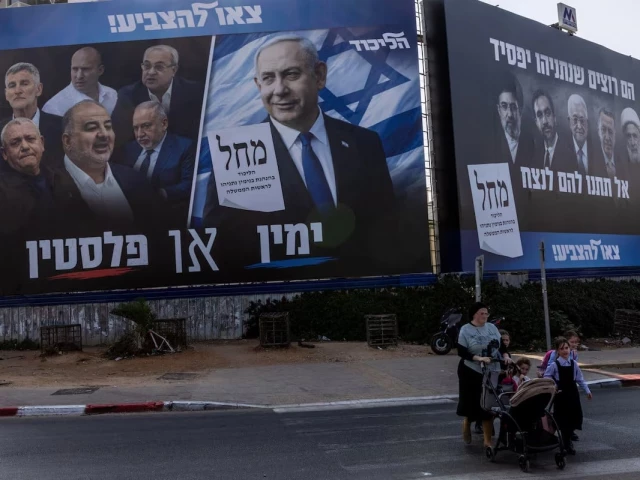
Gal Cohen walks along a memorial wall engraved with the names of the men, women and children slain in the October 7, 2023, Hamas attack on his kibbutz. For him, the idea that the man leading Israel, then and since, may be re-elected on Tuesday is painful.
One-in-ten residents of his kibbutz, Be'eri, were among the 1,200 people killed in Hamas' surprise attack. Dozens were among the 251 taken hostage to Gaza. It was Israel's deadliest single day.
Prime Minister Benjamin Netanyahu should have taken responsibility and stepped down, said Cohen, 61, and the fact that he has fulfilled a full term in office is a slap in the face. Tuesday's election, he said, is critical for Israel.
Read: Israel elections to be held on October 27
"If this government will stay, many hearts and minds will be broken. It will be really hard to continue," said Cohen.
Many of Netanyahu's opponents see the election as an opportunity at last to deliver a long-postponed reckoning for the worst security failure in generations. But even if Israel's longest-serving prime minister loses his majority, he could well escape the decisive verdict his foes are seeking.
Israelis will head to the polls on Tuesday in the first legislative election since the October 7, 2023, Hamas-led attacks and Israel’s subsequent genocidal war on Gaza.
— Al Jazeera English (@AJEnglish) October 26, 2026
Here are five things to know: https://t.co/zYTVfY95dV pic.twitter.com/QOC0bPT24C
Netanyahu has rejected blame for the breach and resisted calls for an independent investigation. He maintains that Israel's wars against Hamas in Gaza and its allies in Lebanon and Iran will result in a more peaceful Middle East.
The task will be complete only with the downfall of Iran's clerical rulers, Netanyahu has said on the campaign trail, and only he has the conviction and standing to deliver.
Opinion polls have for months predicted a sharp drop for Netanyahu's Likud party. But a rival alliance of parties on the right, left and centre looking to unseat him also has no clear path to power, suggesting months of political stalemate with Netanyahu potentially at the helm of a caretaker government.
'Two clicks to the right'
In the days after October 7, Be'eri was crawling with Israeli soldiers patrolling through burnt and shattered homes, floors stained with blood, doors pierced with bullet holes. In some spots, the stench of dead bodies still hung in the air.
The sounds of shelling and Israeli warplanes flying over Gaza were incessant.
Three years on, the kibbutz is up and running, and the sound of construction on brand-new houses echoes across the leafy green grounds. Most members, now residing in another kibbutz, are expected to return by summer.
A collective community established in 1946, now with around 1,000 residents, Be'eri exemplifies the socialist values that dominated Israel's politics in its early decades. Nearly all its votes went to the centre-left in the previous 2022 election, when only around 4% voted for parties in Netanyahu's nationalist-religious coalition.
The attack has made residents question longstanding views that there could be peace with the Palestinians in this generation.
"Everyone in Be'eri has moved two clicks to the right. But I still think that most of us will stay with the opposition, the parties that want to replace this government," he said.
Miri Gad Messika, 48, third generation in Be'eri, hasn't yet decided how to vote. But it won't be for Netanyahu.
"He failed as a leader so many times. And he shouldn't be in politics anymore," she said. "I'm looking for a leader. Unfortunately, it's hard for me to see any leader in Israel at the moment."
"I want to be optimistic," she added, "and I can only hope for a better change."
'Hope is stronger than pain'
Through much of the past three years, opposition to the Netanyahu government gravitated around families of hostages taken to Gaza, some of whom accused the government of dodging responsibility and doing too little to secure their freedom.
Israel will hold its first parliamentary elections since the October 7, 2023 terror attacks on Tuesday.
— CBS News (@CBSNews) October 26, 2026
Former Israeli military chief Gadi Eisenkot is Prime Minister Benjamin Netanyahu’s main challenger in the race. CBS News’ @DovLieber reports from Eisenkot’s final campaign… pic.twitter.com/gq5JgkhRUj
A Tel Aviv open space came to be known as "Hostages Square", site of constant rallies and vigils. Although the last of the hostages were released under a US-brokered ceasefire reached a year ago, the families are still among those most prominently calling for accountability now.
"I don't see any legitimate reason why this government is running again for election," said Ofri Bibas, whose young nephews, a 4-year-old and a 9-month-old, were slain in captivity in Gaza along with their mother. Their father, Ofri's brother Yarden, was released in an early 2025 truce.
Bibas said her goal now is to make every Israeli remember October 7, "to take it with them to the day of the election and remember what happened here and who still hasn't taken responsibility".
Read More: The wider impact of the Hamas-Israeli conflict
On Saturday, thousands of Israelis rallied in Hostages Square. One of the speakers was Danielle Alony, who was kidnapped from Nir Oz with her 5-year-old daughter and freed from Gaza in a brief truce weeks later.
"Go vote," Alony urged the crowd. "In three days we can start writing a new chapter for our children. One in which truth is stronger than fear, responsibility stronger than dereliction and hope is stronger than pain."









This material may not be published, broadcast, rewritten, redistributed or derived from. Unless otherwise stated, all content is copyrighted © 2026 The Express Tribune.











COMMENTS
Comments are moderated and generally will be posted if they are on-topic and not abusive.
For more information, please see our Comments FAQ