Suspect in businessman's murder sent to jail
Updated 2 hours ago

Costlier second-hand items at flea markets attract low, middle-income groups
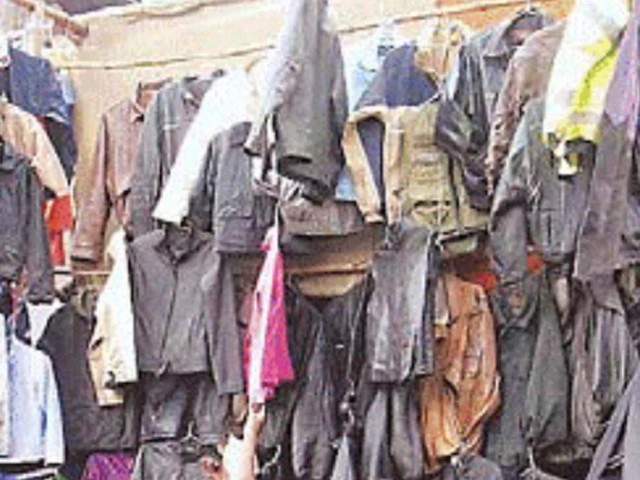
Even before winter fully sets in, second-hand winter clothing, including shoes, coats and shawls begin flying off the stalls at Landa bazaars across the city.
The second-hand clothing items come cheaper than those available in the open market and also boast a variety of unique designs which are sourced from abroad and leftover export inventories. Clothes also come in from donations made to Western charities which are exported to Pakistan.
However, while prices of second-hand clothing used to be affordable for the poor who could not otherwise purchase warm clothes to protect themselves against the cold, in recent times, the increase in prices of items at Landa bazaars, now rebranded as thrift stores, have effectively iced them out.
With increase in clothing prices across the board, middle low-income families were already looking for cheaper clothing options. However, the social media influencer-powered recasting of second-hand clothes as sustainable and economical alternatives to mass-produced lower quality branded options has heightened demand among higher income groups. So much so that now, even women from affluent households are choosing to buy good-quality pieces from Landa bazaars, getting them dry-cleaned and flaunting them as high-quality or vintage pieces.
This year, prices of second-hand clothing in Landa bazaars has risen sharply once again. Children's sweaters are now priced at Rs500, while children's coats cost between Rs700 and Rs1,000. While a winter clothing set for a child could cost up to Rs5,000 in the regular market.
Women's coats are available for Rs1,000 to Rs2,000, while shoes cost Rs500 to Rs1,500. Men's coats are priced at Rs1,000 to Rs1,500, men's jackets at Rs1,500 to Rs2,500. Good-quality sweaters cost around Rs1,200 to Rs1,500.
Residents Amjad Ali and Faizan said people had to get through four months of winter and could not afford new sweaters from major brands costing Rs5,000 to Rs10,000, coats priced between Rs8,000 and Rs10,000 or even mufflers which cost around Rs1,000.
Stallholders Shakoor Khan and Azmatullah said they no longer received any free bales of clothing, and Landa bazaars had become a fully commercial business since the government imposed taxes of up to 200 per cent, in addition to customs duties and transportation costs from Karachi, which had made the goods more expensive. Nevertheless, the second-hand clothing still remains 40 to 60 per cent cheaper than clothes in the open market, providing some relief to low and middle-income families.
Origin of 'Linda' bazaars
The history of Landa bazaars, the centres for used winter clothing and other goods in Pakistan, is linked to British colonial rule.
During British rule in the subcontinent, a British woman named Linda launched a campaign to help the poor. She collected old, used clothes and shoes from wealthy British households and distributed them among poor local people through a free stall at a designated location.
Over time, other people also began bringing their old clothes and the place gradually developed into a proper marketplace. It became known as the Linda Market after the British woman, and the name later evolved into Landa Bazaar through local pronunciation.
When British officers and their families returned from the subcontinent or discarded old belongings such as overcoats, hats, raincoats and winter suits, considering them useless, local contractors and shopkeepers began purchasing and selling these items at low prices.
Today, clothes donated to charitable organisations in Western countries, including Britain, the United States and Europe, reach Pakistan as part of a global second-hand trade worth billions of dollars.









This material may not be published, broadcast, rewritten, redistributed or derived from. Unless otherwise stated, all content is copyrighted © 2026 The Express Tribune.







COMMENTS
Comments are moderated and generally will be posted if they are on-topic and not abusive.
For more information, please see our Comments FAQ