Mossad chief visits Washington as Israel presses Trump to resume Iran war: Report
Updated 1 hour ago

In France's second and third cities, Marseille and Lyon, clashes broke out between hooded youths and police
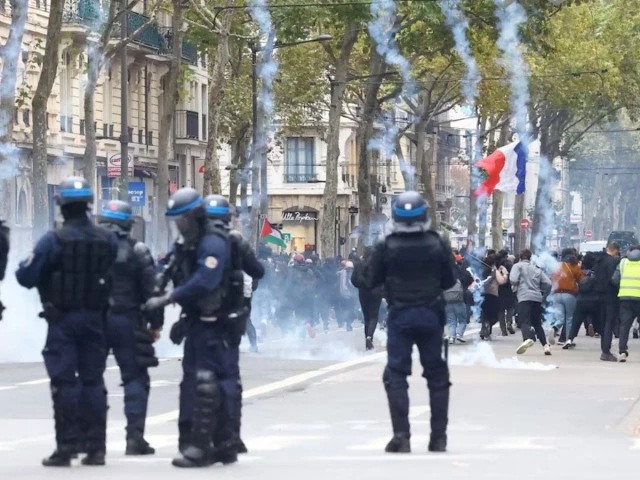
Demonstrators took to the streets of France on Saturday under the watch of 70,000 police officers, with unrest appearing markedly less severe than a week earlier despite scattered confrontations in several cities.
Tens of thousands of people marched peacefully through the French capital, according to police numbers, denouncing the high cost of living and accusing President Emmanuel Macron of cutting public services while failing to tackle rising inequality.
"Down with the state, the police and the fascists," some of the flag-waving crowds chanted.
Elsewhere, police fired tear gas at people in Clermont-Ferrand, Grenoble, Lille and Nice, where a water cannon was deployed after protesters refused orders to pull back.
In France's second and third cities, Marseille and Lyon, clashes broke out between hooded youths and police.
The government deployed 10,000 more police and gendarmes than on October 17, when nationwide protests descended into some of the worst unrest in France in years.
"We have to be ultra, ultra responsive," said Interior Minister Laurent Nunez, who has accused far-left groups and criminal gangs of fomenting violence.
Nunez told reporters that police had arrested 135 people nationwide by early afternoon, many following pre-emptive searches that he said had uncovered fireworks, ball bearings and other items that could be used as weapons.
Shops and museum shut
Much of central Paris took on the appearance of a city under lockdown, with shopkeepers boarding up storefronts, museums closing their doors and more than 20 metro stations shut.
Business groups urged retailers to remain closed after thousands of shops and businesses were damaged or looted across France last weekend.
"There are hardly any customers, so it's not really worth staying open," said Oskar, manager of a Kiton boutique in Paris.
Several of the capital's best-known cultural institutions, including the Louvre, the Musee d'Orsay and the Paris Opera, closed for the day as a precaution, leaving tourists frustrated.
French security forces fanned out across Paris on Saturday ahead of protests that authorities fear could turn violent, with Interior Minister Laurent Nunez urging police to be "hyper-reactive" against troublemakers and looters.
Soldiers from an anti-terrorism military unit patrolled the Champs-Élysées avenue while police vans circled the Arc de Triomphe, looking to protect some of the capital's most famous sites from any repeat of the unrest that shook France last week.
Nunez has mobilised 70,000 police nationwide for Saturday's demonstrations, 10,000 more than on October 17, when a wave of vandalism and looting raised questions about the government's ability to maintain order.
Anger over living costs and strained public services has drawn students, workers and unions onto the streets in recent weeks, but authorities say radical militants and bands of young looters have exploited the protests to sow chaos.
Read: ‘Threat exists’: Paris police warn of possible unrest ahead of protests
Speaking to police in Paris, Nunez warned officers that they would face attempts to target shops, public institutions and security forces.
"We have to be ultra, ultra responsive. We have significant calls for disruption from political groups and quite simply from criminals," he said. "It is going to be a long day."
Shops, museums, opera shut
Many shopkeepers in Paris boarded up storefronts, while luxury retailers beefed up security.
Business groups have urged stores to remain closed after thousands of shops and businesses were damaged or looted across France last weekend.
Lidiya Shevchenko, a sales assistant at a Graziella Braccialini store in Paris, said she doubted many customers would venture out to browse luxury boutiques during the day.
"I suppose the mood is just as important when it comes to shopping," she said.
Several of Paris' best-known cultural institutions, including the Louvre, the Musée d'Orsay and the Opera House, will close for the day to avoid being caught up in any turmoil. More than 20 metro stations were also shut.
The location of Saturday's main Paris demonstration remained unclear after police sought to move organisers away from the city centre towards the southeastern fringes of the capital.
"The declared route poses serious risks of disturbances to public order, notably because of the high concentration of businesses similar to those targeted during the weekend of October 17-18," the Paris police prefecture said.
Read more: Hitler's historic teahouse goes up in flames in Germany, arson suspected
The last-minute decision angered some on the left.
"Once again, those in power are creating disruption for the marches and impossible deadlines for organisations to reorganise themselves. These methods are multiplying across the entire country," hard-left leader Jean-Luc Mélenchon wrote on X.
Demonstration in Orleans against far right
Authorities have sharply restricted demonstrations across much of France. Marseille reversed an earlier ban and authorised a union march, while protests remain restricted in central Lyon. Union rallies will also go ahead in Strasbourg, but bans remain in force in several other cities including Nancy, Metz, Besançon, Belfort, Rouen, Le Havre, Toulon and Limoges.
The first authorised march began mid-morning in Orleans, about 120 km (75 miles) south of Paris, to protest against Marine Le Pen's far-right National Rally, which is holding a congress in the city this weekend.
"We have come to tell the far right, face to face, that we are not afraid," said Bally Bagayoko, the mayor of Saint-Denis and a member of the hard-left France Unbowed (LFI) party.
Tensions were heightened by a shooting west of Paris on Friday in which a gunman suspected of acting out of Islamophobic hatred killed one person and wounded four others, including a 12-year-old girl.





This material may not be published, broadcast, rewritten, redistributed or derived from. Unless otherwise stated, all content is copyrighted © 2026 The Express Tribune.






COMMENTS
Comments are moderated and generally will be posted if they are on-topic and not abusive.
For more information, please see our Comments FAQ