Iranian army orders ground forces to maintain highest combat readiness amid tensions with US
Updated 39 minutes ago

El-Sayed and Rogers vie for a Senate seat that could determine whether Democrats regain control of the chamber
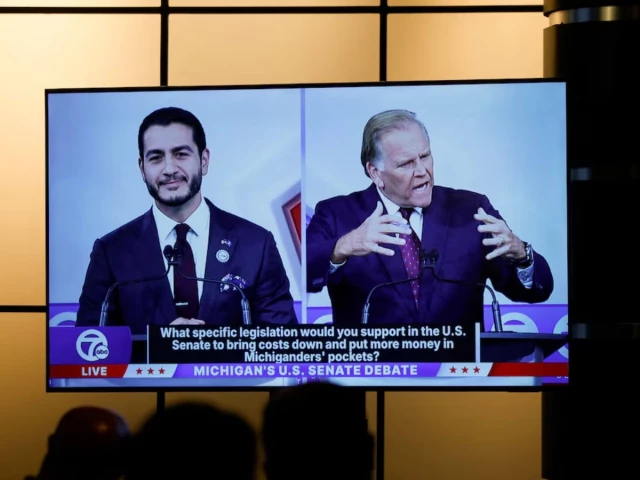
Republican US Senate candidate Mike Rogers and allies, including President Donald Trump, are escalating efforts to link Democratic rival Abdul El-Sayed to the Muslim Brotherhood less than two weeks before the November 3 midterms, with Trump falsely branding him a “jihadist”.
Pollsters and political strategists say the approach aims to dissuade Jewish and Black voters in the Detroit area who backed El-Sayed’s primary opponent, Haley Stevens, from supporting the Democratic nominee.
“It gives them even more reason to pause and not vote for El-Sayed,” said Dennis Darnoi, a Republican political consultant.
El-Sayed and Rogers are vying for the seat held by retiring Democratic Senator Gary Peters in a race that could determine whether Democrats gain the four seats needed to take control of the Senate.
Republicans currently hold a 53-47 majority. El-Sayed has built a narrow lead in opinion polls by focusing on affordability, healthcare and reducing the influence of money in politics.
Rogers has sought to undermine El-Sayed’s support among Jewish voters by highlighting his criticism of Israel’s offensive in Gaza and alleging longstanding family ties to the Muslim Brotherhood, one of the Arab world’s oldest and most influential Islamist groups.
Strategists said the focus on the Muslim Brotherhood also seeks to exploit economic tensions between Black voters and Michigan’s large Arab-American community.
Rogers has cited old social media posts by El-Sayed’s half-sister alleging that their mother was involved with the organisation in the 1970s.
El-Sayed has disavowed the Muslim Brotherhood, denied any connection to the group and said he was not raised by his mother. His parents divorced when he was three, and he was raised by his father and stepmother.
Asked about Rogers’ strategy, campaign spokesperson Alyssa Brouillet said El-Sayed’s “extremist positions” on issues ranging from prisons to the Muslim Brotherhood were alienating Michiganders.
El-Sayed campaign spokesperson Roxie Richner said Rogers was trying to distract from the economic effects of Trump’s agenda.
“Independent fact-checkers have repeatedly debunked Mike’s lies, but their campaign continues to use bad faith attacks on Abdul’s faith and family,” she said.
‘Proud to be an American’
Rogers emphasised the Muslim Brotherhood issue during this week’s televised debate, questioning El-Sayed’s loyalty to the United States.
“If you are going to go to the United States Senate, we need to know: are you for America or are you for these terrorist groups overseas?” Rogers asked.
El-Sayed, the son of Egyptian immigrants who would become the first Muslim elected to the US Senate if he wins, called the question shameful.
“It’s actually quite beneath you, Mike,” he replied. “I am proud of America. I’m proud to be an American. I’m proud of our Constitution that guarantees all of us the right to pray as we choose to pray.”
Rogers, a former congressman, US Army officer and FBI agent, later appealed directly to Democrats who had voted for Stevens, saying they had a place with him if they considered El-Sayed too “extreme”.
Michigan Senate race a ‘toss-up’
It remains unclear whether the Republican strategy is working. Independent political analysts rate the race a toss-up, while polls show El-Sayed with an average lead of 2.6 percentage points, according to RealClearPolling.com.
El-Sayed has recently campaigned with prominent Black political figures, including Senator Raphael Warnock of Georgia, Representative Ayanna Pressley of Massachusetts and 2024 Democratic presidential candidate Kamala Harris. Former President Barack Obama, who has endorsed El-Sayed, is due to campaign with him on Saturday.
Michigan Democratic Party Black Caucus Chair Keith Williams, who backed Stevens in the primary and is now working to rally support for El-Sayed, acknowledged tensions between the Black and Arab-American communities.
Read More: US, South Korean officials see little chance of Trump-Kim meeting this year
“We have to work through our differences,” Williams told Reuters. “At the end of the day, this election is bigger than our differences because we cannot have a senator going to Washington and supporting Donald Trump’s policies.”
Some strategists said the attacks may have come too late to reshape the race and could backfire if voters view them as anti-Muslim.
“I don’t know what this does for them,” said Jim Zogby, a longtime pollster and co-founder of the Arab American Institute, which advocates for the Arab-American community.
“There are people who think Haitians eat cats and dogs and think anybody with an Arabic name is either a terrorist or a member of the Muslim Brotherhood. But that’s a much smaller group of people — and it’s already a Republican group of people.”
Overwhelming support from black voters
A September Emerson College poll showed El-Sayed had 81% support among Black voters, who make up about a quarter of Michigan Democrats.
“There was no sign there in mid-September of erosion of Black support for El-Sayed. I would not suspect that the number would have changed much over the last month,” said Matt Taglia, senior director of Emerson College Polling.
Democrat Jocelyn Benson, who is running for Michigan governor, scored four percentage points higher in the same poll, while Harris received 86% of the Black vote in 2024.
Michigan pollster Steve Mitchell said weaker support among Black and Jewish voters could cost El-Sayed as many as 20,000 votes. Rogers lost his 2024 Senate bid to Democrat Elissa Slotkin by a similar margin.










This material may not be published, broadcast, rewritten, redistributed or derived from. Unless otherwise stated, all content is copyrighted © 2026 The Express Tribune.



COMMENTS
Comments are moderated and generally will be posted if they are on-topic and not abusive.
For more information, please see our Comments FAQ