Three terrorists killed as security forces foil attack on N-25 in Mastung: state media
Updated 53 minutes ago

R-4 meets with foreign ministers of Germany, France, UK and Italy, discuss developments in Gulf amid regional tensions
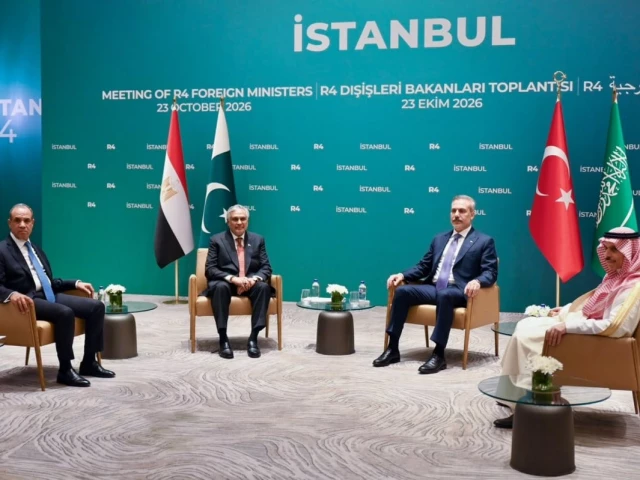
Foreign Minister/DPM Ishaq Dar on Friday met the foreign ministers of Turkiye, Saudi Arabia and Egypt during the sixth Regional Four (R-4) Foreign Ministers’ Meeting, and expressed solidarity with Saudi Arabia in the wake of recent Houthi attacks on the kingdom.
Diplomatic observers say the R-4 grouping is gradually positioning itself as a stabilising middle-tier platform, bridging Gulf, South Asian and Eastern Mediterranean perspectives, at a time when traditional alliances are being recalibrated in the aftermath of the Iran-US conflict.
The Istanbul meeting comes in the backdrop of increasing Houthi attacks on Saudi oil and civilian infrastructure that have reached an unprecedented scale and several conflicts that are converging around the same strategic fault lines that include regional security, energy supplies, maritime routes and the risk of wider war.
FM Dar is currently in Istanbul to attend the R-4 Foreign Ministers’ meeting.
In a post on X, the FO said that FM Dar participated in the 6th R-4 Foreign Ministers’ Meeting in Istanbul, alongside Turkiye FM Hakan Fidan, Saudi FM Prince Faisal bin Farhan Al Saud and Egyptian FM Badr Abdelatty.
Read: R-4 forum focuses on regional security concerns
According to the FO statement, the foreign ministers expressed "solidarity with Saudi Arabia and reaffirmed their support for its sovereignty and territorial integrity, further condemning the Houthi attacks targeting the Kingdom and underscoring the importance of respecting state sovereignty".
Deputy Prime Minister/Foreign Minister Senator Mohammad Ishaq Dar @MIshaqDar50 participated in the 6th R4 Foreign Ministers’ Meeting in Istanbul today, alongside H.E. Hakan Fidan of Türkiye, H.H. Prince Faisal bin Farhan Al Saud of Saudi Arabia, and H.E. Dr. Badr Abdelatty of… pic.twitter.com/PYgO1E3Xbf
— Ministry of Foreign Affairs - Pakistan (@ForeignOfficePk) October 23, 2026
FO stated that the ministers reviewed regional developments since their last meeting in New York, with particular focus on the situation in the Middle East and related security challenges/ conflicts.
The statement further noted that the ministers discussed ways to strengthen regional coordination and advance diplomatic efforts to promote lasting peace, security, and stability.
In a separate meeting of R-4 with the foreign ministers of Germany, France, the UK and Italy, developments in the Gulf region amid ongoing US-Iran tensions came under discussion.
In a post on X, FO said that the "meeting provided an opportunity for exchange of views on regional developments in the Gulf region, their social and economic impacts, and the urgent need to foster diplomatic engagement to resolve regional challenges of peace, security, and stability".
Deputy Prime Minister/Foreign Minister Senator Mohammad Ishaq Dar @MIshaqDar50 participated today in the first meeting in Istanbul with the Foreign Ministers of the R4 (Türkiye, Saudi Arabia and Egypt), along with their counterparts from France, Germany, Italy and the United… pic.twitter.com/ON3eFokBRA
— Ministry of Foreign Affairs - Pakistan (@ForeignOfficePk) October 23, 2026
FO added that FM Dar briefed his counterparts on the diplomatic and mediatory role Pakistan continued to play in de-escalating tensions, preventing resumption of hostilities and promoting peace.
"All Ministers agreed for continued engagement in this format," the statement further noted.
A joint statement issued after the meeting by the FO condemned Houthi strikes on civilians and civilian infrastructure in Saudi Arabia and called on the Houthis to stop attacks on the kingdom.
"They expressed their full solidarity with the Government of Yemen and the Kingdom of Saudi Arabia, and called on the Houthi militia to immediately cease all military actions, threats and attacks, and to return to the political process in good faith," the statement noted.
The ministers also condemned in the "strongest terms" the unacceptable escalation by the Houthi militia, which has deepened humanitarian suffering, as well as the continued strikes carried out by the Houthi militia against the Kingdom of Saudi Arabia, particularly those targeting civilians and civilian infrastructure, and the attacks carried out against commercial shipping in the Red Sea and the Bab Al Mandeb.
🔊 PR No. 3️⃣0️⃣5️⃣/2️⃣0️⃣2️⃣6️⃣
— Ministry of Foreign Affairs - Pakistan (@ForeignOfficePk) October 23, 2026
Joint Statement on the R4 Ministerial Meeting (Istanbul, 23 October 2026)
🔗⬇️ pic.twitter.com/FnDl86yDoN
Concerning the military conflict between the US/Israel and Iran as well as around the Strait of Hormuz, the ministers underlined the urgent need to address this conflict only through dialogue and diplomacy as well as to prevent the "targeting of civilians and civilian infrastructure", including vessels.
The ministers also expressed support for the Islamabad MoU and welcomed continued diplomatic efforts to prevent further escalation and reaffirmed their commitment to a lasting negotiated solution.
"The Foreign Ministers of the Republic of Türkiye, Arab Republic of Egypt, Islamic Republic of Pakistan, and the Kingdom of Saudi Arabia (R4 Group) met today in İstanbul to discuss regional issues of mutual concern, united in their commitment to contribute to diplomatic efforts and guided by the mutual interest to promote peace and stability in the region and beyond, in line with the principles and purposes of the UN Charter," the statement said.
The ministers underscored that the Israeli occupation constitutes the "fundamental source of instability in the region" and beyond, and that Israeli policies create a deep sense of injustice in global public opinion, further calling for the early implementation of the two-state solution in accordance with the relevant UN resolutions.
According to the joint statement, the ministers reiterated their support for the legitimate rights of the Palestinian people, including their inalienable right to self-determination and to establish an independent, sovereign, viable, and contiguous State of Palestine on the basis of the 4 June 1967 lines, with East Jerusalem as its capital, in accordance with relevant United Nations Security Council resolutions in order to achieve comprehensive peace in the Middle East.
The ministers also called for an urgent end to the ongoing Israeli violence, as well as attempts to change the legal and historical status of Jerusalem, and to bring an end to further destruction and humanitarian tragedy in Palestine, further condemning all the previous and current settlement activities in the West Bank and Jerusalem, as well as the settler violence against Palestinians while underlining the urgent need for uninterrupted flow of humanitarian aid and reconstruction in Gaza.
"The Ministers underscored the vital importance of freedom of navigation, permanent maritime safety and security, and safeguarding navigational rights and freedoms. They noted that disruption of sea lanes threatens the security and prosperity of all, through blocking global supply chains, flows of energy, fertiliser and food, impacting vulnerable populations in the region and beyond, and thus requires collective efforts by the international community to address these challenges," the FO said.
According to the statement, the ministers also rejected any measures or restrictions that impair lawful navigation and called for the swift and full resumption of safe, secure and unimpeded passage through the Strait of Hormuz.
The joint statement concluded by stating that the ministers agreed to "maintain close consultation and coordination on the afore-mentioned matters".
Dar meets French counterpart on R-4 sidelines
Meanwhile, FM Dar met with France’s Minister for Europe and Foreign Affairs, Jean-Noel Barrot, on the sidelines of the R-4 meeting.
In a post on X, the FO stated that the two sides discussed ways to further strengthen Pakistan-France bilateral cooperation, adding that FM Dar underscored the importance of sustained engagement and regular dialogue to advance bilateral cooperation across areas of mutual interest.
FO noted that Dar and Barrot exchanged views on current regional and international developments, including the wider economic and social repercussions of ongoing crises, particularly the impact on energy costs.
Deputy Prime Minister/Foreign Minister Senator Mohammad Ishaq Dar @MIshaqDar50 met with France’s Minister for Europe and Foreign Affairs, Jean-Noël Barrot @JnBarrot, in Istanbul today.
— Ministry of Foreign Affairs - Pakistan (@ForeignOfficePk) October 23, 2026
Recalling their recent meeting on the sidelines of the last UNGA, the two sides discussed ways… pic.twitter.com/HSDSaRVomp
"Both sides emphasised the importance of dialogue and diplomacy in addressing regional challenges and promoting peace and international cooperation," the statement added.
It said that FM Barrot appreciated Pakistan’s role and FM Dar's personal efforts in promoting sustained engagement and advancing diplomatic efforts towards regional peace and stability.
"DPM/FM appreciated France’s positive engagement alongside the UK, Germany and Italy with the R4 countries to discuss regional and international developments and support diplomatic efforts towards peace and stability," the FO stated.
Dar meets UK Foreign Secretary Ed Miliband
Separately, FM Dar met UK Foreign Secretary Ed Miliband on the sidelines of the R-4 meeting in Istanbul.
The FO said in a post on X that the two sides expressed satisfaction with Pakistan-UK bilateral relations and agreed to further strengthen bilateral cooperation in areas of mutual interest.
"They exchanged views on evolving regional and international developments, underscoring the importance of dialogue, diplomacy and continued engagement," the statement added.
Deputy Prime Minister/Foreign Minister Senator Mohammad Ishaq Dar @MIshaqDar50 met UK Foreign Secretary Ed Miliband @EdMiliband in Istanbul today.
— Ministry of Foreign Affairs - Pakistan (@ForeignOfficePk) October 23, 2026
The two sides expressed satisfaction with Pakistan-UK bilateral relations and agreed to further strengthen bilateral cooperation in… pic.twitter.com/11UbSrybzb
FO further noted that Miliband commended Pakistan’s efforts to promote regional peace and stability.
According to the FO, FM Dar appreciated the UK’s constructive engagement with the R-4, alongside Germany, France and Italy, in support of regional peace and stability.
Meeting with Saudi FM Prince Faisal Al Saud
Meanwhile, FM Dar also met with Saudi FM Al Saud on the sidelines of the R-4 ministerial meeting.
In a post on X, the FO stated the two leaders reaffirmed the enduring strength of the fraternal ties between Pakistan and Saudi Arabia and their commitment to further strengthening their strategic partnership through close cooperation across all areas of interest and regular consultations at all levels.
Deputy Prime Minister/Foreign Minister Senator Mohammad Ishaq Dar @MIshaqDar50 had a warm and cordial meeting with His Highness Prince Faisal bin Farhan Al Saud @FaisalbinFarhan, Foreign Minister of Saudi Arabia, in Istanbul on the sidelines of the R-4 Ministerial Meeting.
— Ministry of Foreign Affairs - Pakistan (@ForeignOfficePk) October 23, 2026
The… pic.twitter.com/qWjxeWRz9c
The statement added that FM Dar expressed Pakistan’s full support for the sovereignty and territorial integrity of the kingdom of Saudi Arabia.
"Both leaders underscored the special bond between the two countries, reinforced by the Strategic Mutual Defence Agreement and the Makkah Defence Alliance, and their shared commitment to regional peace, security and stability," the FO added.
Dar discusses bilateral relations, regional developments with Turkish FM Fidan
Earlier on Tuesday, Dar met with Fidan and discussed bilateral relations and regional developments, according to the FO.
In a post on X, FO said that the two leaders reviewed bilateral relations and exchanged views on "regional developments", particularly the situation in the Middle East and Palestine, further adding that they expressed concern over "threats to regional stability" and underscored the importance of dialogue, diplomacy and coordinated efforts to promote regional peace and security.
Deputy Prime Minister/Foreign Minister Senator Mohammad Ishaq Dar @MIshaqDar50 held his first meeting in Istanbul today with H.E. Hakan Fidan, Foreign Minister of Türkiye.
— Ministry of Foreign Affairs - Pakistan (@ForeignOfficePk) October 23, 2026
The DPM/FM thanked FM Hakan Fidan for Türkiye’s hosting of the R-4 Ministerial Meeting and the R4+ meeting… pic.twitter.com/ypZmfBAkP4
FO stated that Dar thanked his counterpart for hosting the R-4 Ministerial Meeting and the R4+ meeting with foreign ministers of France, Germany, Italy and the United Kingdom in Istanbul.
According to the statement, FM Dar also conveyed condolences over the loss of life caused by flash floods following heavy rains in Turkiye and wished a swift recovery to those affected.
"The two sides also strongly condemned the Houthi attacks on Saudi Arabia and reaffirmed their commitment to close coordination on regional issues, including under the Makkah Defence Agreement among Pakistan, Türkiye and Saudi Arabia," the FO added.
The statement further noted that both leaders reaffirmed their commitment to further strengthening the longstanding bonds of friendship and brotherhood between Pakistan and Turkiye, and to deepening cooperation across all areas of mutual interest, both bilaterally and in multilateral fora.
Meeting with German FM Wadephul
Meanwhile, FM Dar met with German Federal Minister for Foreign Affairs Johann Wadephul on the sidelines of the R-4 and Germany, France, Italy and the United Kingdom ministerial meeting.
According to an X post by the FO, the two ministers discussed Pakistan-Germany relations, further adding that FM Dar expressed the desire to further strengthen bilateral ties through sustained engagement and cooperation across multiple areas of mutual interest.
Deputy Prime Minister/Foreign Minister Senator Muhammad Ishaq Dar @MIshaqDar50 met with German Federal Minister for Foreign Affairs H.E. Johann Wadephul on the sidelines of the R-4 and Germany, France, Italy and the United Kingdom (E-4) Ministerial Meeting in Istanbul today.
— Ministry of Foreign Affairs - Pakistan (@ForeignOfficePk) October 23, 2026
The… pic.twitter.com/pWz4vZPfiT
The statement further noted that the two ministers also exchanged views on recent regional and international developments, emphasising the importance of dialogue, diplomacy and sustained international engagement to address evolving regional challenges and to promote peace and stability.
"DPM/FM welcomed the constructive engagement of Germany, France, Italy and the United Kingdom with the R-4 framework and underscored the value of continued consultations and diplomatic coordination on issues of shared concern," the FO added.
Dar meets Egyptian FM Badr Abdelatty
In a separate meeting, FM Dar met with Egypt's FM Abdelatty on the sidelines of the R-4 gathering.
In a post on X, the FO stated that the two ministers reaffirmed the longstanding and fraternal ties between Pakistan and Egypt and underscored the importance of sustained high-level engagement in further advancing bilateral relations.
"They agreed to impart greater momentum to cooperation across a range of areas, including trade, business-to-business linkages, agriculture, pharmaceuticals, connectivity, renewable energy, defence, and people-to-people exchanges," the statement added.
Deputy Prime Minister/Foreign Minister Senator Muhammad Ishaq Dar @MIshaqDar50 met with Egyptian Foreign Minister H.E. Dr. Badr Abdelatty @EgyptForeignMin on the sidelines of the R4 Ministerial Meeting in Istanbul today.
— Ministry of Foreign Affairs - Pakistan (@ForeignOfficePk) October 23, 2026
The two Ministers reaffirmed the longstanding and… pic.twitter.com/cV1KY1oJ5y
The FO further noted that Dar and Abdelatty also exchanged views on regional and international developments, particularly the situation in Palestine and the Middle East, and underscored the importance of sustained dialogue and diplomacy in addressing regional challenges.
"They reaffirmed their commitment to continued consultations and closer coordination under the Regional Four (R4) framework and on matters of mutual interest," it added.
Earlier in the day, FM Dar arrived in Istanbul to attend the R-4 meeting of foreign ministers, followed by the first meeting of the seven countries in the expanded R4+E3 format.
According to a FO statement, FM Dar “was received by Ambassador Cihad Erginay, Director General at the Turkish Ministry of Foreign Affairs”.
Pakistan’s Chargé d’Affaires Shaiq Ahmed, Consul General in Istanbul Khawaja Khurram Naeem, Additional Secretary Ambassador Khalil Hashmi, and officers from the Pakistani embassy in Ankara and consulate general in Istanbul were also present to receive him.
Deputy Prime Minister/Foreign Minister Senator Mohammad Ishaq Dar @MIshaqDar50 arrived in Istanbul, Türkiye, to participate in the R4 as well as the R4+ France, Germany, Italy, and UK Ministerial Meeting.
— Ministry of Foreign Affairs - Pakistan (@ForeignOfficePk) October 23, 2026
He was received by Ambassador Cihad Erginay, Director General at the… pic.twitter.com/5HvO1c7UxT
FM Dar was attending the R-4 meeting at the invitation of FM Fidan. The gathering would be the first-ever R4-E3 meeting, bringing together Turkiye, Egypt, Pakistan and Saudi Arabia on one side and Britain, France and Germany on the other.
“This will be the first meeting of the seven countries in this format,” the FO said in an earlier statement, referring to the expanded R4+E3 gathering.
The meetings were expected to focus on “key regional developments” and explore “coordinated diplomatic approaches to address shared challenges and advance regional peace and stability”, the statement said.
During his visit to Istanbul, FM Dar was also scheduled to hold bilateral meetings with his counterparts, the FO said.
“Pakistan’s participation reflects its continued commitment to constructive diplomacy, regional cooperation and the peaceful resolution of disputes,” the statement added.
🔊 PR No. 3️⃣0️⃣3️⃣/2️⃣0️⃣2️⃣6️⃣
— Ministry of Foreign Affairs - Pakistan (@ForeignOfficePk) October 23, 2026
Curtain Raiser: Deputy Prime Minister/Foreign Minister Senator Mohammad Ishaq Dar’s @MIshaqDar50 Participation in the R4 and R4+E3 Foreign Ministers’ Meetings, Istanbul, Türkiye (23 October 2026)
🔗⬇️ pic.twitter.com/CYIgVZqpUo
German Foreign Minister Johann Wadephul, British Foreign Secretary Ed Miliband, French Foreign Minister Jean-Noël Barrot, Egyptian FM Badr Abdelatty, FM Dar and Saudi Foreign Minister Faisal bin Farhan will join Fidan in Istanbul.
The choice of participants was itself significant. The R-4 represents a grouping of major regional players from the Muslim world, while the E3 brings together the three principal European powers that have traditionally played a central role in diplomacy over Iran and wider Middle Eastern security.
Read: Muslim, EU FMs to meet in Istanbul
The Istanbul meeting therefore creates a rare forum where regional and European powers will sit together to discuss conflicts that directly affect both sides.
The Iran-US confrontation has placed the Strait of Hormuz at the centre of international security concerns, while the latest Houthi attacks on Saudi Arabia have added another dangerous dimension to the regional crisis. Meanwhile, the security of the Bab el-Mandeb and other maritime routes remains a major concern for global trade and energy supplies.
Against this backdrop, Turkish media reports say the ministers will discuss the Palestinian issue, the situation in Hormuz, developments in Yemen and diplomatic efforts to end the Russia-Ukraine war. They will also examine areas where the R-4 and E3 could cooperate more closely.
Fidan was expected to push the argument that regional security cannot be achieved through military means alone and that disputes must be addressed through dialogue and diplomacy.
He was also expected to stress the importance of keeping both the Strait of Hormuz and Bab el-Mandeb open, reflecting concerns that further escalation could disrupt already vulnerable international shipping routes.
The Turkish foreign minister was further expected to underline Ankara's support for Saudi Arabia's security following Houthi attacks and to argue that conflicts in the region should not be allowed to feed into one another or spread into new theatres.





This material may not be published, broadcast, rewritten, redistributed or derived from. Unless otherwise stated, all content is copyrighted © 2026 The Express Tribune.








COMMENTS
Comments are moderated and generally will be posted if they are on-topic and not abusive.
For more information, please see our Comments FAQ