NCCIA arrests 4 suspects over child sexual abuse material trafficking in Islamabad
Updated 1 hour ago

Salman Akram Raja says all-parties conference being planned within 10 days to discuss K-P political situation
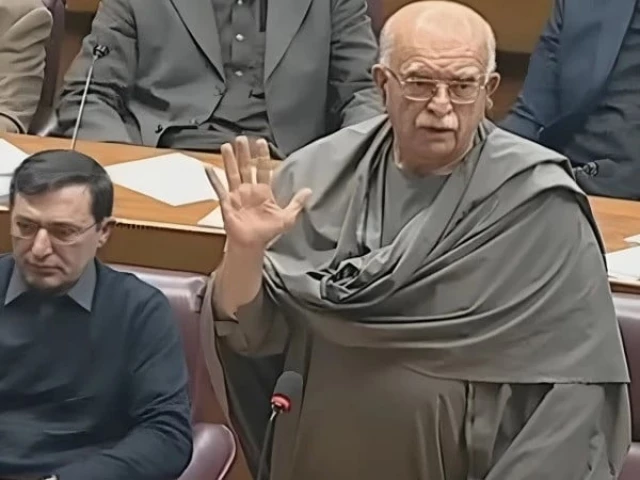
Opposition leaders Mahmood Khan Achakzai and Pakistan Tehreek-e-Insaf (PTI) Chairman Barrister Gohar Ali Khan on Thursday criticised the government over stalled political negotiations and restrictions on parliamentarians, calling for meaningful dialogue and the protection of elected representatives’ rights.
Speaking at a press conference outside Parliament House alongside opposition leaders, Gohar said the opposition had repeatedly engaged in negotiations with the government in good faith and without preconditions, but the process had failed to produce the desired results.
“Our government went away while we kept negotiating with the government,” he said, referring to the opposition’s attempts to pursue political dialogue.
Gohar also questioned the criteria used to assess political leaders’ loyalty to the state, saying that despite nearly three years of the current parliament, he still did not understand the formula used to determine such allegiance. “We have always said that Pakistan comes first and the state comes first,” he said.
“We are treated as though we are not loyal to the state. This perception must end,” he added, calling for an end to questions about opposition politicians’ commitment to Pakistan.
He also called for parliamentarians to be protected so they could represent their constituents freely and without fear. Recalling an incident in September 2024, when opposition lawmakers were allegedly picked up, Gohar said the opposition leader had moved a resolution in the National Assembly in response.
He added that a special committee had also been constituted to address the issue of parliamentarians’ protection.
Achakzai calls for complete recording of parliamentary speeches
Speaking at the same press conference, Opposition Leader in the National Assembly Mahmood Khan Achakzai stressed that parliamentary speeches should be recorded in their entirety, arguing that the official record was essential to preserving the country’s political history and allowing the public to assess the statements of elected representatives.
“The complete speech of a member speaking in the National Assembly being recorded is a constitutional requirement,” he said.
Achakzai said parliamentarians had to struggle even for rights that should ordinarily be guaranteed under parliamentary rules. He maintained that the speaker’s authority should be exercised in accordance with the rules and regulations governing the assembly.
Referring to his speech in the National Assembly a day earlier, he said he had made no inappropriate remarks. He alleged that his four-and-a-half-minute speech had been presented as a nine-minute address.
He also rejected suggestions that his remarks had been directed against the country, saying not a single word in his speech had been against Pakistan.
The opposition leader said the time allotted to opposition lawmakers to speak in parliament had been curtailed, describing the restriction as another obstacle to democratic debate.
Achakzai questioned what he described as the inconsistent issuance of production orders for lawmakers, saying such orders had been issued for some members but not others. He argued that parliamentary proceedings and the rights of elected representatives should be protected without discrimination.
He also criticised the government’s approach to political negotiations, questioning how the opposition could trust a process that, in his view, had been ridiculed by those in power.
He said political dialogue required a meeting with PTI founder Imran Khan. He also recalled that Jamiat Ulema-e-Islam-Fazl chief Maulana Fazlur Rehman had met the prime minister in connection with the issue.
The opposition had asked the government to ensure that the prime minister personally extended an invitation for negotiations, he said. “Negotiations cannot take place in an atmosphere where the process itself is being mocked,” he said.
Achakzai called for a committee to investigate allegations of corruption against the incumbent government, proposing that Defence Minister Khawaja Asif head it.
He maintained that the opposition would resist what it considered an undemocratic system through democratic means. “It is the duty of every citizen who wants to save Pakistan to stand up for democracy,” he said, adding that the country needed a strong parliament and state institutions operating within their respective constitutional jurisdictions.
“We will not hand Pakistan over to an undemocratic system,” he said, warning that such an order could threaten the country’s unity.
Raja Nasir Abbas calls for rule of law, constitutional supremacy
Also speaking at the press conference, Majlis Wahdat-e-Muslimeen chief Allama Raja Nasir Abbas stressed that the rule of law, justice and respect for the Constitution were essential for Pakistan’s progress, saying the country’s political and economic crises could not be resolved without the supremacy of law.
He said the rule of law and access to justice were fundamental to national development. Pakistan could not overcome its ongoing political crisis unless the Constitution was upheld and the rule of law firmly established, he added.
Addressing the country’s economic challenges, Abbas said the economic crisis, too, could not be resolved without ensuring the supremacy of law. He added that justice was necessary to restore public confidence in state institutions and the wider system.
He expressed concern that the trust deficit between the rulers and the people had reached its highest level in the country’s history. He also criticised the continued registration of fabricated cases and first information reports (FIRs), saying such practices further undermined public trust.
Referring to the February 8, 2024, general elections, Abbas alleged that the people’s mandate had been stolen. He said depriving citizens of their right to vote and undermining their electoral choices constituted serious injustices.
He further said tampering with votes amounted to an attack on the Constitution and the rule of law, stressing that protecting the sanctity of the vote was essential to upholding democratic principles and restoring public confidence in the political system.
Abbas reiterated that Pakistan’s sustainable progress, political stability and economic recovery depended on constitutional supremacy, the rule of law and justice for all citizens.
Gohar denies reports of differences within PTI
Meanwhile, Gohar addressed reports concerning internal party affairs, PTI lawmakers in Khyber-Pakhtunkhwa (K-P) and the provincial organisation, urging party members to verify information before reacting to reports.
He said the news that had prompted a social media post by the party’s secretary general was incorrect and that he had spoken to the relevant leaders and lawmakers.
Describing PTI’s lawmakers from K-P as a valuable asset, Gohar praised their role in supporting Imran over the past two years. He said they had remained steadfast despite difficult circumstances and continued to play a leading role in rallies, public meetings and protest marches.
“All these members are standing even more firmly with Imran Khan, his ideology and his struggle,” he said, adding that they enjoyed the PTI founder’s full confidence.
Gohar said no party lawmaker would consider disregarding Imran’s instructions and assured the provincial leadership that it would be consulted on important party decisions.
On the provincial party presidency, he clarified that Junaid Akbar had been appointed by Imran himself and that he had issued the notification in accordance with the PTI founder’s instructions. Junaid would continue to serve as provincial president, he said.
In Junaid’s absence, senior vice-president Noorul Haq Qadri would chair meetings of the provincial organisation under the party constitution, while provincial secretary general Ali Asghar Khan would oversee other organisational matters.
Gohar said discussions had taken place with the relevant office-bearers and that the provincial organisation had expressed the same preference during its meeting. A formal notification was expected to be issued on the matter.
He added that no changes would be made to the provincial organisation or its existing cabinet until Junaid returned.
Emphasising party unity, the PTI chairman said the party’s focus should remain on Imran’s position, political narrative and struggle rather than internal disagreements or unnecessary public statements.
He reiterated that the party remained united under Imran’s leadership and that his decisions and instructions were final.
Gohar also reaffirmed PTI’s position on the K-P chief minister, saying Sohail Afridi remained the party’s choice and that there was no question of considering anyone else for the position, as the decision rested with Imran.
Salman Akram Raja rejects claims Sohail Afridi derailed talks with govt
Separately, PTI Secretary General Salman Akram Raja has rejected claims that non-functional K-P Chief Minister Sohail Afridi was responsible for the breakdown of negotiations with the federal government, saying the talks collapsed over the denial of access to PTI founder Imran Khan’s personal physicians and concerns over provincial autonomy.
In an interview with a private television channel on Thursday, he said the refusal to allow Khan’s personal doctors to examine him was one of the two principal reasons behind the failure of the negotiations.
He said PTI could not grant the federal government unrestricted authority to intervene in the affairs of K-P. “These were the two principal reasons why the talks collapsed,” Raja said, alleging that the government had deliberately undermined the negotiations.
The PTI leader also described the imposition of emergency and governor’s rule in the province as unconstitutional, alleging that the government had introduced the measures to take control of the provincial administration. “They just wanted to take over the province,” he said.
Raja said an all-parties conference (APC) was being planned within the next 10 days, or earlier, to discuss the prevailing political situation. “This is a political issue and therefore all political parties must play their role,” he said.
He disclosed that several political parties were in contact with him over the situation, including Jamiat Ulema-e-Islam-Fazl chief Maulana Fazlur Rehman.
Asked about the role of Pashtunkhwa Milli Awami Party chairman Mehmood Khan Achakzai, Raja said the final decision rested with the PTI founder. He described Achakzai and Majlis Wahdat-e-Muslimeen chief Allama Nasir Abbas as a shield for the party, adding that PTI would continue to seek their political advice and support.
Raja also maintained that PTI’s long march had not ended, signalling that the party’s political campaign would continue.
Meanwhile, PTI leader and Senator Syed Ali Zafar denied that negotiations with the government were imminent, saying decisions concerning the party would be made by its parliamentary party.
“We are yet to determine the terms of reference,” Zafar said while speaking to a journalist from the same television channel. He further alleged that the government had decided to impose governor’s rule around one-and-a-half months earlier.
Yousafzai distances party from YouTubers campaigning against state institutions
PTI's K-P information secretary Shaukat Ali Yousafzai on Thursday distanced the party from YouTubers campaigning against state institutions, saying they had no links with PTI and that such campaigns had negatively affected the party.
Speaking in an interview with a private television channel, Yousafzai said PTI founder Imran Khan had always referred to the armed forces as his own institution, adding that no other viewpoint would be entertained on the matter.
He said PTI had always condemned terrorism and described it as unjustified to label the party’s leaders or workers as facilitators of terrorists. He also alleged that the government had used concerns over peace and security as a pretext to impose emergency and governor’s rule in K-P, calling the move unjustified.
He expressed confidence in Barrister Gohar Ali Khan and Salman Akram Raja, adding that he would not be “intimidated by a YouTuber” based overseas.
Deadlock on emergency and governor’s rule in K-P
The debate over emergency and governor’s rule in K-P intensified in late September amid worsening security concerns and growing political tensions between the federal government and the PTI-led provincial administration.
Federal ministers accused the provincial government of failing to address terrorism and governance challenges, while PTI considered the possibility of an in-house change or dissolution of the provincial assembly.
The federal government subsequently stepped up its warnings, with Law Minister Azam Nazeer Tarar and other officials arguing that constitutional provisions allowed the Centre to intervene if circumstances warranted extraordinary measures. The government cited the deteriorating law and order situation and the provincial administration’s handling of security challenges as precursors for governor’s rule and emergency.
Later, on October 11, President Asif Ali Zardari approved the imposition of emergency and governor’s rule in the province on the advice of Prime Minister Shehbaz Sharif, following approval by the federal cabinet. The government cited escalating terrorist attacks, threats to lives and property, and what it described as a breakdown of the constitutional system in the province.
The measures invoked Articles 232 and 234 of the Constitution, while the federal government also authorised the deployment of the army to assist the civil administration.
Read More: PHC takes up challenge to emergency today
The move transferred executive authority from the elected provincial government to Governor Faisal Karim Kundi and affected 12 districts under the emergency proclamation. PTI rejected the decision, arguing that it undermined provincial autonomy and the party’s electoral mandate.
The intervention also marked the fourth spell of governor’s rule in the province, following earlier instances in 1975, 1994 and 1999.
The issue subsequently moved to Parliament and the courts.
On October 12, a petition challenging the imposition of emergency measures and governor’s rule in K-P was filed in the Peshawar High Court by PTI, a day after President Asif Ali Zardari approved the federal government’s decision on the advice of Prime Minister Shehbaz Sharif. The opposition argued that the constitutional requirements had not been fulfilled and that the intervention violated provincial autonomy.
Three days later, on October 15, a joint sitting of Parliament approved separate resolutions endorsing the emergency and governor’s rule for two months, despite severe protests from the opposition parties.
So far, the government and the opposition remain at loggerheads regarding the governance of the province.




This material may not be published, broadcast, rewritten, redistributed or derived from. Unless otherwise stated, all content is copyrighted © 2026 The Express Tribune.




COMMENTS (1)
Comments are moderated and generally will be posted if they are on-topic and not abusive.
For more information, please see our Comments FAQ