Judi Dench says worsening eyesight means she can no longer act
Updated 3 hours ago

Grammy winner backs calls for clear labelling of AI-generated music and compensation when AI systems use artists' work

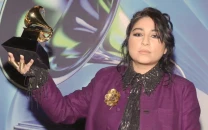
Grammy-winning Pakistani singer Arooj Aftab has called for musicians to receive fair compensation whenever their recordings are used to train artificial intelligence (AI) models or generate new music, arguing that artists should be paid for the use of their work.
In two Instagram stories, Aftab shared campaign messages from United Musicians and Allied Workers (UMAW), a trade union representing music industry professionals, highlighting the need for transparency, proper labelling and fair remuneration as AI-generated music becomes increasingly prevalent.
The first post called for AI-generated recordings to be clearly labelled across the music industry, including by software developers, record labels, studios, distributors and retailers. The campaign argues that listeners should be able to distinguish music created using AI from recordings made by human artists.
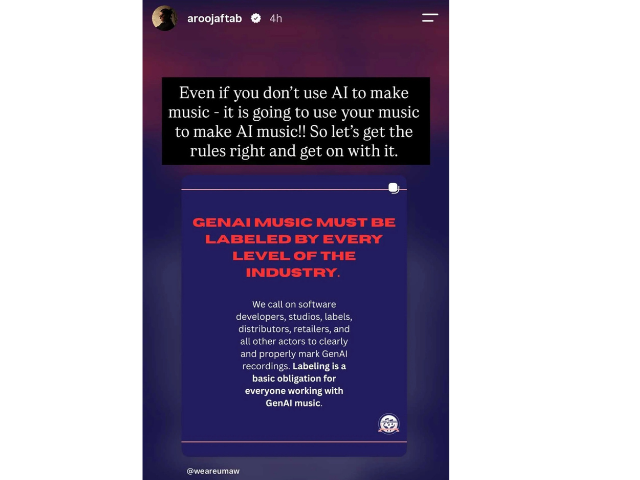
Screengrab: aroojaftab/Instagram
Sharing the message, Aftab highlighted how musicians’ work could be used to develop AI systems, writing: “Even if you don’t use AI to make music - it is going to use your music to make AI music!! So let’s get the rules right and get on with it.”
The singer also endorsed calls for artists to be paid when their recordings are used to train AI systems and when the resulting technology is used to generate new music.
In her second story, Aftab argued that compensation should cover both the initial use of music to train AI models and the subsequent use of what those systems have learnt.
“The artist should be paid bec AI has already used my music to train itself, aka usage,” she wrote, adding that artists should also be paid whenever AI draws on that learning to produce new music, which she described as “derivative work”.
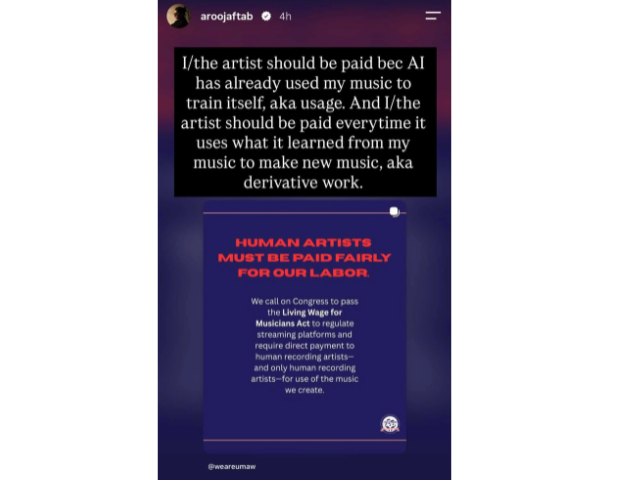
Screengrab: aroojaftab/Instagram
The accompanying UMAW campaign called on the US Congress to pass the Living Wage for Musicians Act, which seeks to address musicians’ earnings from streaming and support direct payments to human recording artists for the use of their music.
Aftab’s intervention comes amid growing opposition from musicians to the unauthorised use of copyrighted creative work in AI development.
In 2024, more than 13,000 artists signed a statement condemning the unlicensed use of human-made music to develop AI systems. The signatories included ABBA’s Björn Ulvaeus and Radiohead’s Thom Yorke.
In February 2025, more than 1,000 musicians, including Kate Bush, released a silent album to protest proposed changes to UK copyright rules that could allow AI developers to use copyrighted material, including music and books, to train their systems under certain conditions.
Streaming platforms have also begun responding to concerns about AI-generated content. Spotify has introduced measures intended to help listeners identify verified human creators and distinguish them from AI music creators, while addressing spam and low-quality tracks.
The debate centres on how copyright, attribution and compensation should apply when AI systems are trained on existing creative works and subsequently generate new material. For musicians such as Aftab, the central question is whether artists whose work helps power these systems should have a say in how it is used and receive compensation for the value it creates.










This material may not be published, broadcast, rewritten, redistributed or derived from. Unless otherwise stated, all content is copyrighted © 2026 The Express Tribune.





COMMENTS
Comments are moderated and generally will be posted if they are on-topic and not abusive.
For more information, please see our Comments FAQ