Russia says it will send first diesel cargo to US on Thursday
Updated 27 minutes ago

Yellow Vest activists seek to revive their campaign against rising living costs, declining public services
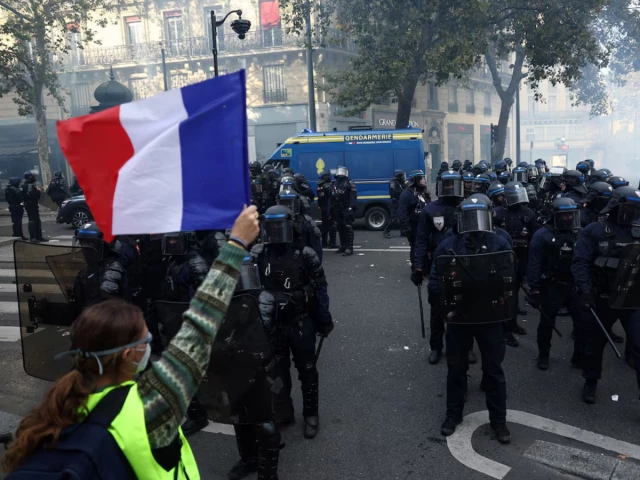
France's Yellow Vest movement filed plans for a major march through Paris on Saturday, presenting the government with its next major test after riots and looting last weekend shook confidence in its ability to maintain order.
Prime Minister Sebastien Lecornu was due to meet union leaders on Wednesday, seeking ways to defuse one of the worst crises France has faced in recent years and avoid a repeat of the violence that swept French cities on October 17.
A representative of the "Gilets Jaunes" (Yellow Vests) movement, which is a grassroots group not tied to the unions, presented plans for a march across the heart of Paris, including areas that were ransacked just days ago.
Student groups have also called for protests the same day to push their demands for more investment in education. Yellow Vest activists are seeking to revive their campaign, which emerged in 2018, against rising living costs and declining public services.
Investors fret, French borrowing costs climb
Last weekend's demonstrations rapidly degenerated into rampant violence, especially in Paris, Marseille, Lyon and Limoges, which overwhelmed police and took hours to contain.
Highlighting investor concern over the situation, French government borrowing costs have risen sharply this week, pushing benchmark 10-year bond yields to 5%, their highest level since July 2002.
Analysts said markets are worried that the unrest could complicate government efforts to repair strained public finances at a time of already mounting budget pressures.
French President Emmanuel Macron said he would meet intelligence services on Thursday ahead of the new protests.
Read: French PM calls for 'partial curfews' in cities hit by riots and looting
Government ministers have promised a vastly reinforced security operation after acknowledging shortcomings in their initial response, with troops expected to be deployed alongside additional police.
In a letter to unions ahead of Wednesday's meeting, Lecornu said their talks should focus on ensuring "the indispensable freedom to demonstrate", which he said some were trying to curtail by associating it with "unacceptable acts".
France's main unions have separately called a nationwide mobilisation for November 5.
"There is huge and legitimate anger, and the answer to that situation is not repression. It is a political response. That's what I will tell the prime minister today," Sophie Binet, head of the CGT union, told RTL radio.
Political backlash as government struggles
A second consecutive night of local curfews passed without major incidents in areas hit by the unrest, offering the government some respite as it prepared for fresh demonstrations.
The unrest has triggered a political backlash ahead of presidential elections next year, with candidates from the far right and hard left performing strongly in polls.
"The government has lost control of everything," far-right leader Marine Le Pen told Franceinfo radio.
Read more: Mass protests in France spiral into worst riots in years
The hard-left France Unbowed (LFI), which has been accused by ministers of fueling the unrest, criticised plans to deploy troops onto the streets of Paris.
"Demonstrators are not enemies within. The French government must not go to war against its own people," LFI's parliamentary group said in a statement.
Protests in other European countries, including Italy and Albania, have added to concerns that anger over living standards risks spreading around the continent at a time when many nations, including France, are struggling with budget woes.
Italy approved a raft of security measures on Tuesday, including a new offence of violent participation in a demonstration and tougher penalties for rioters in response to the turbulence last weekend.








This material may not be published, broadcast, rewritten, redistributed or derived from. Unless otherwise stated, all content is copyrighted © 2026 The Express Tribune.






COMMENTS
Comments are moderated and generally will be posted if they are on-topic and not abusive.
For more information, please see our Comments FAQ