PHC seeks Centre’s response over imposition of emergency, governor’s rule in K-P
Updated 1 hour ago

Notices sent to attorney, advocate generals, relevant authorities; petition argues move was unconstitutional
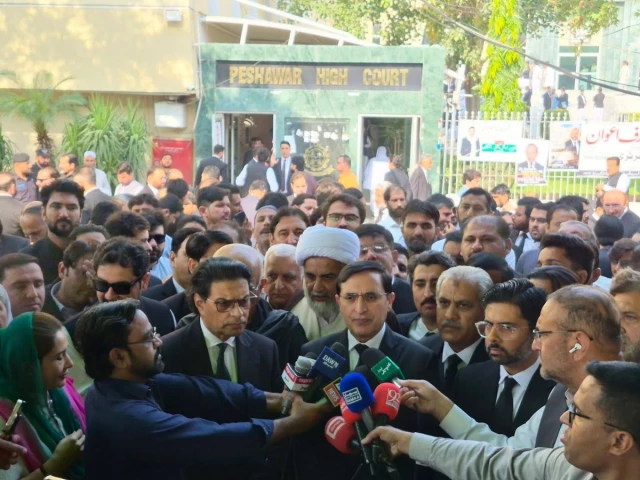
The Peshawar High Court (PHC) on Tuesday issued notices to the federal government, the attorney general, the advocate general and other relevant authorities on petitions challenging the imposition of governor’s rule and emergency in Khyber-Pakhtunkhwa (K-P), after petitioners’ counsel argued that the measures were unconstitutional and had been imposed without fulfilling the legal requirements.
A division bench comprising Justice Ijaz Anwar and Justice Muhammad Faheem Wali heard the petitions filed by Pakistan Tehreek-e-Insaf (PTI) Chairman Barrister Gohar Ali Khan and National Democratic Movement (NDM) leaders, including Mohsin Dawar.
During the hearing, the petitioners’ counsel argued that the provincial government had not lost control of the province and that the imposition of emergency and governor’s rule amounted to an attack on provincial autonomy and democracy.
Barrister Sameer Khosa, representing the petitioners, argued that no circumstances indicated the provincial government was unable to maintain control of the province. He said K-P Chief Minister Sohail Afridi and provincial assembly Speaker Babar Saleem Swati were missing and their whereabouts were unknown.
Justice Anwar asked whether the petition sought their production before the court or their recovery. “Yes, we have made that request in the petition,” Khosa replied.
Citing the Supreme Court’s judgment in the Pir Sabir Shah case, Khosa argued that even if an emergency was imposed, the chief minister and cabinet would continue to function. In the present case, however, the chief minister, cabinet and advocate had been prevented from performing their duties and rendered inactive, he said.
Khosa urged the court to restore the provincial assembly and secure the release of Afridi and Swati.
Petitioners’ counsel PTI Secretary General Salman Akram Raja argued that governor’s rule and emergency had been imposed without fulfilling the legal requirements. He urged the court to declare the measures illegal and restore the provincial assembly.
Read: PHC takes up challenge to emergency today
Raja maintained that Afridi remained the chief minister and the provincial cabinet was still in place. He said a resolution passed by the provincial assembly was necessary for the imposition of emergency, adding that governor’s rule could only be justified if the provincial government was unable to function.
Raja also alleged that the sanctity of homes and the privacy of their occupants were being violated in the province.
Another petitioner’s counsel, Muazzam Butt, Advocate, challenged the legality of both measures, arguing that the constitutional provisions invoked to impose emergency and governor’s rule had not been followed. He said provincial assembly approval had not been obtained for the imposition of emergency.
“If they claim that terrorism has increased, there is an Apex Committee for that,” Butt said, adding that the committee included representatives of the provincial and federal governments, the governor and security forces’ officials.
Butt also questioned the whereabouts of the governor’s report, after the president reportedly said governor’s rule had been imposed on the basis of a report submitted by the governor. The counsel argued that the authorities should explain where the report was and what it contained.
After hearing the petitioners, Justice Ijaz Anwar said the court was issuing notices to the federal government, the Attorney General, the Advocate General and other relevant parties.
Raja then requested the court to also issue an order on the interim relief sought by the petitioners. “We will examine it and pass an order,” the court said.
Political leaders condemn move
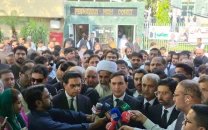
Speaking to reporters at the high court, Gohar said the PTI had challenged both emergency and governor’s rule, alleging that the measures were undemocratic and unconstitutional.
He said the mistreatment of party workers was continuing, adding that the party had always described terrorism as a menace and consistently supported the federal government in the fight against it.
“We had our own government, and our mandate was snatched away,” Gohar said.
He alleged that 12 PTI members of the National Assembly and 14 members of the provincial assembly had been picked up. He also claimed that raids were being conducted at party members’ homes and that they were being harassed.
Gohar said the office of a District Development Advisory Committee chairman had been demolished and plaques marking development projects completed by the party had been removed. He added that deputy commissioners, district police officers and officials at the Advocate General’s Office had been transferred on October 11.
Read more: Achakzai seeks K-P CM whereabouts
National Assembly opposition leader Mahmood Khan Achakzai said decisions should be made through the courts. “We want decisions to be made in courts. If that does not happen, matters will move to the streets,” he said, calling for peaceful protests against the government.
Achakzai said the 1973 Constitution had been drafted with great difficulty and recalled that Article 58(2) had led to the dissolution of four assemblies. He said the opposition had no enmity with either Nawaz Sharif or Asif Ali Zardari.
The K-P chief minister represented 40 million people and had been ridiculed, he said.
Referring to protests against inflation in France, Achakzai said millions of people had taken to the streets and set things on fire, but the French police had not fired a single bullet. “We will also have to stage peaceful protests against this government,” he said, adding that the final phase of the struggle had begun.
Background
The federal government imposed emergency and governor’s rule in K-P on October 11 amid heightened political tensions involving the PTI. The move prompted legal challenges from the party and other opposition figures, who questioned its constitutional basis.
Gohar subsequently sought to amend his pending petition to challenge parliamentary resolutions passed by the National Assembly and Senate on October 14 and by a joint sitting of parliament on October 15, endorsing the emergency.
The application argued that the presidential action under Article 234 of the Constitution was unconstitutional and that subsequent parliamentary approval could not remedy a failure to meet the initial constitutional requirements. It maintained that Article 232 required a resolution from the provincial assembly for an emergency imposed on the grounds of internal disturbance, but no such resolution had been passed by the K-P Assembly.
Gohar asked the court to declare the parliamentary resolutions and emergency notification null and void, suspend the notification pending a final decision and restrain the authorities from taking further action under it.
Separately, petitions were filed seeking the recovery of Afridi, Speaker Babar Saleem Swati and PTI provincial president Junaid Akbar. In the chief minister’s case, the court issued notices to the government, police and other relevant authorities, directing them to submit replies within two days. In the petitions concerning Swati and Akbar, the authorities were directed to respond within 10 days.






This material may not be published, broadcast, rewritten, redistributed or derived from. Unless otherwise stated, all content is copyrighted © 2026 The Express Tribune.




COMMENTS
Comments are moderated and generally will be posted if they are on-topic and not abusive.
For more information, please see our Comments FAQ