Four dead as floods sweep eastern Spain
Updated 30 minutes ago

CDF Asim Munir, Saudi envoy discuss regional security Both sides stress stronger defence cooperation DG ISPR say
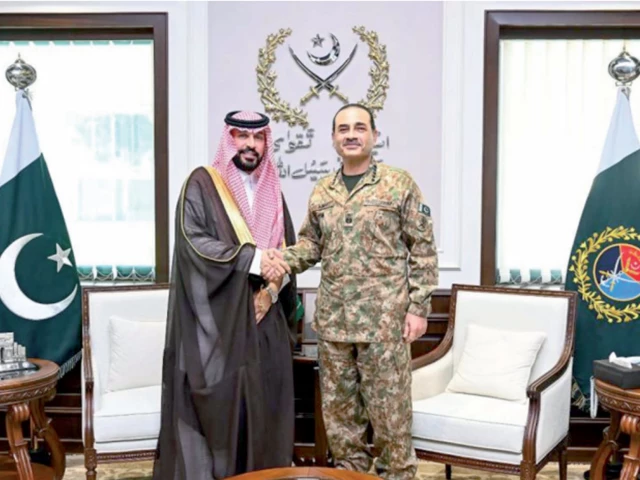
Pakistan and Saudi Arabia on Monday expressed satisfaction over the progress made under the Makkah Joint Defence Agreement and underscored the need to strengthen defence cooperation, institutional linkages and strategic coordination.
The understanding came during a meeting between Chief of Defence Forces and Chief of Army Staff Field Marshal Syed Asim Munir and newly-appointed Saudi Ambassador to Pakistan Dr Rajeh Tami Albugamy at General Headquarters in Rawalpindi, according to the Inter-Services Public Relations (ISPR).
The two sides discussed matters of mutual interest and regional security dynamics, with particular emphasis on further strengthening defence collaboration. Field Marshal Asim congratulated the ambassador on his appointment and expressed confidence that his tenure would reinforce longstanding ties between the two countries, rooted in shared faith, mutual trust and strategic partnership.
"Both the dignitaries expressed satisfaction over the progress made under the framework of the Makkah Joint Defence Agreement and underscored the importance of strengthening defence collaboration, institutional linkages and strategic coordination," the ISPR statement said.
The Makkah Joint Defence Agreement was signed on August 7 by Pakistan, Saudi Arabia and Turkiye. It followed the Strategic Mutual Defence Agreement signed by Pakistan and Saudi Arabia in September 2025.
In an interview with Independent Arabia, ISPR Director General Lt Gen Ahmed Sharif Chaudhry described the Makkah alliance as a defensive arrangement aimed at deterring aggression and promoting regional stability. He stressed that the alliance had no offensive intent and was intended to send a clear message to elements seeking to destabilise the region.
However, he warned that any direct or indirect attack on Pakistan, Saudi Arabia or Turkiye would trigger a collective response under the agreement. "The response will be collective," he said, adding that the alliance was intended to protect its members against threats to their security and territorial integrity.
His remarks came amid heightened regional tensions following missile and drone attacks by Yemen's Houthi group on Saudi Arabia. Chaudhry said collective deterrence would come into play if diplomatic efforts failed to prevent further escalation.
He said Pakistan considered Saudi Arabia's sovereignty, territorial integrity and the security of Islam's holiest sites non-negotiable, adding that Islamabad would continue providing whatever support was needed to safeguard the kingdom.
"The Saudis' sovereignty and territorial integrity, security, and foremost, the security of the Haramain Sharifain is paramount. It's non-negotiable. It's absolute as far as Pakistan is concerned," the chief military spokesperson stated.
The spokesperson urged Muslim countries to unite and avoid actions that could intensify hostilities. Escalation served neither regional interests nor the wider Muslim world, he said, calling instead for restraint and negotiations.
"We need to stop attacking each other," he said, adding that Pakistan's political and military leadership had been working towards that objective. "We need to come to a negotiated outcome. If this failed this instrument of collective deterrence of the Makkah alliance will come into play, as it is coming into play."
Chaudhry said military cooperation between Pakistan and Saudi Arabia had existed for decades, predating the Makkah alliance, and covered multiple areas. He declined to disclose operational details, citing the confidentiality of military arrangements and their tactical and strategic considerations.
He reiterated that the alliance was purely defensive and would remain so. Pakistan, Saudi Arabia and Turkiye shared an interest in peace, stability and prosperity, while their longstanding relations and mutual trust had helped the arrangement develop rapidly, he said.
The military spokesperson said the alliance was not necessarily restricted to its founding members and remained open to countries sharing its commitment to collective deterrence, regional security and stability. However, decisions on potential expansion rested with the leadership of the three countries.
Asked about reports that Egypt and Syria had expressed interest in joining, Chaudhry said the matter would be considered at the appropriate political, strategic and military levels. He did not provide a timeline for any expansion.
On the possibility of Pakistan providing direct military support to Yemen's government, the spokesperson said he did not know whether Islamabad had received an official request. He added that the government would assess and respond to any such request.
Chaudhry also highlighted Pakistan's diplomatic engagement with countries involved in the regional conflicts, including Iran, saying Islamabad had sought to reduce tensions and secure a negotiated, peaceful outcome. He said these efforts would continue to prevent further escalation in the region.











This material may not be published, broadcast, rewritten, redistributed or derived from. Unless otherwise stated, all content is copyrighted © 2026 The Express Tribune.







COMMENTS
Comments are moderated and generally will be posted if they are on-topic and not abusive.
For more information, please see our Comments FAQ