Social media amplifies insecurity, self-doubt
Updated 1 hour ago

Citing Jinnah's guidelines, court sets safeguards for officers
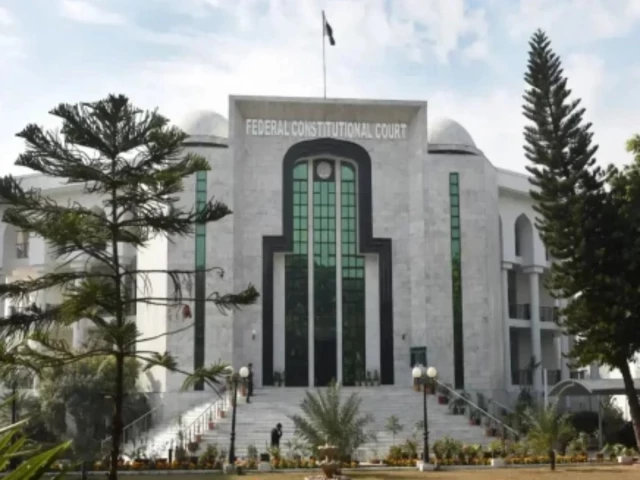
The Federal Constitutional Court (FCC) has ruled that repeated deferments of a civil servant's promotion cannot be used to indefinitely postpone consideration of his case, while clarifying that even three successive deferments do not automatically entitle an officer to promotion.
In a 19-page judgment authored by Justice Ali Baqar Najafi, the court laid down safeguards for civil servants whose promotion cases are repeatedly deferred by the Central Selection Board (CSB).
The judgment, which dismissed a petition challenging the denial of promotion to a police officer from grade 19 to grade 20, drew on the guidelines for civil servants outlined by Quaid-e-Azam Muhammad Ali Jinnah in his famous speech delivered in April 1948.
The judgment observed: "The reason why service structure of civil servants is so much protected and their career progression is made with reasonable objective criteria also lies in the referred speech of Quaid-e-Azam Muhammad Ali Jinnah in which he had given guidelines".
A division bench led by FCC Chief Justice Aminuddin Khan, citing Jinnah's speech, rephrased the guidelines for civil servants as follows: "Never be influenced by any political pressure, do your duty as servants of people and the state honestly and fearlessly, governments, Prime Ministers, Ministers come and go but it is not your business to support or oppose them, serve the governments loyally and morally while maintaining your high reputation, prestige, honour and integrity of your service, understand your own sphere of duty and act with others harmoniously within your sphere and leaders and politicians, likewise, should not try to interfere into your work which is bound to bring horrible diseases like corruption, bribery and nepotism which will do nothing but disservice to Pakistan."
The judgment said an officer whose promotion was repeatedly deferred by the CSB had, at a minimum, the following legally protected interests: first, to have his case considered for promotion whenever it fell due under the applicable rules; second, to have the decision based on objective and prescribed criteria; third, to be informed of specific and intelligible reasons for an adverse decision where the governing policy so required; fourth, to have a genuine opportunity to remove or address the deficiency underlying the deferment; and fifth, not to face indefinite or repeated deferments unsupported by fresh, tangible and legally relevant material.
The court said repeated deferment could not be treated as an unrestricted administrative device through which consideration for promotion could be postponed indefinitely.
"Each deferment must have an identifiable legal basis and must be referable to the conditions prescribed by the applicable promotion rules or policy."
"Where the original deficiency has already been removed, the authority must identify a fresh and lawful basis for any further deferment; otherwise, repeated postponement may amount, in substance, to an indefinite denial of consideration for promotion under the guise of deferment."
The court said deferments could not lawfully become a perpetual or open-ended obstacle to an officer's consideration for promotion. It said this principle assumed particular significance when an officer had been deferred on three successive occasions.
"Three deferments do not, by themselves, confer upon the officer an automatic right to promotion, because promotion is not a vested right and the competent authority retains the lawful discretion to assess comparative merit and suitability in accordance with the applicable rules," the order said.
The court also said that the promotion of junior officers during the intervening period could not, by itself, turn a temporary deferment into permanent supersession, particularly if the original ground for deferment no longer existed.
"The distinction is therefore material: the pendency of the reference may justify deferment; the subsequent acquittal removes the basis of that deferment."
"The former may postpone consideration, but the latter obliges the competent authority to restore the officer to the stream of lawful consideration."
"To hold otherwise would mean that an officer, although ultimately exonerated from the very proceedings which had prevented his consideration, would continue to suffer the adverse consequences of an allegation which never culminated in his conviction or adverse finding."
"Such an approach would effectively transform a temporary deferment into a substantive penalty, although the rules themselves do not contemplate deferment as a punishment."













This material may not be published, broadcast, rewritten, redistributed or derived from. Unless otherwise stated, all content is copyrighted © 2026 The Express Tribune.








COMMENTS
Comments are moderated and generally will be posted if they are on-topic and not abusive.
For more information, please see our Comments FAQ