Pakistan to chair IMF, WB boards in 2027
Updated 1 hour ago

FO skirts KSA-Iran row over Houthi attacks
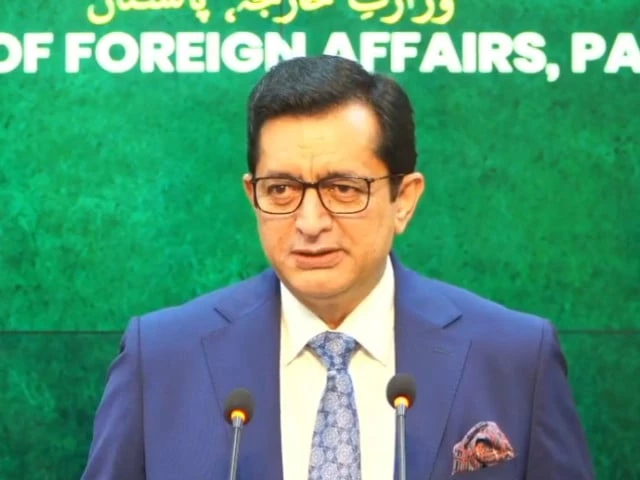
Pakistan on Friday reaffirmed its commitment to Saudi Arabia's security but declined to be drawn into Riyadh's latest accusation that Iran continues to arm and train Yemen's Houthi militia, signalling Islamabad's effort to balance its close defence ties with Saudi Arabia with its engagement with Tehran.
Foreign Office spokesperson Sajjad Haider Khan said Pakistan could not comment on the Saudi allegation against Iran while reiterating Islamabad's broader position that regional conflicts should be resolved through diplomacy.
Asked about Saudi Foreign Ministry Deputy Minister for Public Diplomacy Rayed Krimly's accusation that Iran continued to arm, train and support the Houthi militia in violation of UN Security Council resolutions, Sajjad told reporters that Pakistan could not comment on the allegation.
"I would not be able to comment on the alleged accusation against Iran that you mentioned," he said.
The spokesperson instead reiterated Pakistan's broader position that the regional conflict should be resolved through diplomacy.
"Pakistan is keen to see peace and stability return to the entire region, including the Middle East and West Asia, and will continue to engage with all relevant stakeholders in this regard," he said.
"There is no solution through war. Peace can only be restored through negotiations and the peaceful settlement of disputes."
Pakistan, however, reaffirmed its commitment to Saudi Arabia's security and condemned the latest Houthi attack on King Khalid International Airport in Riyadh.
Sajjad said one Pakistani was killed at Riyadh airport and six others were injured in the recent attacks. The injured, he added, were receiving treatment at different locations in Riyadh while the Pakistani mission was in contact with them and their families.
Pakistan has repeatedly condemned Houthi attacks on Saudi Arabia, including attacks targeting civilian and economic infrastructure, while also supporting dialogue for a political settlement of the Yemen conflict.
The spokesperson said Pakistan remained committed to the sovereignty, territorial integrity, unity and independence of Yemen and supported diplomatic efforts to end the conflict.
He also reiterated that Pakistan would fulfil its obligations under its defence arrangements with Saudi Arabia.
"Pakistan will fulfill its obligations under these agreements," Sajjad said when asked whether the Makkah defence agreement could be practically invoked following repeated attacks on Saudi territory.
However, he stopped short of giving any timeline for military action, saying operational matters, including deployment and action on the ground, fell within the domain of the armed forces, ISPR and the General Secretariat of the Makkah Joint Alliance.
Sajjad also said Pakistan supported Saudi Arabia's right to defend itself under Article 51 of the UN Charter.
Against this backdrop, Pakistan also played down recent remarks by an Iranian lawmaker questioning Islamabad's mediation efforts between Iran and the United States, making clear that the comments would not affect its broader engagement with Tehran.
Sajjad described Iran as a "brotherly country" and said Pakistan's role in facilitating the Islamabad understanding between Iran and the US had been appreciated by the Iranian leadership.
"Iran is a brotherly country, and its leadership has greatly appreciated Pakistan's role in mediation and in bringing the Islamabad MoU to fruition," Sajjad said at his weekly briefing.
He was responding to a question about Iranian lawmaker Mohsen Zanganeh's recent remarks during his visit to Kabul, in which he reportedly questioned Pakistan's mediation role and suggested that even a Pakistani tweet on the issue had been written by Americans.
Sajjad said he had seen the reported remarks but would not comment on their credibility.
"They may also have been taken out of context, as Iran's leadership and people are grateful for Pakistan's efforts," he said, adding that members of Iran's National Assembly had also applauded Pakistan's "constructive role" in the region.
The remarks indicate that Islamabad does not want the comments by an individual Iranian lawmaker to undermine its broader engagement with Tehran, particularly after Pakistan's efforts to facilitate the Islamabad MoU between Iran and the United States.
On Afghanistan, Sajjad said Pakistan remained open to dialogue but made clear that any talks with the Taliban would not be unconditional.
He said Islamabad wanted a "verifiable mechanism" ensuring a complete cessation of terrorist activities emanating from Afghan soil.
Responding to questions about a possible Russian mediation initiative following the recent Moscow Format meeting, he said Pakistan valued its engagement with Russia and would welcome "any sincere efforts by friendly countries" that could address its security concerns.
"At present, I am not aware of any separate, formal Russian mediation initiative being under discussion," Sajjad said.
He added that meaningful progress would ultimately depend on "concrete and verifiable action on the ground" by the Taliban authorities against terrorist groups operating from Afghanistan.
He also confirmed that Pakistan's participation in the Moscow Format meeting was at the special representative level and noted that the absence of a joint communiqué was significant.
"The fact that no joint communiqué was issued after the Moscow Format is self-evident that Afghanistan did not accept the formulation which had been acceptable until last year particularly about presence of terrorist network in Afghanistan," Sajjad said.
On India, the Foreign Office strongly rejected recent remarks by the Indian defence minister threatening aggression against Pakistan, warning that any military action would receive a "forceful response".
"Let there be no ambiguity: Pakistan remains fully prepared to safeguard its sovereignty and territorial integrity against any ill-advised aggression," Sajjad said.
"Our restraint and commitment to peace must never be mistaken for weakness. Any aggression will be met with a forceful response."





This material may not be published, broadcast, rewritten, redistributed or derived from. Unless otherwise stated, all content is copyrighted © 2026 The Express Tribune.

COMMENTS
Comments are moderated and generally will be posted if they are on-topic and not abusive.
For more information, please see our Comments FAQ