Sindh seeks Chinese investment
Updated 1 hour ago

CM proposes K-IV pipeline, smart governance, barrage rehabilitation, climate-resilient agriculture
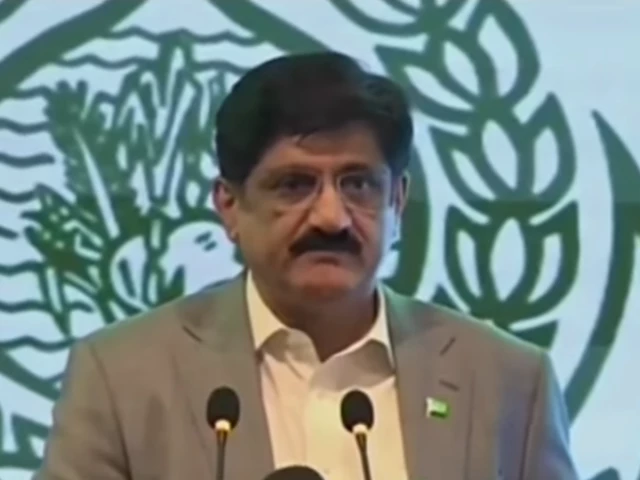
Sindh Chief Minister Murad Ali Shah has sought Chinese investment in water infrastructure, smart governance, pharmaceutical manufacturing and climate-resilient agriculture to strengthen the province's urban management, industrial capacity and food security, according to official statements issued by the provincial information department.
During his official visit to China, the chief minister met representatives of HBSZ Company, Huawei, Humanwell Healthcare Group and Qingfa Hesheng Agriculture Development Co Ltd to explore cooperation in the K-IV pipeline, Sukkur Barrage rehabilitation, artificial intelligence, pharmaceutical production and advanced seed technology.
At a meeting with HBSZ in Wuhan, the CM discussed the proposed 100-kilometre K-IV pipeline for Karachi. The company expressed willingness to undertake its construction, while the chief minister directed officials to initiate work at the earliest.
He also reviewed the Sukkur Barrage Improvement Project, being implemented by a joint venture of China Road and Bridge Corporation and HBSZ. Of the barrage's 54 river gates, 44 have been replaced and made functional, while the remaining 10 are ready for transportation to Pakistan. HBSZ is also fabricating 110 canal gates.
"Sukkur Barrage is extremely important to me. It is the economic lifeline of Sindh," Murad said, adding that its rehabilitation after 90 years had significantly improved water flows.
Launched in February 2023, the project is scheduled for completion by June 30, 2027, with financing from the World Bank and the federal and provincial governments. Rehabilitation of Guddu Barrage is also under way.
Smart governance
During visits to Huawei's urban governance facility and the Wuhan Artificial Intelligence Computing Centre, the CM explored technology-based solutions for public services and city management.
Briefed on systems using real-time data analytics and artificial intelligence, he said Karachi, with more than 20 million residents, could benefit from digital solutions for traffic congestion, water management, waste disposal and urban flooding.
He proposed a pilot project in one district focusing on flood early warning and city operations management, with expansion across Karachi later.
The chief minister also proposed cooperation in data centres, technology transfer, professional training and partnerships between Huawei and Sindh's universities.
Officials said the AI computing centre, launched in 2021, had expanded its capacity to 400 petaflops, providing computing resources to researchers, universities and technology companies.
The CM proposed giving Sindh's researchers access to AI training and advanced computing facilities, highlighting plans to develop Karachi Education City as a hub for research and emerging technologies.
The provincial government plans to pursue the Huawei proposals through a memorandum of understanding at the Sindh Investment and Trade Conference in Shanghai later this week.
Pharma investment
CM Murad invited Humanwell Healthcare Group, also known as Renfu Pharmaceutical Group, to establish manufacturing facilities in Sindh for domestic and regional markets.
Discussions covered pharmaceutical manufacturing, active pharmaceutical ingredients (APIs) and healthcare innovation. He highlighted investment incentives in special economic zones at Dhabeji, Bin Qasim and Khairpur, along with Port Qasim's connectivity.
Inviting Humanwell to replicate its manufacturing investments in Africa, he said Sindh could become an export base for Pakistan, the Middle East, Africa and Central Asia.
He urged the company to send a technical delegation to Karachi to assess joint ventures in APIs and finished medicines, assuring it of provincial facilitation and assistance with regulatory approvals.
Climate-resilient agriculture
The chief minister also invited Qingfa Hesheng Agriculture Development Co Ltd to collaborate on high-yield, climate-resilient crops, local seed production and agricultural technology.
During talks with Chairman Wang Shicai, he proposed joint research, farmer training and seed-production systems suited to Sindh's agricultural conditions.
The company briefed the delegation on its hybrid seeds, including rice, maize, cotton and rapeseed. Its hybrid rice varieties have reportedly achieved yield increases of 20 to 30 per cent in relevant trials.










This material may not be published, broadcast, rewritten, redistributed or derived from. Unless otherwise stated, all content is copyrighted © 2026 The Express Tribune.




COMMENTS
Comments are moderated and generally will be posted if they are on-topic and not abusive.
For more information, please see our Comments FAQ