Govt cuts petrol by Rs2.71, diesel by 3 paisas for Oct 14
Updated 48 minutes ago

Says Makkah pact is purely defensive in nature, not directed against any country
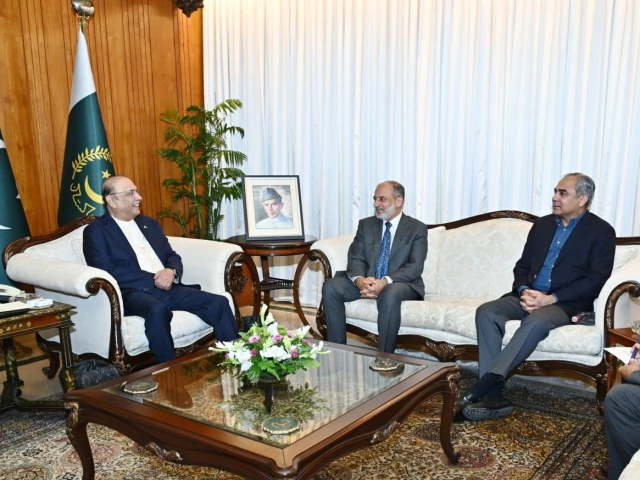
President Asif Ali Zardari reaffirmed Pakistan’s commitment to regional peace and stability under the Makkah Defence Alliance (MDA) in a meeting with Lieutenant General (Rtd) Nauman Mahmood on Tuesday in Islamabad.
On August 7, Pakistan, Saudi Arabia and Turkiye formalised their longstanding strategic relationship through the newly signed Makkah pact, a trilateral security framework that its proponents describe as a defensive arrangement aimed at strengthening collective deterrence, enhancing military cooperation and promoting regional stability.
In a post on X, the office of the president stated that Lieutenant General (Rtd) Nauman Mahmood, the first secretary general of the MDA, formerly called the Makkah Joint Defence Agreement (MJDA), called on President Zardari at Aiwan-e-Sadr.
Read: Lt Gen (retd) Nauman Mahmood appointed first secretary general of Makkah pact
"The president expressed confidence that the Makkah Joint Defence Agreement, signed by Pakistan, Türkiye and Saudi Arabia on August 7, 2026, would strengthen regional peace and stability through defensive cooperation guided by the principles of the UN Charter and international law," it added.
President Reaffirms Pakistan’s Commitment to Regional Peace and Defensive Cooperation Under Makkah Accord
— The President of Pakistan (@PresOfPakistan) October 13, 2026
Lieutenant General (Rtd.) Nauman Mahmood, the first Secretary General pursuant to Makkah Joint Defence Agreement called on President Asif Ali Zardari at Aiwan-e-Sadr today.… pic.twitter.com/9anJjovXdc
The president further underscored that the accord was "purely defensive in nature and not directed against any country, nor it constituted the formation of a new bloc".
The statement emphasised that Pakistan remained committed to the peaceful resolution of conflicts and enhanced regional and multilateral cooperation to address emerging challenges.
Interior Minister Mohsin Naqvi was also present during the meeting.
Who is Lt Gen Nauman Mahmood?
Lt Gen (retd) Mahmood is a former senior Pakistan Army commander with experience in military operations, intelligence, professional military education and strategic affairs.
He was in the race for the army chief when the government was looking for the successor of General (retired) Qamar Javed Bajwa in November 2022. He was known as one of the most non-controversial army generals with an impeccable career and apolitical approach.
Read More: Ex-army officer to head Makkah pact secretariat
A member of the Baloch Regiment, he was commissioned into the army on September 11, 1987.
During his military career, he served in command and instructional appointments, including assignments with an infantry formation and at the Command and Staff College. As a major general, he commanded an infantry division in North Waziristan.
He also served in the Inter-Services Intelligence (ISI), including as director general of its Analysis Directorate, where his responsibilities involved assessment of regional and international developments.
After his promotion to lieutenant general, Naumam served at General Headquarters as inspector general for Communications and Information Technology.
He was promoted to lieutenant general in April 2019 and subsequently appointed commander of XI Corps, commonly known as Peshawar Corps, in December that year.
He remained in command of the corps until November 2021, during a period when Afghanistan was undergoing a major political and security transition following the US military withdrawal.
Nauman was then appointed president of the National Defence University (NDU), Islamabad, becoming the institution's 35th president. He served in that position until April 2023, when he retired from the army.
He has attended professional military courses in Pakistan and abroad, including at the Command and Staff College in Egypt, and is a graduate of the NDU.
On September 23, the government appointed Lt Gen Mahmood as the first secretary general of the MJDA.
The appointment was the first major institutional development since Pakistan, Saudi Arabia and Turkiye signed the pact, and his appointment gives Pakistan the responsibility of establishing and leading the alliance's first secretariat during its formative three-year period.
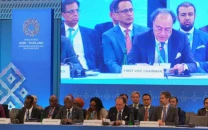
The decision was taken at the inaugural meeting of the Strategic Political and Defence Committee, held under the MJDA, which brought together the foreign and defence ministers and military chiefs of the three countries in Istanbul on August 31.
Under the arrangement agreed in Istanbul, the secretary general would head the alliance's General Secretariat, based in the Saudi capital and tasked with overseeing implementation of the agreement, coordinating joint activities among the three militaries and supporting expanded defence-industrial cooperation.
For Islamabad, the role also provides an opportunity to shape the working structure of the new defence arrangement as Pakistan, Saudi Arabia and Turkiye move from the political commitment announced in Makkah towards a more organised mechanism for defence coordination.
Significance of the Makkah Joint Defence Agreement
The Makkah pact was the latest step in longstanding military and strategic cooperation between Pakistan, Saudi Arabia and Turkiye. Signed in Makkah, the pact established a framework for collective deterrence and stipulated that an armed attack on any one of the three countries would be considered an attack on all three, while providing for wider cooperation across defence.
Also Read: Makkah defence alliance agrees to 'rapid force deployment' in Saudi Arabia: FO
The agreement followed nearly a year of negotiations and came amid heightened instability across the Middle East. Turkiye and Pakistan had sought closer regional security cooperation, while Saudi Arabia had faced growing security concerns as conflicts spread across the region, threatening its territory, energy infrastructure and ambitious economic development plans.
For Pakistan and Saudi Arabia, the trilateral pact is built on their Strategic Mutual Defence Agreement signed in September 2025. That agreement stated that “any aggression against either country shall be considered an aggression against both” and committed the two sides to strengthening defence cooperation and joint deterrence.
The three countries already had extensive military links. Pakistan had provided training and technical assistance to Saudi forces for decades, while Islamabad and Ankara had maintained close defence ties through military training, naval cooperation and defence equipment. In 2023, Saudi Arabia agreed to purchase Turkish drones in what Ankara described as its largest defence export contract.
The signing in Makkah, Islam’s holiest city, added symbolic weight to an agreement that brought together three countries with significant military and strategic capabilities. It also came as Pakistan sought to avoid becoming directly involved in the Iran conflict, instead pursuing diplomatic efforts to mediate, while strengthening its broader regional security partnerships.






This material may not be published, broadcast, rewritten, redistributed or derived from. Unless otherwise stated, all content is copyrighted © 2026 The Express Tribune.




COMMENTS
Comments are moderated and generally will be posted if they are on-topic and not abusive.
For more information, please see our Comments FAQ