India rejects monopoly claim after Musk accuses Ambani of blocking Starlink launch
Updated 37 minutes ago

She chaired a UN commission probing violations by all sides in the Occupied Palestinian Territory and Israel
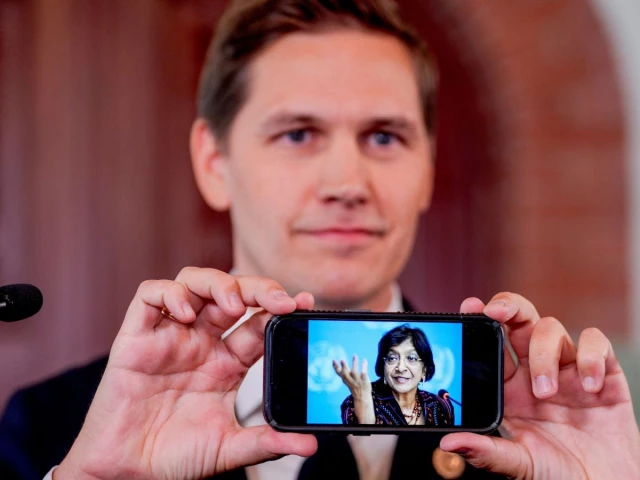
Navanethem "Navi" Pillay, the South African jurist who led a UN inquiry that concluded Israel had committed genocide against Palestinians in Gaza, was awarded the 2026 Nobel Peace Prize on Friday.
The Norwegian Nobel Committee honoured the 85-year-old “for her efforts to promote peace and international law”, placing particular emphasis on her career holding states and political leaders accountable.
Pillay’s work on Gaza became one of the most consequential and controversial chapters of that career.
From 2021 until November 2025, she chaired the UN Independent International Commission of Inquiry on the Occupied Palestinian Territory, including East Jerusalem, and Israel. Established by the UN Human Rights Council, the commission investigated violations committed by all sides and collected evidence that could be used in future legal proceedings.
Its first major report following October 7, 2023, found in June 2024 that Israeli authorities were responsible for war crimes and crimes against humanity during military operations in Gaza. It also concluded that Hamas and other Palestinian armed groups committed war crimes during their attacks in Israel, including deliberately killing civilians and taking hostages.
Read More: South Africa's Navanethem 'Navi' Pillay wins 2026 Nobel Peace Prize
“It is imperative that all those who have committed crimes be held accountable,” Pillay said at the time, arguing that adherence to international law was the only way to end recurring cycles of violence and retaliation.
The commission’s investigation later focused on Israel’s attacks on hospitals and the broader destruction of Gaza’s healthcare system. In October 2024, it accused Israeli forces of deliberately attacking medical facilities and personnel, as well as mistreating Palestinian detainees.
“By targeting healthcare facilities, Israel is targeting the right to health itself,” Pillay said, warning that the destruction would have lasting consequences for Gaza’s civilian population.
“Children in particular have borne the brunt of these attacks, suffering both directly and indirectly from the collapse of the health system,” she added.
‘Absence of action amounts to complicity’
In September 2025, the commission issued its most far-reaching conclusion: that Israeli authorities and security forces had committed four of the five acts defined as genocide under the 1948 Genocide Convention.
These included killing members of a protected group, causing serious bodily or mental harm, deliberately imposing conditions calculated to bring about the group’s physical destruction and taking measures intended to prevent births.
The commission also concluded that Prime Minister Benjamin Netanyahu, President Isaac Herzog and former defence minister Yoav Gallant had incited genocide and that Israeli authorities had failed to punish them for it.
Pillay said the evidence showed “an intent to destroy the Palestinians in Gaza” and placed responsibility with Israeli authorities at the highest levels.
She also directed criticism at governments continuing to arm or politically support Israel.
“When clear signs and evidence of genocide emerge, the absence of action to stop it amounts to complicity,” she said.
The commission called on states to halt transfers of weapons and equipment that could be used to commit genocidal acts, prevent companies and individuals under their jurisdiction from contributing to them and support accountability proceedings.
Israel rejected the findings, accused the commission of bias and maintained that its military campaign targeted Hamas rather than the Palestinian population.
The commission’s determination was not a binding judicial ruling and it did not speak for the UN as a whole. The International Court of Justice is separately considering South Africa’s genocide case against Israel.
Pillay stepped down from the commission in November 2025, citing her age, medical issues and other commitments.
From apartheid to international justice
Born in Durban in 1941 into a South African family of Indian origin, Pillay began her legal career under apartheid, when racial and gender discrimination restricted both her professional opportunities and the rights of her clients.
In 1967, she became the first woman to establish a law practice in the province of Natal. She represented anti-apartheid activists and trade unionists, exposed allegations of torture and helped secure rights for political prisoners held on Robben Island.
Her work attracted the attention of apartheid-era security authorities, and she was denied a passport for years.
After apartheid ended, President Nelson Mandela appointed Pillay as an acting judge on the South African High Court in 1995, making her its first non-white woman judge.
That same year, she joined the International Criminal Tribunal for Rwanda, later serving as its president. Pillay sat on the panel that decided the landmark case against Jean-Paul Akayesu, the first conviction for genocide by an international tribunal.
The judgment also established that rape and sexual violence could constitute acts of genocide when committed with the intention of destroying a protected group, an enduring contribution to international criminal law.
Pillay subsequently served as a judge at the International Criminal Court from 2003 to 2008 and as UN high commissioner for human rights from 2008 to 2014. She currently serves as an ad hoc judge at the International Court of Justice in The Gambia’s genocide case against Myanmar.
Announcing the award, the Nobel Committee said Pillay’s career demonstrated how international law could provide accountability for victims and offer an alternative to violence at a time when courts and legal institutions were facing growing political attacks.
The Nobel Peace Prize, carrying an award of 12 million Swedish kronor ($1.2 million), will be presented in Oslo on December 10.









This material may not be published, broadcast, rewritten, redistributed or derived from. Unless otherwise stated, all content is copyrighted © 2026 The Express Tribune.
COMMENTS
Comments are moderated and generally will be posted if they are on-topic and not abusive.
For more information, please see our Comments FAQ