India braces for Cyclone Arnab with evacuations
Updated 38 minutes ago

Iranian official says 'illegal routes' in Strait of Hormuz to soon be blocked
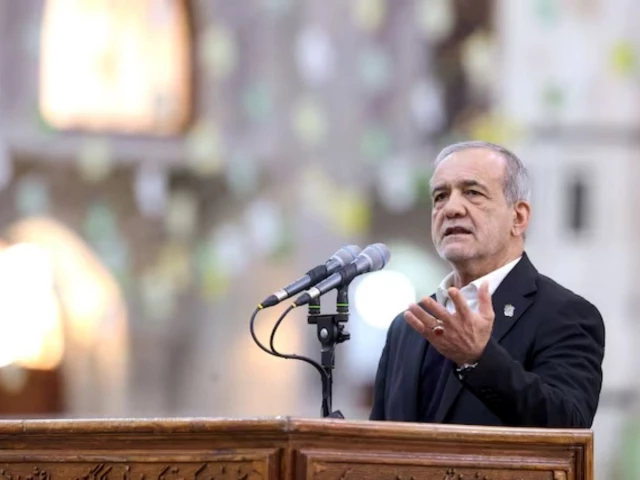
Iranian President Masoud Pezeshkian said during a call with his Russian counterpart, Vladimir Putin, that reaching an agreement with the United States was “not out of reach” if Washington adhered to international legal frameworks, according to the Iranian presidency.
The two leaders discussed regional developments, Iran-US negotiations and relations, according to a statement.
Pezeshkian briefed Putin on negotiations between Iran and the US mediated by Pakistan, describing Washington’s “double standards and maximalism” as the biggest obstacle to reaching a fair agreement.
He said Tehran was prepared to reach a “balanced and fair” agreement that would ensure lasting peace and security in the region.
“Our red line is Iran’s national interests and the rights of the Iranian people,” said Pezeshkian, adding that if Washington adhered to international legal frameworks, reaching an agreement would not be out of reach.
The Iranian president also described Gulf countries as Iran’s “brothers” and expressed regret about the use of US military bases in those countries for attacks against Iran.
He said Tehran was ready to cooperate with neighbouring countries to achieve regional peace and security without the presence or involvement of powers from outside the region.
Putin reiterated Russia’s support for diplomatic efforts to reach a political settlement to the war and said Moscow was ready to keep helping find a diplomatic solution, according to the statement.
He also stressed the need to respect Iran’s sovereignty and territorial integrity, and backed Tehran’s demands for compensation for damage caused during the war and long-term security guarantees against additional attacks.
The two leaders reaffirmed their commitment to expanding cooperation under the Comprehensive Strategic Partnership Treaty and maintaining close coordination in international forums.
Iranian official says 'illegal routes' in Strait of Hormuz to soon be blocked
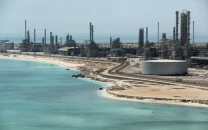
Transit routes in the Strait of Hormuz deemed illegal by Iran will soon be closed, an adviser to the Revolutionary Guards' Commander told the semi-official Fars News Agency on Wednesday, referring to the southern pathway hugging Oman's coast.
Mohammadreza Naqdi said these "few routes" had been created by blasting and damaging some of the rocky passages in the strategic waterway and were used by "small boats smuggling oil and transferring it to tankers", challenging the narrative that Gulf oil exports are regaining pre-war levels.
"The Strait of Hormuz is closed, and the armed forces of the Islamic Republic of Iran have full control over it. This situation will continue until Iran’s legitimate demands are met,” he added.
A seven-day moving average for crude exports from the region was 18.3 million barrels per day on September 30, provisional data from Kpler showed, with volumes topping pre-war levels on 14 days in September.
That included Gulf oil sent via Hormuz, the Red Sea, and from terminals and ship-to-ship transfers in the Gulf of Oman.
The IRGC has consistently denied that seaborne crude flows in the strait are rebounding thanks to US Navy help, with another IRGC adviser, Majid Mirahmadi, saying on Thursday that a daily average of 10 ships transit the waterway against an average of 125 before the war, which started on February 28, when the US and Israel killed Supreme Leader Ayatollah Ali Khamenei in a Tehran airstrike.
Despite growing oil flows in September, Iranian attacks on tankers and logistical constraints have persisted and call into question whether higher flows can be sustained durably.
Iran will never give up its right to enrich uranium: senior Iranian official
Earlier, a senior Iranian official told Reuters that Iran would never give up its right to enrich, but details could be discussed later, adding that US ideas about Iran’s nuclear programme were at odds with Iran’s demands.
The official's comments came in response to earlier comments made by US Secretary of State Marco Rubio and US Vice President JD Vance.
The official said Vance’s comments on Iran’s nuclear programme were the Americans’ “ideas and requests”.
There have been no negotiations between Iran and the US about Tehran’s nuclear programme, the official said, adding that the US must first meet Tehran’s conditions before the nuclear issue can be discussed.
US' recognition of Iran’s right to enrichment is Tehran’s red line, the official said.
Iran has failed to reach agreement with US on nuclear programme: Rubio
US Secretary of State Marco Rubio said on Wednesday that Iran has "failed to take advantage of multiple opportunities" to reach an agreement with the United States on its nuclear programme.
He made the comments during his trip to Greece in a meeting with the Greek foreign minister.
He also said that Iran has “lost complete control” of the Strait of Hormuz, US Secretary of State Marco Rubio said Wednesday, adding that Tehran’s economy was “in total and complete freefall,” AFP reported.
“There’s almost as much oil flowing out now as there was before this conflict began. So they’ve lost complete control of the Straits,” Rubio said.
Earlier, US Vice President JD Vance said in an exclusive interview with Reuters that Iran must make a “meaningful” reduction in its nuclear enrichment capacity to satisfy US demands and end the countries’ seven-month war, even as Washington was unsure how Tehran makes decisions in negotiations.
Vance has taken a leading role in negotiating a settlement to the conflict and brokered a provisional peace agreement in June that quickly fell apart. The war has jolted global energy markets and become a political liability for President Donald Trump and fellow Republicans ahead of November midterm elections.
Speaking on Monday after a campaign trip in Alaska, Vance said any agreement would require Iran to reduce its nuclear enrichment capacity, rather than offer assurances of future nuclear drawdowns.
"If you don't want a nuclear weapon, then why do you need 60% enriched fuel? And if you want to show commitment to not building a nuclear weapon, don't build highly enriched fuel. That's a very basic threshold issue," Vance said.
Read: Iran warns regional states of ‘different and decisive’ response to future attacks
"I think if they want to show a commitment to not building a nuclear weapon, they would do something meaningful on their enrichment capacity."
Iran and the US have exchanged proposals in recent weeks aimed at ending the war and reopening the Strait of Hormuz, a vital global energy shipping route. Trump rejected Tehran's latest offer and has warned that military operations could intensify after the midterms.
Vance said the US remained open to an agreement but would require concrete Iranian nuclear concessions.
"We're not going to trade words for actions," Vance said.
Unclear how Iran makes decisions: Vance
Complicating matters, Vance said Washington is uncertain who makes decisions in Tehran.
Vance said the US was in talks with Iranian President Masoud Pezeshkian and Foreign Minister Abbas Araghchi. But it was unclear how much authority they wield within Iran's power structure, he said, after joint US-Israeli strikes at the start of the war killed Supreme Leader Ayatollah Ali Khamenei.
"One of the things we picked up on is it's not totally clear how their country makes decisions," Vance said. Separately, Trump said on Tuesday his "biggest problem" is no one knows who is running Iran.
Read more: 'Anything could happen': Trump says 'big decision' incoming regarding Iran
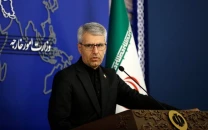
Iran's Foreign Ministry spokesperson said on Sunday that US officials are well aware of who their Iranian counterparts are and how Iran's decision-making system works.
"The problem is actually the opposite: it lies in the contradictory positions and mixed messaging from US officials," Esmaeil Baghaei told a weekly press conference.
Vance told Reuters he has held personal conversations with field commanders to gauge battlefield conditions. He dismissed concerns over critical munitions shortages and added that while Iranian troops are periodically able to strike commercial ships in the Strait of Hormuz, they are largely unable to prevent energy exports through the waterway.
Vance declined to say if he was leading peace talks, though he is frequently cited as the White House's top negotiator.
"We're certainly involved," he said. "Ultimately, the president of the United States is driving things."
The war — and its $3 billion monthly price tag — has become a key issue on the campaign trail. Higher energy prices have put Trump and Republicans on the defensive in competitive states that will decide control of Congress.
Iranian FM stresses continuation of dialogue, cooperation with neighbours
Foreign Minister of Iran Abbas Araghchi emphasised that continued dialogue and cooperation with neighbours is the path prioritised by Iran for building a region that is secure and stable, according to state news agency IRNA.
In a message regarding the visit of his Armenian counterpart, the Foreign Minister of the Islamic Republic of Iran wrote that on Monday he hosted Ararat Mirzoyan, the Foreign Minister of the Republic of Armenia, in Tehran.
FM @araghchi stresses continuation of dialogue and cooperation with neighborshttps://t.co/CK6nqwhNgD pic.twitter.com/HMWz0oJTNe
— IRNA News Agency ☫ (@IrnaEnglish) October 7, 2026
Araghchi added that during the meeting they reviewed the expanding relations between Tehran and Yerevan, as well as ways to deepen cooperation in the areas of economy, trade, transportation, energy, and other fields of mutual interest.
He said that it was Iran's belief that regional issues should be resolved through the participation and initiatives of the countries within the region, without the interference of extra-regional forces.
He emphasised that continued dialogue and cooperation with neighbours was the path the Islamic Republic of Iran prioritises to build a more secure, stable, and prosperous region.
Iran envoy: US attacks damaged 111 petrochemical, pharmaceutical facilities
Iran’s ambassador to the Netherlands and Representative to the Organisation for the Prohibition of Chemical Weapons (OPCW) has said that US military attacks on Iran’s chemical industries damaged 111 petrochemical and pharmaceutical facilities, disrupting supply chains and affecting the implementation of the Chemical Weapons Convention.
Iran’s Permanent Mission to the OPCW on Tuesday released excerpts from remarks by Hadi Farajvand at the 113th session of the OPCW Executive Council, saying that 60 petrochemical complexes, 44 pharmaceutical factories and seven pharmaceutical facilities in Iran were damaged during the US attacks, according to IRNA.
Iran envoy: US attacks damaged 111 petrochemical, pharmaceutical facilitieshttps://t.co/upDjlprtCY pic.twitter.com/2W5sQlLb2n
— IRNA News Agency ☫ (@IrnaEnglish) October 7, 2026
Farajvand said the damage inflicted on Iran’s chemical and pharmaceutical industries had disrupted supply chains and affected the implementation of obligations under the Chemical Weapons Convention.
He also stressed that protecting chemical facilities from armed conflicts is essential to preserving the integrity of the Convention, peaceful activities in the field of chemistry and international cooperation.
He added that the deliberate US attacks on the facilities had raised serious concerns regarding several articles of the Chemical Weapons Convention, as well as the object and purpose of the international treaty.
‘Iran’s economy will not break’: Central Bank governor vows resilience against US economic warfare
The Governor of the Central Bank of Iran (CBI), Abdolnaser Hemmati,told the Iranian public that the national economy would not break under the weight of US economic warfare, claiming that Tehran avoided Washington’s primary objective of triggering catastrophic hyperinflation, according to Press TV.
In a televised interview, Hemmati provided an assessment of the country’s economic battlefield, acknowledging the daily pressures felt by citizens while stating that Iran had neutralised the most severe threats engineered by the United States and the Israeli regime.
‘Iran’s economy will not break’: Central Bank governor vows resilience against US economic warfarehttps://t.co/Meo0iww16X
— Press TV 🔻 (@PressTV) October 7, 2026
Hemmati emphasised that while inflation remains a challenge, the CBI has successfully prevented the economic collapse that US planners had anticipated.
"I am not talking about low inflation; I am talking about the fact that heavy, catastrophic inflation was supposed to happen, and this was one of America's primary goals—a goal that Trump and his Treasury Secretary repeat every day," Hemmati stated. "Fortunately, this did not happen, and the Central Bank has a plan and is actively pursuing liquidity control."
"They planned to bring Iran to economic collapse within two weeks, claim victory, and leave. Now, nine months have passed," he said, referring to the ongoing US-Israeli military and economic aggression that began earlier this year.
"Now they come and say that in another two weeks, Iran will collapse economically. Ten days have passed since that claim, and we are on the front lines of the economic war. We will give them the exact same answer: the result they want is the result they will get themselves."








This material may not be published, broadcast, rewritten, redistributed or derived from. Unless otherwise stated, all content is copyrighted © 2026 The Express Tribune.






COMMENTS
Comments are moderated and generally will be posted if they are on-topic and not abusive.
For more information, please see our Comments FAQ