Digital transactions hit 13.2b
Updated 1 hour ago

Aurangzeb calls population growth, climate change critical survival challenges
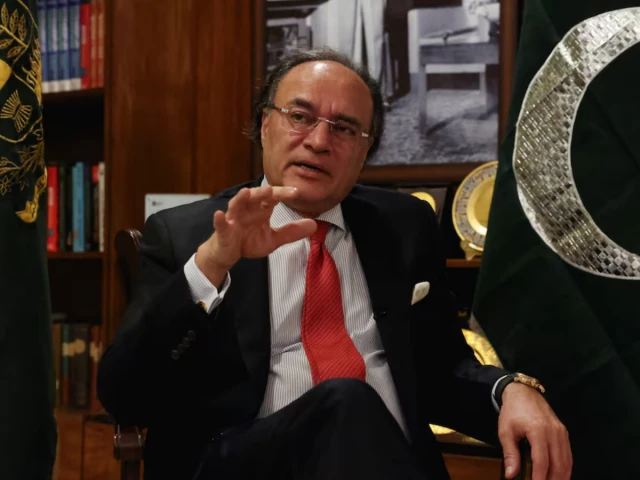
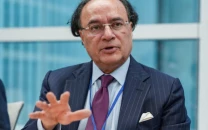
Federal Minister for Finance Muhammad Aurangzeb has said Pakistan has the investment framework and financing available and the world should provide the capacity needed to complete projects. Pakistan is ready for investment and has met its basic requirements by controlling its deficit, increasing foreign exchange reserves, securing an improved credit rating and issuing Panda and Eurobonds.
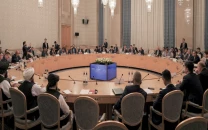
He made these remarks on Tuesday while addressing the "Investing in Pakistan's Sustainable Future Fair and Conference", organised by the UNDP and federal and provincial governments. The finance minister said the State Bank had provided a draft of the Green Taxonomy Framework. As part of the Climate Prosperity Plan, the Pakistan Stock Exchange was working on an ESG Index alongside a 14-day programme, which would help bring the performance and information of listed companies to the forefront.
He said Pakistan was using its own resources for funding in addition to support from the World Bank, Asian Development Bank and other financial institutions. He said investors in London and New York believed that Pakistan was moving in the right direction. "We need to work on promoting domestic investment because an increase in domestic investment will pave the way for greater foreign investment."
He said economic stability was fundamental to promoting investment, while the private sector could play an important role in economic growth and investment. Public-private partnerships were an effective means of promoting investment and cooperation between the government and private sector was essential for development projects.
The finance minister said four factors were important for economic growth, including the policy framework, financing capacity and bankable projects. Therefore, Pakistan needed to focus on improving its capacity.
Aurangzeb said population growth and climate change were matters of survival for Pakistan, which would have a population of 400 million people by 2045. He mentioned that the country remained focused on day-to-day issues, but it now needed to pay attention to the critical survival challenge as well. The World Bank and IMF were also supporting Pakistan, while the country required further assistance to build capacity. "The discussion has now moved beyond 'what and why' to 'how and who'." The finance minister said Pakistani business groups had started working together by forming consortia. Eleven IPOs were held during the last fiscal year, the highest in 20 years, while five IPOs had taken place at the Pakistan Stock Exchange during the past three months.
He said the government had a key role to play in promoting investment. The government was focusing on fiscal discipline and economic stability, while increasing exports alongside economic growth remained a priority. "Pakistan needs economic growth that is responsible and sustainable," he remarked, adding that economic policy would have to move forward while keeping global economic conditions in view.
Addressing the conference, Senator Sherry Rehman said population growth was the biggest threat to sustainability. She said 36 million children in the country were out of school and a lack of financing and capacity was hindering efforts to resolve those problems, but the private sector could help bridge that gap. She said climate-related concerns were increasing, while changing conditions made it difficult to develop bankable projects. Population growth and migration towards cities were major challenges, she said. A large number of people moving to cities did not have adequate representation.
Water supply and waste disposal would be among the major challenges in the coming years, she added. Local institutions would have to be strengthened to address urban problems, but there was a shortage of financial resources and institutional capacity to deal with these challenges.
Available resources were insufficient compared with the rapidly growing urban population. She said sustainable urban development required proper planning and adequate resources. Sherry Rehman emphasised that cooperation between the public and private sectors was proving to be a successful model, particularly through public-private partnerships (PPPs), under which the two sectors could combine their resources and regulatory frameworks.
She said developing bankable projects was not easy amid changing circumstances and a fragmented port landscape. She stressed that effective partnerships between the public and private sectors could play an important role in making development projects bankable.










This material may not be published, broadcast, rewritten, redistributed or derived from. Unless otherwise stated, all content is copyrighted © 2026 The Express Tribune.



COMMENTS
Comments are moderated and generally will be posted if they are on-topic and not abusive.
For more information, please see our Comments FAQ