Lula wins historic fourth term as Brazilian president
Updated 6 minutes ago

Yemeni troops retake key coastal positions, advance towards Mocha; rebels make gains around Taiz

Saudi-backed Yemeni government forces launched a major counteroffensive on Monday, driving the rebel Houthi fighters from key positions around the Bab el-Mandeb Strait and advancing towards Mocha, while the rebels tightened their grip around the strategic city of Taiz.
Government forces reached the outskirts of Mocha late on Monday, with four government sources saying Houthi fighters were retreating towards the highlands. Yemen's Defence Ministry said the city had fallen, although Reuters could not independently verify the extent of the government gains.
The forces had already seized key positions, including an airstrip in Dhubab district at the mouth of the strait, a vital oil route whose seizure by the Houthis last month sent shockwaves through energy markets. The Houthis rejected the government's claims as baseless.
The government said it had launched attacks on several fronts, while Yemen's military spokesman said government forces carried out more than 1,000 strikes against Houthi artillery and rocket-launcher positions, defensive fortifications, supply lines and logistics assets.
Despite the offensive, the Houthis continued to make gains around Taiz, according to government military sources. The group captured sections of a mountain road, leaving government forces in the city increasingly isolated, although one government source denied that the road had been cut.
The Houthis also warned that Saudi airspace was unsafe for civilian flights and would become a theatre of operations for their forces, according to the group's Saba news agency. Saudi Arabia said it had attacked hundreds of targets to provide air cover for government forces around Bab el-Mandeb.
The fighting has placed another major energy route at risk after Iran's closure of the Strait of Hormuz restricted Gulf energy exports. Control of Bab el-Mandeb could allow the Houthis to disrupt shipping between the Mediterranean and Indian Ocean.
Riyadh is backing the campaign as part of efforts to restore free traffic in the Red Sea and end Houthi attacks on its territory. The Houthis could still attack vessels with drones from positions farther up the coast and inland even if government forces regain the coastal area around the strait, according to the Reuters.
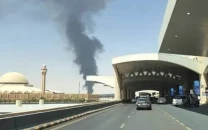
The strategic stakes were underscored by a fresh attack on Saudi Arabia's East-West oil pipeline. An energy-sector source told AFP that pumping was halted after a station east of Riyadh in Khurais was damaged in an attack.
The Houthis had claimed the previous day that they targeted sites belonging to Saudi oil giant Aramco, including infrastructure in Khurais. The East-West pipeline runs about 1,200 kilometres between Saudi oilfields in the east and the Yanbu terminal on the Red Sea.
Meanwhile, the renewed fighting has deepened Yemen's humanitarian crisis. The UN migration agency said on Monday that 184,000 people had been displaced since the war resumed, while AFP cited UN figures putting the number at more than 145,000.
Taiz, Yemen's third-largest city, has remained a major frontline since the civil war began. Government forces still control the city, but Houthi fighters have long besieged it from the north, east and west, according to AFP.
The conflict resumed after a 2022 ceasefire held for several years. The Houthis seized Sanaa in 2014 and subsequently took control of much of northern Yemen, prompting a Saudi-led coalition to intervene the following year in support of the internationally recognised government.















This material may not be published, broadcast, rewritten, redistributed or derived from. Unless otherwise stated, all content is copyrighted © 2026 The Express Tribune.






COMMENTS
Comments are moderated and generally will be posted if they are on-topic and not abusive.
For more information, please see our Comments FAQ