Mawra Hocane and Ameer Gilani welcome baby boy
Updated 3 hours ago

Artists fear shrinking work as artificial intelligence takes on instruments, production and mastering
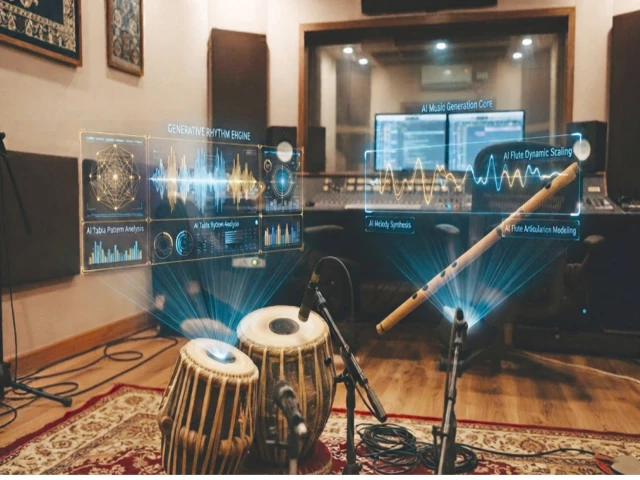
Artificial intelligence has quietly redrawn the boundaries of creativity, entering fields once considered the preserve of human talent and imagination. From writing and photography to graphic design, video production and music, tasks requiring years of skill can now be completed within minutes.
For Pakistan's musicians, however, the transformation is more than a technological shift. Work that once required live instrumentalists, studio time and teams of professionals is increasingly being done through AI, often at a fraction of the cost, threatening livelihoods built over years.
Renowned flutist Salman Adil says AI has already produced 'Pasoori' in the voice of Nusrat Fateh Ali Khan, despite the legendary singer never having performed the song. Musicians once believed instruments such as the tabla, flute and sitar would be difficult for AI to reproduce, but that assumption has changed.
Instead of physically playing an instrument, Salman explains, AI learns from existing music and uses those elements to create something new. For musicians whose income depends entirely on recording work, that development is increasingly becoming a source of concern.
Salman recalls a regular client who used to pay him Rs5,000 to Rs10,000 for each flute track but eventually stopped hiring him. When he asked why, the client said they had shifted to AI, where a subscription costing around Rs5,000 provided music, including flute parts, for several songs.
Renowned tabla artist Qamar Babar describes a similar experience. "We are people who play live music and live instruments, but because of AI our opportunities have become very limited," he says, recalling a time when musicians were regularly called for recording sessions.
"Where a live musician was needed before, people now try to get the work done through AI," Babar says. He believes the entire recording chain has been affected, even though he acknowledges that artificial intelligence has made many musical tasks easier.
For live musicians, he says, the change has been deeply damaging. "We are genuinely worried about where things will go and how much work will remain for people like us. Right now it is difficult to understand how our work will move forward with AI."
Music producer and composer Jibran Rafiq explains why AI has gained such rapid acceptance. Most singers in Pakistan do not have large production budgets, he says, making a cheaper and faster alternative particularly attractive.
Previously, producing a song meant hiring musicians, booking a studio and paying a producer and other professionals. In Saraiki music, for instance, a basic production costs around Rs25,000 to Rs30,000, although Jibran says its distinct style has not yet been fully replicated by AI.
For musicians, the decline in recording opportunities is already apparent. "Some musicians used to record two to four songs in a day. Now that has come down to two, three or four songs a week," Jibran says, adding that the reduction directly affects their income.
Studios, too, are feeling the impact as people who once paid separately for mixing and proper mastering increasingly turn to AI-based mastering. Jibran says many singers do not fully know what good mastering sounds like and therefore accept whatever AI produces.
He warns that the immediate savings could eventually affect artists' creative skills, musicians' livelihoods and the wider music market. Yet he and Salman both see signs that listeners may eventually seek human musicians again as the novelty of AI-generated music begins to fade.
Jibran says much of the AI-produced music began to sound alike, causing people to become bored. Platforms are also responding to AI-generated content in different ways. "This was a trend that came very fast, but now its graph is coming down," he says.
Salman believes AI cannot reproduce the experience of live music, where people sit together and develop a deep and soulful connection with what is being performed. He recently heard an AI-generated qawwali that he found highly artificial and far removed from the original.
In another case, a client who had used AI for a flute part eventually sent it to Salman and asked him to replay it with a human feel. Matching the machine's precision was difficult, he says, but the client preferred the human performance.
The shift has created another burden for musicians: proving that their work is genuinely theirs. Music director Akash Sonu visited Salman's studio to film a flute recording so he could show his own client that the part had been performed by a human rather than generated by AI.
Salman believes artists may increasingly have to prove that their work is authentic. For musicians who depend entirely on recording opportunities, the question is no longer simply whether AI can make music, but whether the market will continue to value the human skill behind it.
He sums up the dilemma in a single line: "AI is killing skill, but there is no substitute for the human vibe." Until that human quality is valued again in the market, musicians whose livelihoods depend on recording work remain uncertain about what comes next.






This material may not be published, broadcast, rewritten, redistributed or derived from. Unless otherwise stated, all content is copyrighted © 2026 The Express Tribune.

COMMENTS
Comments are moderated and generally will be posted if they are on-topic and not abusive.
For more information, please see our Comments FAQ