Foreign experts to find K2 Airways' black box
Updated 1 hour ago

Heavy showers flood roads; strong winds topple rooftop tanks, collapse house walls
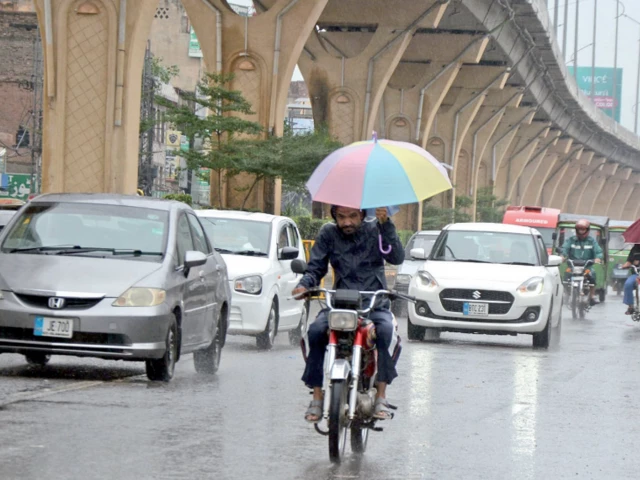
The first heavy rain of the winter season accompanied by a strong storm lashed the twin cities of Rawalpindi and Islamabad on Monday, causing heavy water tanks installed on rooftops to fall into streets and walls of two houses to collapse.
Torrential rain turned streets and roads in all low-lying areas into ponds, with water standing up to one foot along roads and streets.
Due to disruption in movement, attendance of students in schools and colleges remained considerably low on Monday, while accused persons could also not reach courts on time.
The drainage system, which had been completely paralysed and damaged during the monsoon, has resulted in heavy rain now causing damage not only in low-lying areas but also in posh localities.
Water accumulated along all roads in Rawalpindi Saddar, while up to one foot of water also collected along Saidpur Road, Rawal Road, Iqbal Road, Raja Bazaar, Saddar Road, Girja Road, Dhok Syedan Road and Pindora Road.
In all low-lying areas, floodwater begins receding on its own after four to five hours.
A strong storm began around Sehri time in the morning, blowing away a heavy water tank installed on the roof of a house in Dhok Khabba. The tank fell from the roof and remained hanging over the street from water pipes for five hours, obstructing vehicles and pedestrians.
Another water tank fell from a rooftop into a street in Millat Colony, Mukha Singh Estate. Walls of two houses along the rainwater drain in Fazalabad and Javed Colony collapsed into the drain.
Rain continued for several hours, while water accumulating at different places also accelerated soil erosion along the banks of Nullah Leh.
Although the construction of concrete embankments to prevent soil erosion along Nullah Leh had been announced, work has yet to begin, causing erosion to increase and potentially leading to serious damage at any time.
As rain continued until 9am, a large number of children could not go to school. The first winter rain also brought a chill to the weather and completely broke the heat, with air conditioners switched off and fans running at slower speeds.
The pre-monsoon heavy rain and the first winter rainfall caused widespread waterlogging, while the three dams supplying water to the twin cities - Rawal, Simly and Khanpur - were again filled to capacity, prompting a decision to open their spillways.
PML-N city central leader Sheikh Asad Zahoor demanded an inquiry into flooding in the city despite the government spending billions of rupees on drainage.
Citizen Action Committee Chairman Malik Zaheer Awan called for financial assistance to compensate citizens for losses suffered during flooding in the monsoon season.
box
Cool weather fuels dengue risk
RAWALPINDI. Heavy monsoon downpours measuring 20 to 33 millimetres hit the twin cities on Monday morning, prompting WASA Rawalpindi to deploy dewatering machinery across low-lying areas. The autumn temperature decline has also created ideal transmission conditions for dengue and seasonal viral infections.
Warning against heightened dengue threats, Rawalpindi District Health Officer (DHO), Dr Jawad Zahid, said standing rainwater, combined with daytime temperatures dropping into the favourable 22°C30°C range, significantly accelerates mosquito larvae development.
Dr Jawad confirmed that dengue cases in Rawalpindi have reached 27, with over 191,468 larval breeding sites detected and destroyed across the district this season. Further, the authorities have initiated stern legal actions, including registering over 2,717 FIRs and sealing 678 premises against anti-dengue SOP violations.
The DHO urged residents to eliminate stagnant water immediately from rooftops, flowerpots, and water storage containers.
According to a National Disaster Management Authority (NDMA) flood bulletin, major rivers remain at normal flow levels, with Nullah Leh recording safe water levels of 5 feet at Katarian and 2 feet at Gawalmandi. However, the NDMA issued an urban flooding alert valid through September 30 for Rawalpindi, Islamabad, and Murree, warning of flash floods in seasonal Potohar streams as the Pakistan Meteorological Department (PMD) forecasts continued isolated heavy rainfall, which in turn maintains a favourable environment for dengue breeding and other diseases.
Addressing the concurrent rise in seasonal illnesses as northern winds signal the gradual transition from summer heat to cooler autumn weather, public health expert Dr Adnan Khan cautioned that sudden temperature fluctuations weaken immunity, triggering influenza, typhoid and acute viral fevers.
He advised consuming boiled or filtered drinking water, avoiding uncovered street food, wearing long-sleeved clothing during peak mosquito activity at dawn and dusk, and seeking immediate medical evaluation at designated hospital fever clinics upon experiencing persistent high fever, body aches, or flu symptoms. APP















This material may not be published, broadcast, rewritten, redistributed or derived from. Unless otherwise stated, all content is copyrighted © 2026 The Express Tribune.






1727268465-0/Untitled-design-(42)1727268465-0-208x130.webp "sisyphus in the land of saviours")
COMMENTS
Comments are moderated and generally will be posted if they are on-topic and not abusive.
For more information, please see our Comments FAQ