Power supply chains face a new test
Updated 7 hours ago

18 funds worth Rs2tr take shape as Pakistan seeks to formalise property market
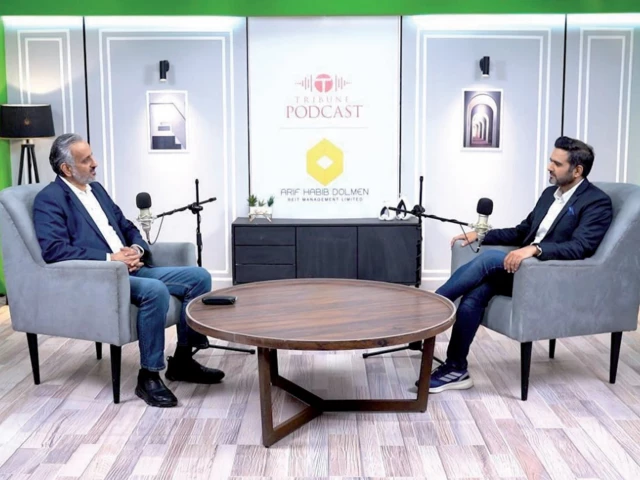
Pakistan's real estate investment trust (REIT) sector is gaining traction, with 18 funds established and projects worth more than Rs2 trillion under development, according to Arif Habib Dolmen REIT Management Company CEO Muhammad Ijaz.
Speaking on a Tribune podcast, Ijaz said REITs could help formalise Pakistan's largely informal real estate sector while allowing investors with relatively modest capital to participate in property-related businesses.
He said the REIT framework addressed two major challenges associated with real estate investment – the need for substantial capital and the illiquidity of property assets.
Under the model, real estate assets are divided into units that can be purchased by investors, making participation possible for both small and large investors.
Ijaz said Dolmen City REIT, Pakistan's first REIT, had an asset value of around Rs22 billion when it was launched, with 2.2 billion units issued at Rs10 each. "Those who want to invest Rs5,000 can do so, and those who want to invest Rs5 billion can also do so," he said.
Explaining the regulatory framework, he said the title of REIT assets remained with the trustee, while investors held REIT units that effectively represented their ownership interest. Trustees are licensed entities, including the Central Depository Company (CDC) and Digital Custodian Company, while REIT management companies are responsible for managing the underlying business.
Ijaz said five REITs were currently listed on the Pakistan Stock Exchange, with additional listings expected soon. Rental REITs are required to be listed within their first year, while developmental and hybrid REITs are required to be listed within three years, he said.
He distinguished between rental and developmental REITs, saying rental REITs generally acquire built-up properties and generate income by leasing them, while developmental REITs develop land or projects for sale or lease.
According to Ijaz, REITs are required to distribute 90% of distributable income to unit holders. He said Dolmen City REIT had initially offered a yield of around 10%, while its yield for investors who bought units at around Rs11 had subsequently risen substantially as the unit price increased.
He also highlighted the emergence of property-share schemes aimed at people who could not afford to purchase an entire apartment.
Under the model, investors can purchase a fractional share of a property. For example, a 1,800-square-foot apartment valued at Rs30 million could be divided into 100-square-foot shares worth Rs1.8 million each.
Ijaz said investors could accumulate additional shares over time and potentially sell them later. The model is being developed initially in Naya Nazimabad, with the ownership and rental arrangements managed through institutional and contractual structures.
He said the REIT sector was no longer confined to Karachi. Of the 18 REIT funds, 10 were in Karachi while eight were in Lahore and Islamabad. Projects include developments associated with Naya Nazimabad, Surjani Town, Lahore's Central Business District, Ravi Urban Development Authority and Rifah Medical City.
Ijaz said a 150-acre project in Surjani Town had been divided into two REIT funds, focusing on horizontal and vertical development, with emphasis on environmentally friendly urban development.
He argued that construction and real estate development could play a significant role in Pakistan's economic growth because the sector relied heavily on local labour and locally available raw materials.
However, he cautioned against speculative trading in property files, saying the sector needed greater professionalism, institutional participation and regulatory clarity.
Ijaz also called for greater availability of mortgage finance and institutional funding for professionally managed housing projects. He said "build-to-rent" could emerge as an important business model, allowing people to access professionally managed rental housing rather than bearing the financial and administrative burden of constructing their own homes.
He said Pakistan's real estate sector had significant potential if supported by better taxation policies, institutional investment and professional project management.
"Construction and real estate development should be kept in priority," Ijaz said, stressing that the sector could generate employment and stimulate economic activity across multiple industries.






This material may not be published, broadcast, rewritten, redistributed or derived from. Unless otherwise stated, all content is copyrighted © 2026 The Express Tribune.



1727268465-0/Untitled-design-(42)1727268465-0-208x130.webp "the reverse renaissance")

COMMENTS (1)
Comments are moderated and generally will be posted if they are on-topic and not abusive.
For more information, please see our Comments FAQ