47 Palestinian families face forced displacement amid Israeli blockade
Updated 1 hour ago

Rubio says Trump remains open to Iran deal but will not allow Tehran to have nuclear weapons
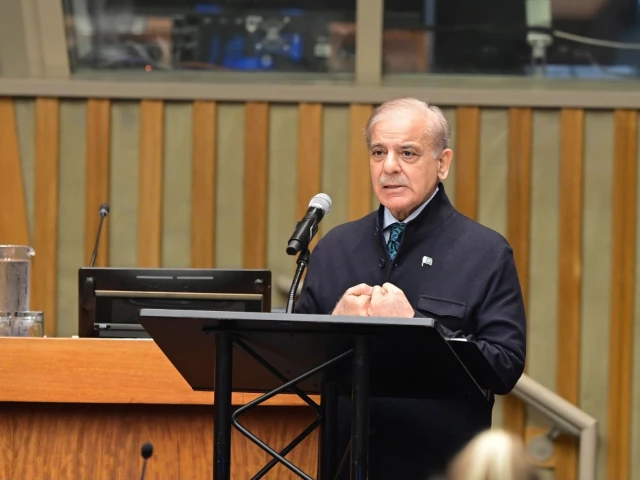
Prime Minister Shehbaz Sharif said on Wednesday that Pakistan remained fully committed to facilitating dialogue between Iran and the United States, describing Islamabad as a “sincere and honest mediator” in efforts to de-escalate the Middle East conflict.
Speaking to reporters at the United Nations headquarters, the prime minister said Pakistan was “completely focused” on helping bring an end to the hostilities and remained determined to advance diplomatic efforts despite an unpredictable turn in events following the signing of the Islamabad Memorandum of Understanding.
“Pakistan is playing the role of a sincere and honest mediator between Iran, our neighbourly country, and the United States,” PM Shehbaz said, referring to the MoU he signed alongside Iranian President Masoud Pezeshkian and US President Donald Trump.
“Unfortunately, events after that got a bit unpredictable, but Pakistan is completely focused. We have not lost hope; we [are] absolutely determined that we will further make efforts and make progress to de-escalate the situation,” he added.
Pakistan has continued to advocate dialogue and diplomacy as the means of resolving the Iran-US standoff, with Islamabad describing the MoU as a framework for regional de-escalation.
Pakistan’s Prime Minister Shehbaz Sharif said at UN headquarters on Wednesday, September 23, that Islamabad is playing the role of a “sincere and honest mediator” between Iran and the United States. Referring to the Islamabad Memorandum of Understanding signed by Sharif, US… pic.twitter.com/lhCv7QHare
— Iran International English (@IranIntl_En) September 23, 2026
US president open to making a deal with Iran: Rubio
US Secretary of State Marco Rubio said that President Donald Trump was still open to making a deal with Iran to end the war while emphasising that the US would not allow Iran to have a nuclear weapon.
“The core issue here is that Iran can never have a nuclear weapon. The president is open, still to this moment, to making a deal with Iran that allows Iran to be what it should be, which is a great and prosperous country,” he said, speaking to reporters in New York on sidelines of the UN General Assembly meeting.
SECRETARY RUBIO: Iran can never have a nuclear weapon. pic.twitter.com/COHoSPBivz
— Department of State (@StateDept) September 23, 2026
A senior Iranian official told Reuters that Tehran was reviewing the US response to its proposal to end hostilities, but significant differences remained between the positions of the two sides as diplomatic efforts continued.
The official said the indirect talks with the United States on Tuesday had also discussed reopening the Strait of Hormuz and lifting the US naval blockade on Iran.
Pezeshkian says Iran will not surrender in war with US, but believes in diplomacy
Iranian President Masoud Pezeshkian earlier told the annual gathering of world leaders at the United Nations that Iran would not surrender in the war with the United States, but believed in diplomacy to try to end the conflict.
Pezeshkian said that the Iranian people had been the “victims of terrorism”, rejecting US President Donald Trump’s description of Iran as “terrorists”.
Addressing the UN General Assembly, Pezeshkian displayed images of victims of an American strike on a school in Minab at the start of the war, along with images of a sports hall in Lamerd destroyed by US bombardment.
“The United States, by using weapons with multiple warheads, targeted that sports hall. They martyred and assassinated our scientists, our men, women and children. Innocent children who in truth had committed no crimes, no sins,” he said.
Pezeshkian stressed that while Iran had responded to strikes by the United States and Israel, it had not targeted civilian areas.
The United States delegation walked out at the start of Pezeshkian's speech. The US mission to the United Nations did not immediately respond to a request for comment.
🔴 LIVE: Iran's President Masoud Pezeshkian delivers a speech at the UNGA on the second day of the annual general debate in New York. https://t.co/wo8MrOIloL
— Al Jazeera English (@AJEnglish) September 23, 2026
“Yes, they did hit us, but we did not bend the knee. We did not bow our head,” he said. “We responded, but we did not hit civilian populations.
“They came into surrounding territories and targeted our universities, our healthcare centres, our schools, our hospitals, our infrastructure; all of it against international law,” Pezeshkian added.
He also said that Hamas chief Ismail Haniyeh had been assassinated in Tehran by Israel on the day of his inauguration as president.
“Israel targets any neighbourhood in any city in any province, commits assassinations like a true terrorist,” he emphasised.
“Those who are terrorists, and train and protect terrorists, describe us as such,” he added. “We have only defended ourselves; we are not terrorists.”
In the first part of his speech, the Iranian leader held up an image of the Islamic Republic's late supreme leader Ali Khamenei, who was killed in an airstrike on his compound in Tehran on the first day of the US-Israeli assault on Iran.
He also held up images of children killed in a strike on a school.
A UN fact-finding mission on Iran said earlier this month that it had reasonable grounds to believe that the US was behind two military strikes on a school and a sports facility in Iran, and that these constituted war crimes.
Pezeshkian addressed the 193-member General Assembly a day after US President Donald Trump spoke. Trump used his speech on Tuesday to make the case for his war on Iran, arguing he has prevented Tehran from obtaining a nuclear weapon and warning that he could "annihilate the Islamic Republic" if no deal is reached to end the conflict.
Hormuz cannot be used for passage of weapons used against Iran: Pezeshkian
Pezeshkian said Iran wants to have "strong neighbours" near the Strait of Hormuz, but cannot allow those who seek to impose "insecurity" on Iranians to have access to it.
"We cannot let some have free access and gain their interest from a waterway, while at the same time using that waterway to impose their aggressions upon us, to impose insecurity upon us, to forbid us access to our own waterways," he stated.
Iranian President Masoud Pezeshkian:
— Clash Report (@clashreport) September 23, 2026
Iran does not see her neighbors as security rivals — we want to have strong neighbors.
In the waters of the Strait of Hormuz, we do not want to impose insecurity. We cannot let some have free access and gain their interest from a waterway,… pic.twitter.com/q9YcnRREJw
Iran has had its grip on the Strait of Hormuz, which was a conduit for a fifth of global oil and liquefied natural gas before the war.
The strait lies between Oman and Iran, linking the Gulf north of it with the Gulf of Oman to the south and the Arabian Sea beyond.
Iran has said it could reopen the Strait of Hormuz within days if the US eased military pressure and lifted its blockade on Iranian ports.
"It cannot be the case that everyone benefits from the Strait of Hormuz while we are denied access to shipping through this waterway. The permanent deployment of hostile fleets and the expansion of the war will not lead to peace," Pezeshkian said
Iran needs nuclear energy, not a nuclear bomb, Pezeshkian says
Pezeshkian said Iran needs peaceful nuclear energy, not a nuclear bomb.
"For our country, peaceful nuclear technology is part of our inherent progress," he said, adding, "Iran does not accept nuclear technology to be at the exclusive disposal of some, of a handful."
Iranian President Masoud Pezeshkian:
— Clash Report (@clashreport) September 23, 2026
We will not bow our head and give up the right that is inherently ours.
We say it clearly: no nuclear weapons, and no limitations to peaceful nuclear technology. pic.twitter.com/YsMSrKNuw0
"We say it clearly, no nuclear weapons and no limitations to peaceful nuclear technology," he said.
Iran threatens to paralyse airports in neighbouring countries if they stop Iranian flights
Secretary of Iran's Supreme National Security Council, Major General Mohsen Rezaei, said in an interview with state TV on Wednesday that if neighbouring countries cooperated with the United States by stopping Iranian flights, Iran would ensure their airports could not function.
Major General Rezaei: Neighboring states should avoid being drawn into US games and reckless moves when it comes to Iranian aircraft flights.
— IRNA News Agency ☫ (@IrnaEnglish) September 23, 2026
Should that happen, we will likewise halt the flights of aircraft belonging to neighboring countries that side with US.
Hope for progress after US, Iran hold first shuttle talks in months
The first shuttle talks between the United States and Iran in months raised hopes on Wednesday that the adversaries could make some progress towards ending the Middle East war, although neither side spelt out any change in their positions.
Iran's Foreign Minister Abbas Araghchi and US envoys Steve Witkoff and Jared Kushner communicated through mediators on the sidelines of the UN General Assembly in New York, the first such contacts since an interim ceasefire agreement collapsed in July.
"Steve and Jared had a very productive meeting today with mediators of Iran, merely mediators. Let's see what happens with that," US President Donald Trump said. "They've been mediated for a while, but I think there's a lot of momentum for them to make a deal. It's what we're hearing from everybody."
Earlier, Trump had told the UN General Assembly in a speech that he had to decide whether to make a deal with Iran or "annihilate" the country. Iran's President Masoud Pezeshkian was due to address the gathering on Wednesday.
Iran's Foreign Ministry spokesperson Esmaiel Baghaei said Tehran had engaged with the United States through a Qatari mediator in New York and conveyed conditions, including an end to the war on all fronts and a halt to US "acts of aggression".
Some Iranian state media had earlier reported that Araghchi and Witkoff had met, but Iranian officials clarified to Reuters that this was not face-to-face. Araghchi met the prime minister of Qatar, Sheikh Mohammed bin Abdulrahman Al Thani, who has been one of the main mediators at previous talks.
Oil prices hold at two-week low
The diplomatic opening helped keep oil prices near two-week lows, with Brent crude now holding just below the $100-a-barrel threshold it had shot through this month, after Houthi fighters in Yemen launched a major offensive and fired into Saudi Arabia.
The war, launched by Trump in February alongside Israel as "Operation Epic Fury", has lasted nearly seven months, killing thousands of people, disrupting global energy supplies and spreading to other countries in the region — first to Lebanon and more recently to Yemen.
Trump repeated previous assertions that the war could end around the time of November's US midterm elections, though he has not explained why.
Since diplomacy broke off in July, the sides have repeatedly exchanged fire, although Trump has held back from a full-blown resumption of strikes after receiving advice from his military commanders that munitions were running low.
An interim agreement reached in June and signed by Trump and Pezeshkian would have given Iran its main demands: lifting financial sanctions and unfreezing assets in return for talks on limiting its nuclear programme.
But that deal unravelled within weeks over shipping rules in the Strait of Hormuz, a conduit for a fifth of global oil and liquefied natural gas before the war. Iran wants to exert greater control of the strait and collect fees from ships that use it, which Washington rejects.
Despite near-daily attacks on tankers, traffic through the strait has gradually increased in recent weeks. Oil producers have paid shipping companies fees worth as much as a quarter of a cargo's value to switch off transponders, navigate the route and transfer crude to other vessels beyond the strait.
Exports from the United Arab Emirates have already recovered to pre-war levels, and Saudi Arabia has sold 60 million barrels of Gulf oil for both this month and next, to be delivered beyond the strait off the coast of Oman, a big increase from August.
Even so, disruption continues to squeeze global energy markets. About a third of Gulf oil is estimated to be missing from global supplies. Shortages have particularly hit refined products such as diesel, causing inflation, pushing up interest rates and hurting Trump's Republicans ahead of the elections.
The risk of further disruption has increased since the Iran-backed Houthis advanced in Yemen this month, threatening traffic through the Bab el-Mandeb Strait at the southern entrance to the Red Sea, an alternative export route used by Saudi Arabia.
Washington, for its part, has imposed a blockade on Iranian ports, deepening Iran's economic crisis. Iranian officials say they are willing to endure the blockade to achieve their goals, and will not reopen the Strait of Hormuz until it is lifted.
Iran airlines cancel flights as US sanctions hit
Iranian airlines were forced to cancel some international flights after the US tightened sanctions on Iran’s aviation industry in a new effort to cripple its economy.
Flights to Baghdad, Muscat, Qatar, Georgia and Azerbaijan were suspended, but routes to multiple other destinations remained available, including China, AFP reported, citing a travel agent in Tehran.
Some flights to Istanbul were also scheduled, though others had been cancelled, the travel agent said, adding: “The situation is unstable and we are no longer selling tickets for the time being for fear of cancellation.”
Yemen's Houthis to target US interests if it supports Saudi-led strikes: report
A Houthi military adviser told AFP that the group would attack US interests in the Middle East if Washington intervenes in Yemen’s conflict in support of Saudi Arabia or tries to unblock the Bab al-Mandeb strait.
“If America dares to intervene militarily with its fleets or tries to take control of Bab al-Mandeb, it is a red line for them and anyone else… we will fight over it,” military adviser Abed Mohammed al-Thawr said.
Europe cannot claim support for rule of law while supporting US-Israeli aggression against Iran: Araghchi
Iranian Foreign Minister Abbas Araghchi said European countries cannot claim to support the rule of law and human rights while remaining indifferent to, or supporting, the US-Israeli military aggression against Iran, according to Iranian media outlet IRNA.
Araghchi made the remarks during a meeting with Dutch Foreign Minister Tom Berendsen on Tuesday on the sidelines of the 81st session of the United Nations General Assembly (UNGA) in New York.
The two foreign ministers discussed bilateral relations as well as regional and international developments.
Araghchi criticised European countries’ double standards toward regional developments, particularly their silence regarding hostile US and Israeli actions against Iran.
Europe cannot claim support for law while backing US-Israeli aggression: @araghchi https://t.co/4P2jwZZ8ku pic.twitter.com/smjMk4EWWK
— IRNA News Agency ☫ (@IrnaEnglish) September 23, 2026
He also said repeated US treaty violations and its pursuit of war were the main causes of insecurity in the Persian Gulf and Strait of Hormuz.
Araghchi said that restoring peace and stability in the region requires an end to US illegal and aggressive actions and respect for Iran’s national rights and interests.
Berendsen, for his part, stressed the importance of diplomacy and outlined the Netherlands’ views on current regional developments and interactions between Iran and Europe.
Iran calls Trump ‘annihilation’ threat a sign of ‘strategic desperation’
Iran’s military dismissed Trump’s threats against the country that he made in his address to the UN General Assembly, warning that it is ready to respond to further attacks, Al Jazeera reported on Wednesday.
BREAKING: Iran calls Trump 'annihilation' threat a sign of ‘strategic desperation’
— Al Jazeera Breaking News (@AJENews) September 23, 2026
🔴 LIVE updates: https://t.co/P3eetlPDMu pic.twitter.com/J6IRLEMWOj
In a statement carried by the Mehr News Agency, Iran’s General Staff has accused the US president of using the UN podium to justify “aggression”.
“Such words demonstrate America’s strategic dead end in its aggression against the Iranian nation,” it says. It has described Trump’s repeated threats as “not a sign of power but a sign of their strategic desperation”.
The military’s statement, according to Mehr, also warns that Iran’s armed forces are ready to deliver strikes against the US and Israel that would be more severe, more crushing and less predictable than earlier in their war.
US senator rebukes Trump's threat to 'annihilate' Iran at UN
US Senator Bernie Sanders, responding to a clip of President Donald Trump’s speech at the United Nations regarding Iran, urged Congress to end “Trump’s war in Iran”.
Sanders said Trump’s threat to “annihilate” Iran is a “war crime”.
“That is barbarism. And it is something the United States must never be associated with.”
Sanders said in his post that "Trump’s war in Iran is illegal and unconstitutional. Congress must end it NOW.”
Macron says France ready to be more engaged to make Strait of Hormuz transit possible
French President Emmanuel Macron told US media that he does not “want to engage in a confrontation with any country, but we are ready to be more engaged to protect some capacities to make this transit possible”, regarding the Strait of Hormuz, Al Jazeera reported on Wednesday.
In an interview with ABC News, Macron has said that the “main objective” of his meeting with US President Donald Trump was “to find the right deal to open” the vital waterway and address the escalating global energy crisis.
He has criticised the US decision to go to war in the first place, saying that “regime change by bombing a country is not something I think feasible”. He has added that “it doesn’t work. And we did this mistake several times in the past decades”.
Regarding the decision not to assist the US earlier, Macron notes that “when you want to engage people, you strategise with them, and you ask them before launching a war, and we decided not to join this war because we considered, and I still consider, it was not the right option”.
FM Araghchi criticises France’s ‘interventionist’ stance toward Iran
Araghchi has criticised France’s interventionist positions toward Iran in a meeting with French Foreign Minister Jean-Noel Barrot on Tuesday afternoon on the sidelines of the 81st UNGA session, stressing the need for the French embassy to respect the Islamic Republic’s laws and regulations, according to IRNA.
The two officials discussed Iran-France diplomatic relations as well as regional and international developments.
Araghchi emphasised that the French embassy must comply with Iranian laws and regulations.
He called France’s stance on regional developments, particularly its position regarding the US and Israeli military aggression against Iran, unacceptable.
Referring to France’s double standards on human rights, Araghchi said Paris could not claim concern for human rights while remaining silent over crimes against humanity by the United States and the Israeli regime against the Iranian people, including the killing of Iranian women and children.
He also criticised France for cooperating in the implementation of illegal US sanctions against the Iranian people.
Araghchi stressed that Iran seeks relations based on mutual respect and interests with all countries, including France, but will act firmly and decisively to defend its interests and national interests.
Iran says it conveyed conditions for end to war to US through Qatari mediator, IRNA reports
Baghaei said the communication took place through a Qatari mediator, adding that “the aim of this interaction was to convey Iran’s conditions, including ending the war in all areas, stopping US aggressive actions and the naval blockade and economic war, and releasing Iranian assets.”
Baghaei said Iran's conditions also included an end to the naval blockade and economic warfare, and the release of Iranian assets, IRNA reported.
US Special Envoy Steve Witkoff said on X that the US side “engaged in lengthy talks with the Iranian delegation through the mediators, who shuttled between the two sides throughout the day,” on the sidelines of the United Nations General Assembly.
Today, on the sidelines of the United Nations General Assembly, we engaged in lengthy talks with the Iranian delegation through the mediators, who shuttled between the two sides throughout the day. They successfully completed a round of discussions that we hope will prove…
— Special Envoy Steve Witkoff (@SEPeaceMissions) September 22, 2026
“They successfully completed a round of discussions that we hope will prove constructive and promising. The mediators will continue their work,” Witkoff added in his post.
Iran says 50% of damaged South Pars gas field production capacity restored, Fars news reports
Iran has restored about 50% of damaged production capacity at the South Pars gas field, Deputy Oil Minister Ahmad Zeraatkar was reported as saying on Wednesday by the semi-official Fars news agency, adding that all planned restoration work would be completed before winter.
Zeraatkar said in late August that about 40% of the damaged capacity had been returned to production.
Shipping traffic via Strait of Hormuz stays below 10-day average, data shows
Three commodity vessels transited the Strait of Hormuz on Tuesday, down from four a day earlier and below the 10-day moving average of about 15, preliminary shipping data showed on Wednesday.
Read: Trump says US, Iran held ‘very good’ meeting, another scheduled soon
The figures may change as some ships typically switch off their transponders during the voyage.
All three vessels, including one Panamax tanker, were exiting the strait, the data from ship tracker Kpler showed at 0700 PKT.
One ballast liquefied natural gas tanker, Al Mafyar, however, reappeared inside the strait on Tuesday, after being last seen outside of the waterway on September 19, according to both Kpler and LSEG data.
The Strait of Hormuz carried a fifth of the world's oil and gas before the US-Iran conflict.
US President Donald Trump said on Tuesday that he could annihilate Iran if there is no deal to end the war, but also suggested an agreement could come soon amid a diplomatic push at the United Nations.
Meanwhile, 22 commodity vessels transited the Bab el-Mandeb Strait on Tuesday, another maritime chokepoint on the southwest tip of Yemen and a vital trade route for oil between the Red Sea and the Gulf of Aden.
The data showed 14 vessels heading towards the Red Sea and 8 towards the Gulf of Aden. They included five Panamax tankers, six Supramax vessels, four Aframax tankers, a Suezmax tanker and a very large crude carrier.
Read more: Trump says there will be a deal with Iran after the midterms
The number is compared with an average of around 26 ships using the strait in the past 10 days.
Yemeni government forces seize strategic mountain in southern Taiz
Yemeni government forces established full control on Tuesday over strategic Mount Qarfan in southern Taiz province following clashes with Houthi rebels, said a defence official.
Government forces backed by popular resistance from the sons of Bani Omar tightened their control over Mount Qarfan, said Major General Abdulaziz Al-Majidi, chief of staff of the Taiz military axis, in a statement issued by the Armed Forces Media Centre.
Majidi said the confrontations resulted in more than five Houthi fighters being killed and the injury of around 20 others, adding that the group continued launching mortar rounds against military positions.
The Houthis did not immediately comment on the territorial loss.
Mount Qarfan occupies a key position along the rugged mountain chain on the Jardad-Bani Omar front between Ash Shamaytayn and Al-Wazi'iyah districts, giving holding forces command of fire control and surveillance across the surrounding valleys.
The advance unfolded amid escalating hostilities that have shifted front lines since July following recent Houthi advances along the western coastline toward the Bab al-Mandeb Strait.
Separately, Yemen's armed forces downed a Saudi surveillance drone over Al-Mokha in the Taiz province.
Yemeni armed forces downed an armed Saudi surveillance drone over Al-Mokha in Taiz province, on Yemen's western coastline. pic.twitter.com/LonEgIYJVM
— IRNA News Agency ☫ (@IrnaEnglish) September 23, 2026
Iran’s president arrives in New York for 81st UN General Assembly
Iranian President Masoud Pezeshkian arrived in New York to attend and address the 81st session of the United Nations General Assembly, his office announced on Tuesday.
Iranian diplomatic officials, including Iran's ambassador and deputy permanent representative to the UN, welcomed the delegation upon their arrival following their morning departure from Tehran.
Pezeshkian is expected to hold separate meetings with several participating heads of state alongside engagements with various political and cultural figures during the diplomatic summit. His formal address before the General Assembly Hall will take place on Wednesday.
The trip comes amid the ongoing war between the US and Iran and follows an announcement by the Trump administration confirming that Washington would permit a core Iranian delegation to attend the high-level week in line with host country obligations under the UN Headquarters Agreement.
The approved delegation includes Pezeshkian, Iranian Foreign Minister Abbas Araghchi and essential diplomatic personnel, though US authorities denied entry visas to several supplementary members, including segments of the president's media staff.
Explosion heard near Iran's Qeshm Island in Strait of Hormuz
An explosion was heard near Qeshm Island in southern Iran's Hormozgan province, state media reported.
The official news agency IRNA said the noise originated from the direction of the sea rather than land.
The agency said that no rockets or missiles struck the island, while local authorities have not issued a formal statement explaining the exact source or nature of the blast.
Qeshm Island, situated within the strategic Strait of Hormuz, is the largest island in the Gulf.
The incident coincides with persistent maritime and military friction in the Strait of Hormuz, a vital energy transit chokepoint that has served as a central theatre throughout the Iran war.
Kaja Kallas discusses Hormuz reopening, Iran diplomacy with Araghchi
European Union foreign policy chief Kaja Kallas discussed diplomatic prospects and maritime security with Iranian Foreign Minister Abbas Araghchi on Tuesday on the sidelines of the UN General Assembly, emphasising the need to ensure free navigation.
"We addressed diplomatic prospects for ending the US-Iran war and fully re-opening the Strait of Hormuz. There were no tolls or fees for passage before the war, and there should be none after the war," she said in a post on X.
Kallas said that “navigation must be free and unimpeded, both in the Strait of Hormuz and the Bab al-Mandab Strait.”
I met with Iranian Foreign Minister Araghchi on the sidelines of the UN General Assembly.
— Kaja Kallas (@kajakallas) September 22, 2026
We addressed diplomatic prospects for ending the US-Iran war and fully re-opening the Strait of Hormuz. There were no tolls or fees for passage before the war, and there should be none… pic.twitter.com/u5ZqUMWCDz
“I also raised domestic repression inside Iran, including the sharp rise in executions and death sentences,” she said.




This material may not be published, broadcast, rewritten, redistributed or derived from. Unless otherwise stated, all content is copyrighted © 2026 The Express Tribune.




COMMENTS (3)
Comments are moderated and generally will be posted if they are on-topic and not abusive.
For more information, please see our Comments FAQ