Oil falls as Russian diesel supply prospects counter Gulf supply risks
Updated 1 hour ago

Says IMF loan is whole-of-govt programme, not a single division's project
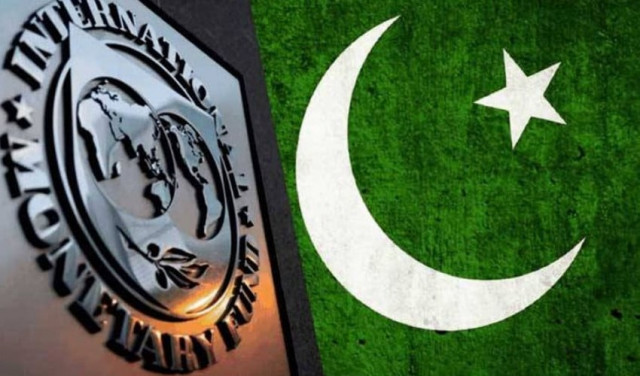
A day after Planning Minister Ahsan Iqbal sought a role for the Planning Commission in the International Monetary Fund (IMF) talks and described it as "fiscal numbers" focused, the Ministry of Finance on Tuesday turned down the assertion.
The "IMF programme is demonstrably not confined to numbers or fiscal targets", said the ministry in a detailed response. The finance ministry also sought to make a distinction between its role "for overall programme coordination" and agreement on benchmarks that were the responsibility of other divisions and provincial governments. The ministry's reaction came the day the IMF mission landed in Karachi for the fourth review of the $7 billion loan programme, which is expected to continue till October 7.
"Concerned ministries and institutions participate and lead technical discussions, including benchmark setting relating to their respective mandate," said the finance ministry. A day earlier, Ahsan Iqbal had said that he recommended to the prime minister that a representative of the Planning Commission should also be included in the team that would negotiate with the IMF. The planning minister said that the IMF programme was not just about numbers, but it would have implications for economic growth, development and people.
The statement added that the Finance Division "fully recognises that macroeconomic stabilisation is a means towards sustainable and inclusive economic growth". The finance ministry further said that certain assertions and interpretations regarding the Ministry of Finance, Pakistan's engagement with the IMF, and the government's economic stabilisation programme did not accurately reflect the facts or institutional process.
It said that this could create an incorrect impression among the public and market participants. "The IMF programme is a whole-of-government programme, not a Finance Division programme," it added. The characterisation that the Ministry of Finance has maintained tight control over programme design and negotiations did not accurately reflect the institutional arrangements underlying Pakistan's IMF programme, said the ministry.
It added that a clear distinction needed to be maintained between the Finance Division's responsibility for overall programme coordination, and the agreement on benchmarks with the IMF leading to policymaking, legislative and implementation responsibilities of respective federal ministries and provincial governments.
However, the finance ministry did not comment whether it was ready to accept a representative of the Planning Commission as part of the IMF parleys. But the ministry said that the appropriate policy debate was therefore not stabilisation versus growth but how to transition from stabilisation towards sustainable growth without any fiscal and external imbalances that necessitated reverting to the IMF stabilisation programmes, as witnessed in the past.
It added that the IMF's Extended Fund Facility and the Resilience and Sustainability Facility encompassed reforms and commitments falling within the mandates of multiple federal and provincial institutions, including the Finance Division, Planning Commission, Ministry of Planning, Ministry of Energy, provincial governments, FBR, SBP and other relevant stakeholders.
The ministry stressed that the published IMF programme explicitly encompassed growth-enhancing structural reforms, social protection, governance, energy-sector efficiency, climate resilience and reduction of distortions in the economy. The latest IMF staff report specifically states that policy discussions focused on accelerating reforms to support stronger growth, while protecting vulnerable households. While reacting to the talk of petroleum levy being the central point of the IMF programme, the finance ministry said that the levy was not the central point of the loan programme.
The assertion that the Finance Division has made PDL the "central point" of the IMF programme is misleading. The programme's fiscal strategy was substantially broader and revolved around FBR revenue mobilisation, expansion of the tax base, provincial taxation and expenditure rationalisation, it added. The finance ministry said that for the current fiscal year, the IMF programme specifically emphasised the need for additional revenue mobilisation and strengthening FBR performance rather than relying solely on petroleum taxation.
The petroleum levy is one of the revenue instruments, and describing it as the centrepiece of the programme materially overstates its role, according to the ministry. The finance ministry admitted that while the programme did not prescribe a single permanent headline PDL rate in the manner suggested, the published programme documents contained explicit details concerning petroleum pricing and levies. These include the alignment of domestic fuel prices with international prices through regular adjustments.








This material may not be published, broadcast, rewritten, redistributed or derived from. Unless otherwise stated, all content is copyrighted © 2026 The Express Tribune.








COMMENTS
Comments are moderated and generally will be posted if they are on-topic and not abusive.
For more information, please see our Comments FAQ