Naqvi assures no trees will be cut at Islamabad’s F-9 Park
Updated 3 hours ago

Two apex courts may come into conflict as FCC examines legality of private hospital treatment
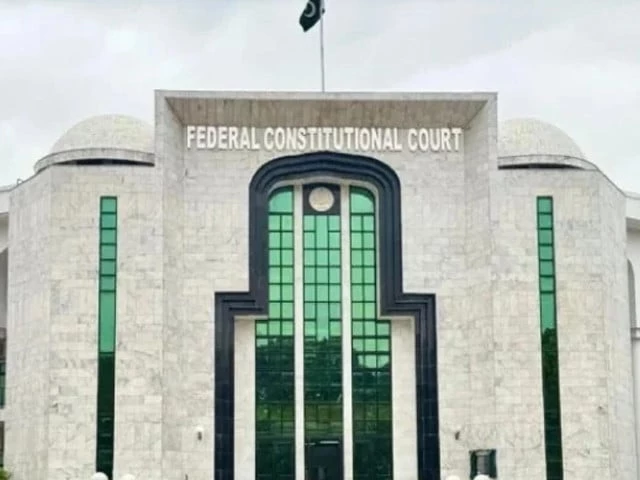
The Federal Constitutional Court (FCC) has raised questions over the Supreme Court's August 18 order directing the shifting of former prime minister Imran Khan to Shifa International Hospital for medical treatment, potentially setting the stage for an unusual legal confrontation between the country's two apex courts.
During Monday's hearing of the appeals filed by three inmates who seek Imran-like treatment, FCC Justice Ali Baqar Najafi observed that there should be no discrimination among prisoners, as the jail manual clearly provides that inmates are to be shifted to government hospitals for treatment.
Another member of the FCC bench, Justice Aamer Farooq, questioned why the Supreme Court had ordered Imran's treatment at a private hospital when the jail manual specifically provides for prisoners to be treated at government hospitals.
The observations have assumed significance as the FCC has issued notice to Attorney General for Pakistan (AGP) Mansoor Awan for legal assistance, observing that the matter involves questions requiring interpretation of the Constitution and the law.
Legal experts believe the FCC proceedings could have a direct bearing on the proceedings pending before the Supreme Court regarding Imran's transfer to Shifa International. A three-member Supreme Court bench headed by Justice Shahid Waheed is scheduled to resume hearing on Tuesday of a matter concerning Imran's sister Uzma Khan, who has challenged the government's failure to implement the August 18 order.
Her contempt petition against the prime minister and others for allegedly violating the Supreme Court's directive has also been fixed for hearing on Wednesday.
The parallel proceedings have triggered debate among lawyers over whether the matter could lead to a face-off between the Supreme Court and the newly established FCC.
A law officer said the FCC had constitutional authority to call for a case pending before another court if it involved a substantial question of law concerning the interpretation of the Constitution.
He referred to Article 175E of the Constitution, under which the FCC may, on its own motion or otherwise, if it considers that a case involves a substantial question of law concerning constitutional interpretation, call for the record of any case pending before any court and make such order in the case as it deems appropriate.
The provision, according to the law officer, means that the FCC could summon a case pending before the Supreme Court if it determines that the matter falls within its constitutional jurisdiction.
The FCC has, in a number of judgments, already sought to define its position vis-à-vis the Supreme Court following the 27th Constitutional Amendment.
In one such ruling, the FCC held that its decisions were binding on all courts, including the Supreme Court. It also observed that, following the 27th Amendment, the Supreme Court no longer possessed the authority to interpret the Constitution and law in matters falling within the FCC's constitutional jurisdiction.
In the Riaz Hussain case, FCC Justice Rozi Khan Barrech observed that Article 189 of the Constitution provides that a decision of the Supreme Court deciding a question of law or enunciating a principle of law is binding on all other courts in Pakistan, with the exception of the FCC.
According to the judgment, this exception stems from the 27th Amendment, under which decisions of the FCC are binding on all courts in Pakistan, including the Supreme Court. Consequently, all courts are constitutionally required to follow FCC judgments.
Similarly, FCC Justice KK Agha held in a separate judgment that although Supreme Court decisions were not binding on the FCC under Article 189, the constitutional court could treat such decisions as having persuasive value or as constituting obiter dicta, which it may or may not choose to follow.
Justice Aamer Farooq has also observed that Article 189 makes Supreme Court decisions binding on courts subordinate to it, including high courts. At the same time, decisions of the FCC are binding on every court in the country, including the Supreme Court and high courts.
Senior lawyers believe the FCC has several options in dealing with the matter.
One option is for the FCC to exercise restraint and allow the Supreme Court to decide the issue, particularly because the August 18 order directing Imran's transfer to Shifa International was an interim order.
During Monday's hearing, FCC Chief Justice Amin-ud-Din Khan asked counsel for the petitioners why they had not moved an application before the Supreme Court seeking to become a party to the proceedings concerning Imran.
A law officer said that if the FCC ultimately decides the issue, the Supreme Court would be bound to follow the constitutional court's jurisprudence. "If the Supreme Court does not comply with the FCC's order, it will amount to a violation of the Constitution," he said.


















This material may not be published, broadcast, rewritten, redistributed or derived from. Unless otherwise stated, all content is copyrighted © 2026 The Express Tribune.

1727268465-0/Untitled-design-(42)1727268465-0-208x130.webp "the reverse renaissance")




COMMENTS
Comments are moderated and generally will be posted if they are on-topic and not abusive.
For more information, please see our Comments FAQ