North Korean state media releases photos of Kim Jong Un amid death rumors
Updated 5 hours ago

Consulate to close within 30 days after UK announced ban on imports from illegal Israeli West Bank settlements
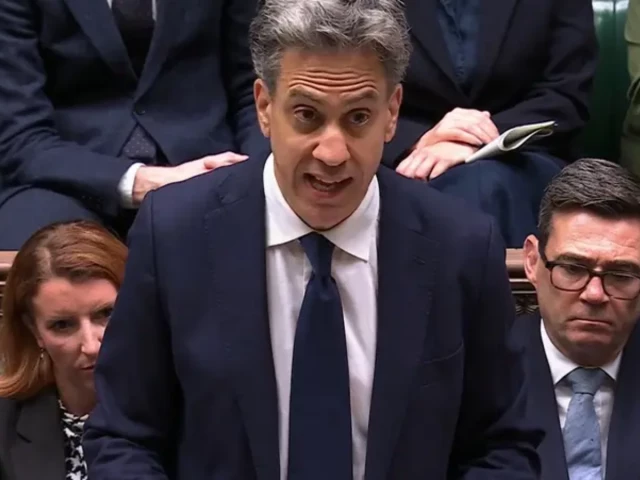
British Foreign Secretary Ed Miliband said on Wednesday he regretted Israel's decision to order the consulate to close, but said it was not a surprise, as the move came shortly he announced a ban on imports from Israeli settlements in the occupied West Bank, along with sanctions targeting companies and individuals involved in settlement expansion.
"We weighed the costs and benefits of acting (...) and we thought we simply could not stand by because we feared Israeli action," he told BBC TV.
Israel notified the British consulate in occupied East Jerusalem that it must close within 30 days, Israeli public broadcaster KAN reported on Wednesday.
Earlier on Tuesday, Miliband announced in the House of Commons a ban on imports from illegal Israeli settlements in the occupied West Bank, sanctions on companies and individuals facilitating settlement expansion, and additional sanctions on extremist Israeli occupiers accused of supporting or inciting violence against Palestinians.
Read: UK, France and Canada sanction Israeli West Bank settlements, in support for two-state solution
Miliband said Israel had "turned a blind eye" to violence carried out by settlers against Palestinians.
British diplomats working at the consulate, whose presence in Jerusalem dates back to 1839, will also lose their diplomatic status in 30 days, the Israeli officials and two sources said.
UK officials assigned to a US-led Gaza coordination mission in Israel, as well as British diplomats based in Ramallah, have been given seven days to leave, one of the Israeli officials and the two sources said.
Israel has also announced that Britain would no longer be allowed to train Palestinian security forces in the West Bank, and that 12 British lawmakers and other nationals, including former Labour Party leader and outspoken critic of Israel Jeremy Corbyn, would be banned from entering the country.
Prime Minister Benjamin Netanyahu's office did not respond to a request for comment on the consulate closure.
Israel's Foreign Minister Gideon Saar said on X that he had thanked Kemi Badenoch, the leader of the British opposition Conservative Party, for her criticism of the sanctions.
Badenoch wrote in the Sun newspaper that the Labour government was "putting its own party-political interests ahead of our national interest".
Miliband on Tuesday told lawmakers that, in addition to banning imports of goods from Israeli settlements in the West Bank, the UK would also take measures against companies and individuals providing services to settlements including "construction, infrastructure, financing, or real estate".
France and Canada also said they would ban the import of products from Israeli settlements, while nine other countries including Denmark and Portugal endorsed the British action.
In response, Saar called the action by Britain "morally distorted" and accused the UK of "blatant interference in the affairs of a sovereign state and its electoral process" ahead of next month's Israeli election.
The sanctions are the latest in a series of actions targeting Israel's settlement policy and underscore its growing diplomatic isolation among some of its traditional allies.
There has so far been a muted response from the United States, with US Secretary of State Marco Rubio saying Washington did not want to see "anything destabilising" in the West Bank while declining to specifically comment on the UK sanctions.
Netanyahu driving Israel toward international isolation
The Israeli opposition has repeatedly accused Netanyahu of driving the country toward international isolation through his government’s policies and the genocide in Gaza. Netanyahu himself acknowledged about a year ago that Israel is entering a form of isolation.
Since taking office in late 2022, Netanyahu’s government has approved 104 new illegal settlements, while 160 agricultural outposts have been established in the occupied West Bank, according to Palestinian figures.
Read more: Egypt, Jordan welcome UK measures restricting trade linked to illegal Israeli settlements
During the first half of 2026, Israeli occupiers carried out 3,488 attacks in the occupied West Bank, killing 17 Palestinians and fully or partially displacing 26 Bedouin and pastoral communities, according to the Palestinian Colonisation and Wall Resistance Commission. The commission also documented the establishment of 42 new illegal outposts.
Around 750,000 Israeli occupiers live in 194 illegal settlements and 400 illegal outposts across the occupied West Bank, including occupied East Jerusalem, according to Palestinian figures.
Israel has occupied the West Bank, including East Jerusalem, since 1967. The international community considers Israeli settlements in the occupied territories illegal under international law, a position Israel rejects.












This material may not be published, broadcast, rewritten, redistributed or derived from. Unless otherwise stated, all content is copyrighted © 2026 The Express Tribune.






COMMENTS
Comments are moderated and generally will be posted if they are on-topic and not abusive.
For more information, please see our Comments FAQ