Hundreds queue in Hong Kong to glimpse Van Gogh painting unseen in public for 60 years
Updated 4 hours ago

Actors also reflect on their family connection, the changing television industry and Karachi’s decline
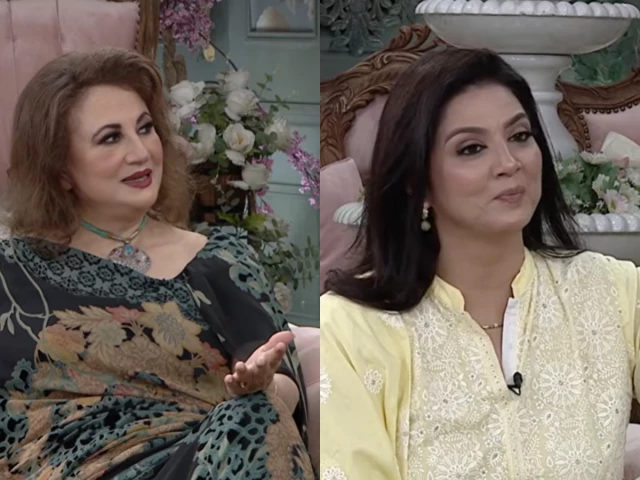
Veteran actors Faryal Gohar and Savera Nadeem offered contrasting but equally candid perspectives on marriage, family and personal boundaries in a recent conversation. While Gohar spoke openly about enduring nine years of an abusive marriage, Nadeem explained why she has deliberately kept her own family life away from the public eye.
For Gohar, speaking about marriage meant revisiting a deeply difficult period of her life. She revealed that she spent nine years in an abusive relationship, enduring physical violence and a restrictive environment despite her education and background. “I endured 9 years of an abusive marriage. I was subjected to physical violence and a restrictive environment,” she said.
Severe health complications and the loss of her unborn children eventually became a turning point for Gohar, prompting her to leave the marriage. Looking back, she said the experience taught her lessons about independence, boundaries and self-respect.
“That struggle taught me independence, setting firm boundaries, and self-respect,” she said. “Women must recognise their worth and leave such toxic situations,” she added.
Nadeem's experience of marriage has been markedly different, but she too spoke about the importance of drawing boundaries around her personal life.
Addressing longstanding curiosity about her husband, who works as a software professional outside the entertainment industry, she said keeping her family away from social media was a conscious choice. “I didn't share any pictures or details regarding my family on social media, and that happened by design,” she said.
She also rejected the idea that her marriage was the result of a conventional arranged match, pointing out that she had made the decision herself. “We got married because we wanted to get married. Do you think that I am a person who will fall for an arranged marriage trap?” she said.
The couple had been introduced through mutual friends, Nadeem explained, and quickly formed a connection. “We clicked; it was like a mutual connection, and we never looked back after that,” she said.
Their early relationship also came with an amusing detail: her husband had never seen her acting before they married. Nadeem recalled taking matters into her own hands and introducing him to her work.
“Before our marriage, he had never seen my acting, which I later showed him by force through DVDs. I wasn't interested in whether he wanted to see it or not,” she said, laughing that he has nevertheless remained a supportive partner.
That partnership has also shaped how Nadeem approaches motherhood. She said she and her husband share the same approach to raising their children, with routine playing an important role in their household.
“We strictly follow a routine, and we have made our children follow the same routine because I heard doctors saying that children thrive and feel secure in a proper routine,” she said.
For Nadeem, motherhood has also influenced the rhythm of her career. Rather than viewing breaks from work as interruptions, she said they have been a natural part of managing her responsibilities at home.
“Motherhood and family require careful management, and I have always prioritised my family's well-being while taking natural breaks during different stages of my children's growth,” she said.
The conversation also revealed why the bond between Gohar and Nadeem extends well beyond their shared profession. “Our relationship goes far beyond just being colleagues,” Gohar said, explaining that her late sister, Madeeha Gohar, was married to Nadeem's father, Shahid Nadeem.
The family connection has given the two actors a relationship that predates many of their professional experiences together. “We have shared a deep bond and travelled together for years,” Gohar said.
Their conversation eventually moved from their personal lives to the industry they have both witnessed changing over the years.
For Nadeem, one of the biggest differences between the television industry of her early career and today's production environment is the loss of time devoted to preparation. “During the PTV days, there was discipline, warmth, and thorough rehearsals. We used to sit together, read lines, build character depth, and work like a real family,” she said.
That culture, she suggested, has been replaced by a faster and more commercial approach. “Now, the industry has become heavily commercialised. The focus often shifts toward quick turnarounds and long technical set hours rather than prioritising artistic performance and script quality,” she said.
Both actors felt that the change extends beyond production schedules. They remembered an era when long days on set often meant shared meals, conversations and a stronger sense of camaraderie among cast and crew.
Today, they noted, actors are more likely to retreat to their vanity vans between takes, leaving less room for the kind of informal interaction that once helped create a sense of brotherhood on set.
Gohar also recalled a Karachi very different from the one she sees today, remembering the cultural opportunities that shaped her own youth.
“I learned Kathak and Bharat Natyam right here in Karachi during my youth. Karachi was a city of lights, culture, and endless opportunity for everyone from labourers to traders,” she said.
She attributed the city's decline to civic mismanagement and called on residents to demand better services.
“The local administration has ruined a historic city. Taxpayers in Karachi deserve basic civic infrastructure and proper waste management, and citizens must raise their voices and demand better,” she said.














This material may not be published, broadcast, rewritten, redistributed or derived from. Unless otherwise stated, all content is copyrighted © 2026 The Express Tribune.






COMMENTS
Comments are moderated and generally will be posted if they are on-topic and not abusive.
For more information, please see our Comments FAQ