RMC's building plan drive triggers traders' revolt
Updated 49 minutes ago

From Lahore to Karachi and Peshawar, the PIMS tragedy has unveiled fire-safety failures at major hospitals as authorit
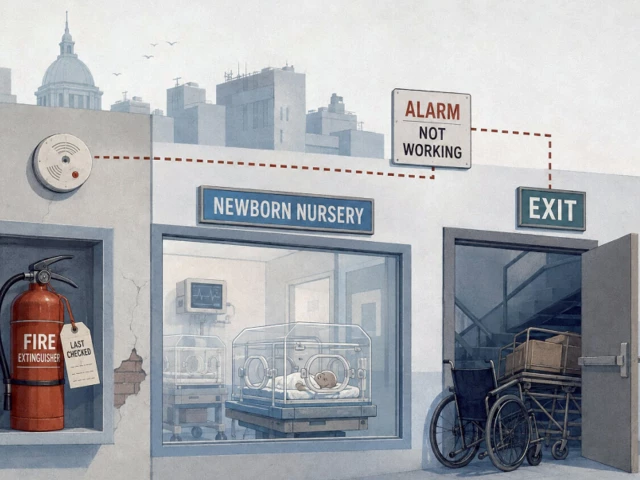
A newborn in a hospital is perhaps the most defenceless life imaginable - too small to run, too young to cry for help and entirely dependent on others for survival. A nursery is meant to be the first fragile bridge between the safety of the womb and the uncertainty of the outside world. Yet for the infants who died in the PIMS Hospital fire in Islamabad, the very ward entrusted with their care cradled them in flames.
The deaths of the 14 infants have now triggered a flurry of meetings, inspections, committees and orders across the country, with governments suddenly scrambling to assess fire-safety arrangements in hospitals. But the haunting question remains: why must babies die before officials begin checking whether the alarms work, whether extinguishers are functional and whether hospital staff know how to respond when fire breaks out?
From Lahore and Karachi to Peshawar, the tragedy has exposed a disturbing disconnect between safety measures recorded on paper and preparedness on the ground - where, in an emergency, a few minutes can mean the difference between rescue and death. Why did the government take notice of fire safety in hospitals only after the flames had already claimed children's lives?
A 2017 report by the Wafaqi Mohtasib's Secretariat warned that PIMS was already struggling under a patient load far beyond what it was designed to handle, with patients arriving from across the region and even Afghanistan. It highlighted overcrowded inpatient wards, outdated infrastructure and equipment, and the absence of adequate systems to manage the burden. The report also called for stronger quality assurance and better hospital management. Yet these warnings were clearly shoved under the rug.
In Lahore, major government hospitals including Mayo Hospital, Jinnah Hospital, Services Hospital, Ganga Ram Hospital, Lahore General Hospital and Children's Hospital have fire extinguishers, hydrants, fire alarms and emergency exits. Yet publicly available information does not clearly establish whether equipment is functional, when comprehensive drills were last conducted or how many employees are practically trained to respond when a fire breaks out.
Mayo Hospital's website lists a Disaster and Emergency Management Plan, mock fire exercises and a fire emergency evacuation plan, suggesting that the institution has a formal mechanism for dealing with disasters. But details about permanent firefighting personnel, functional hydrants and the date of the most recent full-scale drill remain unclear.
The gap between paperwork and preparedness is even more concerning in private hospitals, where safety SOPs may appear complete in official records but practical implementation is reportedly another matter altogether. Sources said staff drills and proper inspections are not conducted regularly in some facilities, while water-based firefighting systems are absent from several wards.
Even fire extinguishers themselves have reportedly raised questions. Sources revealed that some cylinders have not been properly certified, while in certain cases handwritten stickers appear to have been placed on equipment to indicate changes or checks. Offices may possess the required documentation, but practical exercises - the difference between knowing a procedure and actually saving a life - are reportedly missing.
An officer at Mayo Hospital told The Express Tribune that the system largely operates through verbal instructions. Whenever a fire has broken out in a hospital in the past, Rescue 1122 personnel have been called to control it.
Despite annual budget allocations, an officer alleged that practical fire-safety measures remain neglected. Sources confirmed that hospital staff have gone long periods without drills, while designated emergency-response personnel are not always clearly identified or available. At several major Lahore hospitals, extinguishers and emergency exits are reportedly inadequate or expired, while some alarms, hydrants and sprinklers are either absent or non-functional.
The danger is not hypothetical. In June 2022, a fire in the medical store on the third floor of Children's Hospital Lahore took nearly seven hours to control, with seven hydrants used and a large quantity of medicines destroyed, disrupting hospital operations.
Jinnah Hospital also suffered a fire in its operating theatre in September 2022, destroying medical equipment and other items, although no patients or staff were reported injured. At Services Hospital, a short circuit caused a fire in the new operation theatre in 2020, forcing patients to be shifted to other wards before Rescue 1122 extinguished the blaze.
These incidents underline the question that authorities repeatedly confront only after an emergency: what happens during the first few minutes?
A fire extinguisher mounted on a wall is of little use if nobody knows how to operate it. An emergency exit serves no purpose if it is blocked. A fire alarm cannot save patients if it does not work, while a hydrant becomes little more than a decoration if water pressure or pumps fail.
Following the PIMS incident, Punjab authorities have now ordered hospitals to strengthen their response mechanisms. A high-level meeting chaired by Provincial Health Minister Khawaja Salman Rafique reviewed fire and emergency safety arrangements and directed action against negligence.
Rescue 1122 was instructed to provide formal emergency-response training to hospital staff, while responsibilities were to be clearly assigned. The government also ordered that one emergency-response officer and one fire warden be appointed in every ward, alongside immediate updates of mock exercises, equipment inspections and emergency plans.
Health Secretary Azmat Mahmood said fire alarms and detection systems were being installed on an emergency basis across Punjab. Electrical wiring, equipment and other systems were ordered to undergo thorough inspections, with monthly reports to be submitted to the department.
A provincial task force was also established to inspect hospitals, while administrations were directed to prepare evacuation and emergency-response plans with Rescue 1122.
But such orders raise another question: why was this machinery not already working?
The same question is being asked in Karachi, where concerns over hospital preparedness are particularly acute.
At the National Institute of Child Health (NICH), reportedly more than 400 children visit the emergency department every day while over 300 remain admitted. Yet sources revealed that the hospital has no fire-safety alarm system, while several wall-mounted extinguishers are in poor or non-functional condition.
The main NICH building has only one entrance, while its emergency department has two reportedly small gates. About a month ago, a short circuit caused a fire in the Medicine One ward on the third floor. No casualties were reported, but the incident exposed the vulnerability of a facility packed with children and families.
Karachi's other major hospitals face similar concerns.
Jinnah Hospital has 13 major buildings housing operating theatres, intensive care units and sophisticated electrically powered equipment. Its electrical wiring has reportedly deteriorated, while the hospital did not receive a budget this year specifically for repairing electrical and medical equipment. Fire extinguishers are available, but several are reportedly non-functional.
More troublingly, the hospital's last fire drill was conducted in 2017, despite drills being intended to give doctors, nurses, paramedics, security personnel and other employees practical training.
Jinnah Hospital Joint Executive Director Dr Muhammad Suleman said the hospital has 2,000 beds, with 6,000 to 7,000 patients visiting its outpatient department daily and around 1,300 attending the emergency department. Following the PIMS incident, he said, a separate firefighting team was being established.
At the Civil Hospital, Medical Superintendent Dr Khalid Bukhari said four short-circuit incidents had occurred last year. He said more than 200 extinguishers were available, of which 180 were functional, and that fire drills were conducted twice a year. However, the hospital reportedly lacks designated emergency evacuation routes despite having more than 50 units.
Abbasi Shaheed Hospital, meanwhile, reportedly has only 13 fire extinguishers, no fire alarm system and no dedicated emergency exit. Hospital staff are also said to lack firefighting training.
The consequences of electrical failures have already been deadly.
Former Medical Superintendent of Sindh Government Liaquatabad Hospital Dr Atiq Qureshi said a short-circuit fire in February 2024 severely burned seven hospital employees. They were shifted to the Burns Centre at Civil Hospital, but five died.
Qureshi said inadequate firefighting equipment had compounded the incident. He added that five short-circuit-related fire incidents were reported at government hospitals in 2024, while ten such incidents occurred in Karachi hospitals in 2023.
The problem is aggravated by the age of some hospital buildings. Civil Hospital dates back to 1898 and Jinnah Hospital to 1930. Although new departments and increasingly sophisticated medical equipment have been added over the decades, concerns remain over whether electrical infrastructure has kept pace.
Large oxygen plants installed at these hospitals create another layer of danger. A fire involving oxygen systems can spread rapidly, yet sources said effective arrangements for dealing with such incidents remain inadequate at several facilities.
In Khyber-Pakhtunkhwa, the PIMS fire has similarly triggered a scramble.
The provincial government and Health Department have formed committees in Peshawar and other districts to inspect hospitals and examine fire extinguishers, alarms and emergency equipment. Yet major hospitals in the provincial capital already face questions over preparedness.
Lady Reading Hospital, one of the province's largest healthcare facilities, receives between 7,000 and 10,000 outpatient visitors every day and has a 55-bed nursery. According to information available to The Express Tribune, fire extinguishers and alarm systems in its older buildings are not functioning properly, although equipment in some newer buildings is operational.
Similar concerns have been raised about City General Hospital, Khyber Teaching Hospital and Hayatabad Medical Complex, particularly regarding emergency exits and firefighting equipment.
Residents say authorities should not wait for another tragedy.
Shahid Khan, a Peshawar resident, believed the Islamabad incident had forced the government to wake up. Khan questioned the condition of hospitals outside major cities, where emergency facilities may be even more limited.
The administrations of LRH, Hayatabad Medical Complex and Khyber Teaching Hospital, however, maintained that their firefighting equipment was functional and that fire drills were conducted every three months.
Rescue 1122 spokesperson Bilal Faizi said the service provides training and mock exercises to government and private institutions whenever requested. "Meetings have recently been held with hospitals and relevant departments to discuss training and equipment," claimed Faizi.
But the central issue remains whether hospitals should have to request such training only after a disaster has exposed their vulnerabilities. Across the country, the evidence suggests that the problem is not merely a shortage of extinguishers. It is the absence of a culture of continuous preparedness.
According to experts, a proper fire-safety audit must go beyond paperwork to establish whether hydrants, pumps and alarms work, exits are clear and trained staff are available on every shift. In a real fire, they added that there is no time for meetings or notifications - only minutes to save a patient who cannot walk or a newborn who cannot breathe without assistance.
For governments across Pakistan, the latest tragedy has once again provided an opportunity to act. The question is whether they will act before the next fire - or once again after it.









This material may not be published, broadcast, rewritten, redistributed or derived from. Unless otherwise stated, all content is copyrighted © 2026 The Express Tribune.


1727268465-0/Untitled-design-(42)1727268465-0-208x130.webp "the poor man s burden")


COMMENTS
Comments are moderated and generally will be posted if they are on-topic and not abusive.
For more information, please see our Comments FAQ