Two killed in 'CCD encounters'
Updated 2 hours ago

Committee Chowk market turns into foul-smelling, sewage-ridden site
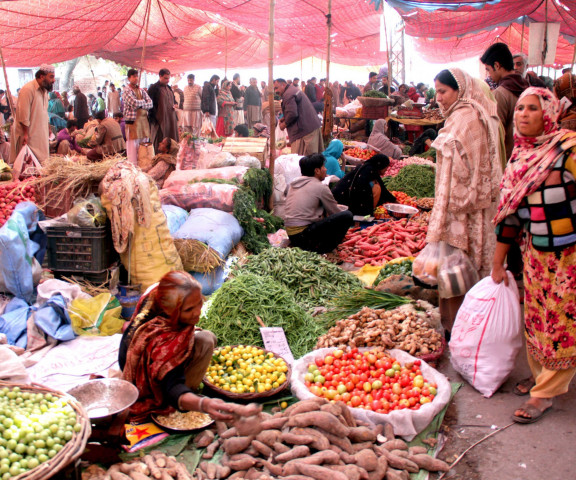
Sunday bazaars established at 16 different locations in Rawalpindi in 1980 to provide people with affordable food items and other necessities have lost their official status.
They have allegedly started selling rotten items in the absence of official patronage and standard operating procedures (SOPs).
The situation at Committee Chowk, the city's largest and most central Sunday bazaar, is particularly alarming. The lack of security has turned it into a complete security threat.
The market is being held amid stagnant sewage water, foul-smelling garbage and dirt, while there is virtually no drainage. A large rainwater drain is located nearby, and its dirty water accumulates in the market.
Water remains stagnant at various places, where dengue larvae and mosquitoes are found in large numbers.
Piles of garbage are scattered everywhere, resembling small hills. Stallholders spread sacks, cloth and tarpaulins over the garbage piles and sell vegetables and fruits on top of them.
A foul smell persists throughout the Sunday bazaar. When the Sunday bazaars were established, they had SOPs, including barriers at the entrance, police checkposts, an office of the price control committee and the office of the price magistrate and assistant commissioner (city).
In 2025, the official status of all Sunday and Friday bazaars across the district was withdrawn, resulting in the removal of barriers, security, police pickets, price magistrates and price control committee offices. The sanitation system was also discontinued. For the past two years, the bazaars have appeared to operate without proper control.
The entire ground of the bazaar is now covered with sewage and rainwater. Hawkers place stones and sacks in the water and sell vegetables and fruits on top of them, which also remain exposed to sewage water.
Poor people and low-paid employees are forced to buy these vegetables and fruits from garbage and sewage-covered areas because they are cheaper.
At the end of the Sunday bazaar, stallholders leave behind the vegetables and fruits that remain unsold instead of taking them away. Several families, including women observing purdah, wait from 10pm to 11pm for the stallholders to leave, after which they start picking up the discarded vegetables and fruits.
These painful scenes can be witnessed every Sunday after 10pm and 11pm. The following day, the area becomes a source of food for goats, cows, rats, cats and mongooses because of the garbage, rotten vegetables and fruits, chicken remains and fish waste.
The waste remains there for three to four days and decomposes.
Residents of the area, including Sharif Qureshi, Chaudhry Imran and Khawar Iqbal, said the complete SOP for the Sunday bazaar should be restored or the market should be closed. They demanded complete cleaning of the area after every Sunday.
They said the dirt was causing the spread of inflammation of the nose, ears, throat and eyes, tuberculosis, hepatitis, jaundice, malaria, cholera, dengue and cancer in the surrounding area.
The district administration and the sanitation company said the Sunday bazaar did not have official status and that sanitation and security there were not their responsibility.














This material may not be published, broadcast, rewritten, redistributed or derived from. Unless otherwise stated, all content is copyrighted © 2026 The Express Tribune.








COMMENTS (1)
Comments are moderated and generally will be posted if they are on-topic and not abusive.
For more information, please see our Comments FAQ