UAE says Omani flydubai co-pilot planned suicide attack on Tel Aviv flight
Updated 24 minutes ago

Iran government says diplomacy and defence inseparable, vows to resist US sanctions
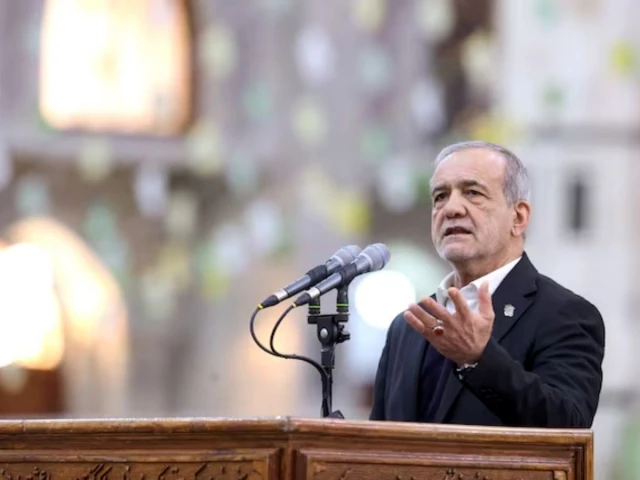
Iranian President Masoud Pezeshkian on Saturday urged US President Donald Trump to avoid creating turmoil, saying problems could be resolved through dialogue and implementation of a memorandum of understanding.
“If we proceed through dialogue and on the basis of the memorandum of understanding, we will resolve the problems and secure our rights,” Pezeshkian said in a ceremony in Tehran, as cited by Mehr News Agency.
“It is in the interest of the country, the region and the world that Trump does not create turmoil and that Israel does not cause insecurity and aggression,” he added.
Pezeshkian said Iran does not favour war but would respond firmly to any assaults.
“We do not like war, but we will stand with strength against aggression and defend ourselves,” he said, adding that no power could force a united nation determined to defend its territory to surrender.
He said Tehran was seeking to resolve problems through dialogue, but stressed that the Iranian people, officials and military commanders would “never surrender” in the face of threats and aggression.
The president also accused Israel of seeking to sow divisions among Muslim countries, saying greater unity among Islamic nations could thwart such efforts.
Turning to domestic issues, Pezeshkian said maintaining industrial production during the coming winter was a “red line,” stressing that supplies of gas, electricity and water to production facilities should not be interrupted.
He said the government would manage consumption of water, electricity, gas and fuel and, if restrictions became necessary, would first impose them on government offices and public buildings rather than shift the burden onto the public.
Pezeshkian called on the public to cooperate with the government to maintain stability, saying Iran’s adversaries should not believe that pressure would force the country to surrender.
US naval blockade put Iran under ‘exceptional’ conditions during war: Tehran governor
The US naval blockade imposed on Iran created “very exceptional and unique” conditions for running the country during the war, Tehran Governor Mohammad-Sadeq Motamedian said Saturday.
Speaking on a television program, Motamedian said Iran had faced intensified sanctions alongside attacks on the country’s infrastructure and the naval blockade, according to the Iranian Students’ News Agency (ISNA).
“The blockade imposed on our country in the maritime domain meant that managing the country took place under truly exceptional and unique conditions,” he said.
Motamedian said infrastructure across Iran, particularly in Tehran, had come under attack during the war, noting that the capital was a major focus of US-Israeli attacks.
He said more than 1,200 electricity infrastructure sites across Tehran province were targeted in attacks during the US-Israeli war, but authorities managed to restore services within a short period.
Water infrastructure was also damaged but quickly repaired, while telecommunications and gas infrastructure were also affected, he added.
He also said sanctions against Iran were intensified during the war, adding further pressure on the country’s economy.
Iran transfers $7.5b in oil revenues to central bank despite US naval blockade: report
Iran transferred $7.5 billion in oil revenues from sales during the first four months of the current Iranian year to the central bank, the semi-official Fars News Agency reported Saturday.
The funds would be sufficient to cover the government’s foreign-currency expenditures from July through December, the report said, citing information obtained from Iran’s Oil Ministry.
Iran has enough oil available for sale outside the US naval blockade to meet the revenue requirements set under its state budget for March 21, 2026-March 20, 2027, according to the report.
Oil revenues on March 21-July 22, the first four months of the Iranian year, reached 99% of the amount projected in the budget for the period, according to the report.
The development comes amid a US naval blockade imposed on Iran, which has disrupted Tehran’s oil exports and maritime trade.
Iran government says diplomacy and defence inseparable, vows to resist US sanctions
The Iranian government pledged on Saturday to stand firm against US sanctions and what it called US-Israeli "conspiracies," saying diplomacy and defence were "complementary, coordinated and inseparable" tools for protecting the country’s national interests, security and territorial integrity.
In a statement carried by state media, the government said it would pursue both tracks simultaneously and focus on curbing inflation, creating jobs, supporting domestic production and gradually reducing dependence on the dollar.
Iran war depletes US military stockpiles, limiting global deterrence: report
The extensive use of advanced weaponry in the war against Iran has severely depleted US military stockpiles, limiting Washington’s ability to deter threats from China and Russia, The Wall Street Journal reported Friday.
Military planners expressed concern that the resource drain has forced the US European Command, the division responsible for American military operations across the continent, to adjust its operational plans.
US officials assessed that Washington could not fully execute contingency plans to defend Taiwan, the self-governing island over which China claims sovereignty, if a military operation occurs in the short term.
Read: US has fired over 850 Tomahawk missiles at Iran, raising stockpile concerns
Moving air defence units to the Middle East from Japan, South Korea and Germany has created “soft spots” in the American global military posture that could take years to refill, according to officials.
Inventories in Europe of PAC-3 Patriot interceptors and ATACMS surface-to-surface missiles are considered at “beyond critical” levels, some officials claimed. Additionally, THAAD anti-missile interceptors and counter-drone systems have been redirected to the Middle East, further diminishing continental supplies. The moves have sharply restricted the ability of Western nations to send interceptors to Ukraine as Russian missile attacks continue.
The White House and the Pentagon have officially denied any munition scarcity. The Trump administration said the US military maintains enough resources to serve all of US President Donald Trump’s goals.
UN maritime agency says 400 ships stranded in Gulf amid ongoing Mideast war
The International Maritime Organisation (IMO) said Friday that 400 vessels and 6,000 seafarers are stranded in the Gulf six months after the war in the Middle East began.
“While some ships and their crews have been able to leave the Gulf, up to 400 ships carrying around 6,000 seafarers have been unable to depart safely since the conflict began,” Arsenio Dominguez, the head of the IMO, said. He described the situation in the Strait of Hormuz, a strategic waterway through which one-fifth of global oil trade passes, as “unresolved.”
The UN agency has verified at least 70 attacks on international shipping since the war started on February 28, resulting in the deaths of 19 seafarers.
Read more: Pakistan working to bring US-Iran back to Islamabad MoU: FO
Dominguez emphasised that the disruption of vital supply chains for fuel and fertiliser has “grave” consequences for communities and economies worldwide. He noted that the situation is particularly distressing for the thousands of “innocent” workers living under conditions of “heightened risk and uncertainty.”
Dominguez encouraged a “renewed political will” from member states and the shipping industry to restore freedom of navigation through the waterway.
The US and Iran signed a memorandum of understanding in June and launched negotiations toward a final agreement. Talks later stalled, however, over disagreements about security guarantees and freedom of navigation through the Strait of Hormuz.






This material may not be published, broadcast, rewritten, redistributed or derived from. Unless otherwise stated, all content is copyrighted © 2026 The Express Tribune.





COMMENTS
Comments are moderated and generally will be posted if they are on-topic and not abusive.
For more information, please see our Comments FAQ