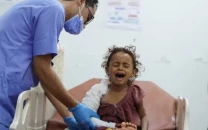
WHO warns escalating conflict in Yemen takes 'devastating toll'
Updated 2 hours ago

FO demands written, verifiable guarantees against use of Afghan soil for terrorism

Pakistan said on Thursday it remained open to state-level dialogue with Afghanistan, but stressed that any mechanism for resolving bilateral disputes would only be sustainable if Kabul took "tangible and verifiable" action against militants operating from its territory.
Foreign Office spokesperson Tahir Andrabi said Pakistan had taken note of a proposal by Afghan interim Interior Minister Sirajuddin Haqqani for a dedicated mechanism involving committees from both sides to improve coordination and communication.
"We remain open to state-level dialogue," the spokesperson said at the weekly press briefing.
However, he cautioned that the sustainability of any such mechanism would depend on actions rather than assurances, demanding that the Afghan Taliban ensure that Afghan territory was not used for terrorism against Pakistan.
"Kabul must honour its international commitments, including those under the Doha framework, and ensure that Afghan soil is not used by hostile proxies, particularly the TTP and BLA, against Pakistan," Andrabi said.
He said Islamabad was ready for institutional coordination provided it produced verifiable counterterrorism measures and effective border management.
Asked whether Pakistan had ended its engagement with friendly countries seeking to mediate between Islamabad and Kabul, Andrabi said he was unaware of any such understanding with China.
Pakistan's position, he said, remained unchanged: the Afghan side must provide verifiable written assurances that its territory would not be used for terrorism against Pakistan.
The spokesperson also responded to allegations from Afghan officials that Pakistan was behind unrest in Badakhshan, categorically denying the accusations.
He said Pakistan expected the Afghan Taliban to act independently and fulfil its international obligations by preventing its territory from being used for terrorism.
Pakistan, he added, had evidence of Indian involvement in terrorism in Pakistan emanating from Afghan soil.
"If their activities are at the behest of a certain neighbouring country to promote terrorism in Pakistan ... then, unfortunately, we will have to call them proxies," Andrabi said.
He reiterated that assurances from Kabul would have to be accompanied by concrete and verifiable measures against militant groups.
The spokesperson also rejected reports suggesting that Field Marshal Syed Asim Munir travelled to Tehran as an envoy of President Trump or at Washington's behest.
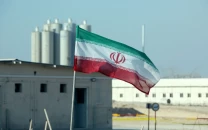
He said the army chief and chief of defence forces' August 24 visit to Tehran was undertaken "purely in the context and backdrop of Pakistan's ongoing role as a mediator" in the US-Iran standoff.
The visit focused on regional de-escalation, breaking the military stalemate and efforts towards a negotiated settlement, while also seeking renewed momentum for reopening the strategic Strait of Hormuz.
Andrabi said Pakistan remained positive that momentum would be generated towards reopening the waterway, whose closure had disrupted global supply chains, particularly energy supplies.
He said subsequent visits by Qatari and Omani officials to Tehran reflected broader efforts for dialogue and a settlement.
"Eventually, it is up to the parties to decide their actions through a sovereign decision that is to be taken in Tehran and Washington," he said, adding that mediators could only facilitate the process.
On Pakistan's trade with Iran amid US pressure, the spokesperson said Islamabad was following international law and its bilateral trade agreements with Tehran.
He also said Pakistan hoped economic issues would form part of a wider settlement of the US-Iran standoff.
Turning to India, the Foreign Office categorically rejected claims by India's former Chief of Defence Staff regarding an alleged Indian drone that could have struck the strategic site at Kirana Hills near Sargodha during the May 2025 conflict.
Andrabi described the claims as "self-contradictory and retrospective", saying Pakistan's air defence network had prevented India from achieving its military objectives.
"No strategic asset or sensitive infrastructure was compromised in Pakistan," he said.
The spokesperson said Pakistan's subsequent military response under Operation Bunyan-ul-Marsoos demonstrated its ability to impose costs across the conflict spectrum.
He also dismissed attempts to revisit the May 2025 conflict through selective narratives and "dramatised productions".
"History is established by facts and evidence, not by Bollywood-style retrospective claims," he said.
In another India-related development, Pakistan protested the demolition by Indian authorities of sheds, benches and a walkway adjacent to the consular section of Pakistan's High Commission in New Delhi.
Andrabi said the structures had been used by people seeking consular services and visas and called the Indian action a violation of the Vienna Convention on Diplomatic Relations.
He rejected any comparison with Islamabad's anti-encroachment operation in the Diplomatic Enclave, saying Pakistan had given advance notice to all diplomatic missions, including the Indian High Commission, before removing unauthorised structures.
Meanwhile, Pakistan is set to assume the chairmanship of the Shanghai Cooperation Organisation (SCO) for a one-year term following the SCO Council of Heads of State summit in Bishkek from August 31 to September 1.
Prime Minister Shehbaz Sharif will attend the summit and hold bilateral meetings with Kyrgyz leadership.
The highlight of Pakistan's chairmanship will be the SCO Council of Heads of State summit to be hosted in Islamabad in 2027.










This material may not be published, broadcast, rewritten, redistributed or derived from. Unless otherwise stated, all content is copyrighted © 2026 The Express Tribune.




COMMENTS
Comments are moderated and generally will be posted if they are on-topic and not abusive.
For more information, please see our Comments FAQ