Why New Yorkers are willing to wait in line for almost anything
Updated 6 hours ago

Rizwan Ali Jaffri, Saima Hussyn, Mahnoor Sheikh and Noor Xarmina share how unlikely beginnings led them to acting
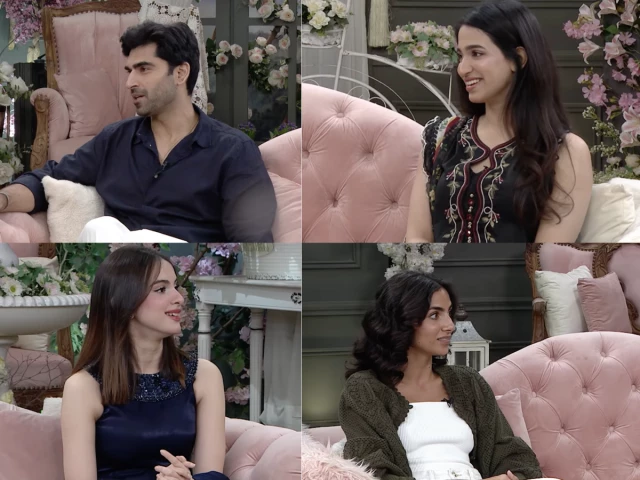
For some, acting is a childhood ambition. For others, it begins with an unexpected audition, a friend’s suggestion or even a chance conversation on a film set. For Rizwan Ali Jaffri, Saima Hussyn, Mahnoor Sheikh and Noor Xarmina, the road to showbiz has been anything but conventional.
In an interview, the emerging actors opened up about their journeys into the entertainment industry, the families and careers they came from, and what they have learnt since stepping in front of the camera.
Their paths have taken them from education and corporate jobs to modelling, school performances and childhood Dubsmash videos — proving there is no single route into acting.
From football to film
For Jaffri, acting was never part of the plan. Before entering modelling, he was a football enthusiast. “I used to play football and had long hair. I used to watch Italian footballers,” he recalled.
It was a friend, Ali Shakeel, who first introduced him to modelling. Jaffri had little idea what the profession involved at the time. “He was like, ‘I want to shoot you.’ I didn’t know about modelling. I was like, ‘Oh, there are magazines too?’ From there, my portfolio went on.”
Modelling eventually opened the door to acting. Director Sarmad Khoosat encouraged him to make the transition, leading to his project Paani Jaisa Pyaar. Jaffri later appeared in dramas such as Deewar and Bas Tere Saath.
The move from modelling to acting, however, required him to develop an entirely different set of skills. “Modelling is more about posture. Here, it’s a different line of expressions and dialogue.”
Working alongside seasoned actors has also been an important part of his learning curve. Jaffri recalled his experience with Nauman Ijaz in the telefilm Chal Dil Mere as particularly valuable. “He is a very good teacher. He tells you the whole scene, how to do it. He’s amazing at it. He understands your character very well too.”
While showbiz became an increasingly important part of his life, education remained a priority. Jaffri said his father, who holds a PhD in computer science, initially wanted him to focus on academics and was not particularly enthusiastic about his modelling ambitions.
Eventually, Jaffri found a way to pursue both. He completed a master’s degree in business and technology and interned at Coca-Cola, gaining first-hand experience of the corporate world.
“I think education is very important. Your exposure and understanding increases,” he said. “Wherever you’re going, marketing also plays a role — the theories of how to approach someone or go about a brand.”
A second career for Saima
Unlike Jaffri, Saima Hussyn did not grow up with a clear ambition to become an actor. “I was not interested, but when someone pitched me the idea, I was doing a nine-to-five job at the time.”
She had heard similar suggestions from others but had never taken them seriously. Fahad Sarfaraz, however, convinced her to at least give it a try. “Many people had said it to me, but I didn’t take it seriously. So he was like, ‘Okay, just give an audition.’”
The audition did not even lead to the character she had initially tried out for. The production team felt her appearance was better suited to another role and cast her accordingly. “They thought my face was very innocent for that role, so they gave me another drama.”
About a year into her television career, Hussyn had appeared in Daam-e-Mohabbat, with another project, Kaisa Yeh Ishq, yet to air. At the same time, she is pursuing a bachelor’s degree in psychology — a combination that makes for long days on set. “This is 12 hours’ time, but at least this is something I like to do,” she said.
She is also the younger sister of actor Sonya Hussyn, a connection that inevitably brings assumptions about nepotism. She, however, believes audiences are capable of deciding for themselves who deserves to move forward.
“If people say, ‘Oh, it’s easy because she’s her sister,’ I think the audience is intelligent enough now to know that you only go beyond if you excel in acting. If they like her, they’ll make her go ahead.”
Having accompanied Sonya to sets in the past gave Hussyn a glimpse into the industry, but observing from the sidelines was very different from experiencing it herself. “I used to go with Sonya to sets and see production, but doing it yourself is different and tough.”
Mahnoor’s childhood dream
For Mahnoor Sheikh, there was never much doubt about what she wanted to do. She began pursuing acting professionally at 17, having already spent years dancing, hosting school events and experimenting with videos. “I always wanted to be an actor,” she said.
Having grown up partly in Jeddah, Sheikh returned to Pakistan during her college years and decided it was time to pursue the ambition she had been talking about for years. “I was a dancer and everything — being a host in school and all. When I came to Pakistan, I was like, ‘I should try.’”
Getting her parents on board was the next challenge. Sheikh remembers carefully timing the conversation with her father after receiving a television commercial opportunity. “I was like, I’ll tell him at night after work so he isn’t in a mood. I told him, ‘From Citrus Talent I got a TVC offer and I want to go do it.’”
Her father’s relaxed response left her almost more surprised than a refusal would have. “He was like, ‘Okay, however you think.’”
Before entering television, Sheikh had also experimented with Musical.ly and Dubsmash, using whatever she had available to practise performing. “I had an iPad and used to do whatever I could.”
She eventually began auditioning and working in television commercials, with her mother often accompanying her to auditions. “My mom used to come with me. I am really close to her. I’m like, ‘I’m just a baby, I don’t know anything.’”
Now, with credits including Nalaik, Deewar and Mohabbat Reza Reza, Sheikh approaches the profession with the same enthusiasm that drew her to it in the first place. “I am very punctual. I love my work, whatever I’m doing, and being excited.”
Leaving finance behind
Noor Xarmina’s journey took her from finance to acting, with a detour through drama school and modelling along the way.
After completing her bachelor’s and master’s degrees, Xarmina was working in finance when she decided to walk away from a conventional career. “I did bachelors, masters and used to work in finance. Then I quit my job because I always wanted to be an actor.”
Raised by parents who valued stable professions, Xarmina said she had always gravitated towards performance despite the expectations around her.
“I was raised in Pakistan, raised by a lawyer and engineer — to be something safe. But I always enjoyed it. Even in school, I used to do plays and dramas. Something clicked. I wasn’t happy at work.”
Rather than immediately trying to break into television, she chose to train. She attended a summer course at a drama school in London, an experience that confirmed she was making the right decision.
“I didn’t have a plan. I attended drama school in London. I was like, ‘Let me train, get practice.’ It’s one of the oldest drama schools in the world. I had so much fun. I did a summer course and I was like, ‘Oh my God, this is what I want to do for sure.’”
By then, Xarmina was already in her mid-20s, an age she noted was later than when many actors begin. Faced with the choice of continuing her life abroad or returning to Pakistan, she chose the latter.
“I was like, should I go to LA and be a waitress or go to Pakistan? My parents had retired and settled in Islamabad. It’ll be a good chance to go back, spend time with them and do that.”
Her parents were supportive in different ways. Her mother encouraged her, while her father remained sceptical about the financial prospects of an acting career. “Mom’s always supportive. Baba is like, ‘There’s no money in this.’”
Before establishing herself as an actor, Xarmina also entered modelling and unexpectedly won Miss Universe Pakistan. “I also started modelling. I did six months, then I won Miss Universe Pakistan. Out of nowhere, my whole year went into that.”
She eventually moved to Karachi, where she felt the opportunities for an aspiring actor were greater, and began working in television.
Her entry into acting also involved a chance connection with actor Sheheryar Munawar. The pair were filming a music video in Lahore when they began talking on set. A year later, Munawar asked her to audition for a production house he was launching. Another year passed before she was offered a role in Dar-e-Nijaat, which is premiering now.
For Xarmina, one of the biggest challenges has been mastering Urdu. Although her parents are diplomats and Urdu was spoken at home, she said she became much more comfortable with the language through living and working in Pakistan.
“You learn from listening to people. People would tell me, ‘Watch dramas.’ I also learned a lot of Urdu from modelling. You have to live here and immerse yourself.
Scripts can help actors improve their vocabulary and delivery, she added, but developing an authentic accent takes time. “When you get a script, you can learn very well. Accents will take time.”
For four actors who arrived at the same destination by very different routes, that willingness to learn may be the one thing they have in common. From football and finance to corporate careers and unexpected auditions, each found their way to the camera on their own terms — and their journeys are still unfolding.






1700422050-0/image-800x600-(54)1700422050-0-208x130.webp "marriyum says punjab cm s rising popularity behind criticism over uk trip terrorism remarks")




This material may not be published, broadcast, rewritten, redistributed or derived from. Unless otherwise stated, all content is copyrighted © 2026 The Express Tribune.




1727268465-0/Untitled-design-(42)1727268465-0-208x130.webp "elite survival pact")
COMMENTS
Comments are moderated and generally will be posted if they are on-topic and not abusive.
For more information, please see our Comments FAQ