
Among the surviving artistic treasures of ancient Gandhara, even the smallest objects reveal profound insights into the lives, beliefs, and cultural values of the people who inhabited this remarkable crossroads of civilisations. The Mirror Handle-Standing Woman, dating to approximately the first century BCE and carved from phyllitic schist, is one such object. Measuring only 12.1 centimetres in height, and now on display at The Metropolitan Museum of Art, New York, US, this delicately sculpted artefact demonstrates that artistic excellence in Gandhara was not confined to monumental Buddha sculptures or grand architectural complexes. Instead, artistic refinement extended into everyday life, where practical objects became expressions of beauty, identity, social status, and cultural sophistication.
The artefact was initially used as the handle of a mirror for looking at oneself, for personal grooming, and possibly for ritual purposes. The standing female figure sculpted on it makes it a work of art, and it is the harmonious coupling of form and function evident in ancient Gandharan society. Most importantly, the artefact provides a glimpse into the social and cultural world of women, personal adornment, artistic ideals and intercultural exchange in one of the most cosmopolitan historical periods in South Asia.
The Mirror Handle-Standing Woman is a wonderful example of the incredible artistic expression of ancient Gandharan culture. Investing technical expertise and significance in this commonplace item, the sculptor made the woman look like a beautifully dressed young woman with a poised, elegant stance, whose finely detailed anatomy and carved drapery demonstrate the aesthetic sophistication and ideals of femininity of the ancient Gandhara culture. The intricate hairstyle, the jewellery and the flowing clothes reflect the artist's keen observation of the era’s everyday fashion trends and his sense of grace, dignity and social status. The naturalistic portrayal of the body, the balance of the composition, and the folds of the drapery demonstrate how indigenous South Asian culture merged with Hellenistic art conventions prevalent in Gandharan art.
Gandhara was in a unique geographical location in the northern part of Pakistan and the eastern part of Afghanistan in the first century BCE. The area lay along trade routes linking Central Asia, Persia, India, and the Mediterranean world, and it evolved into one of the most culturally diverse societies in antiquity. Its cities were continuously traversed by merchants, monks, artists, diplomats, and travellers, who shared their ideas, art, technology, and religion.
The Gandharan society was influenced by successive political powers such as the Achaemenids, Greeks, Indo-Greeks, Scythians, Parthians and ultimately the Kushans. These influences were not a replacement for local traditions; instead, they blended with local customs to give rise to a unique artistic language distinct from any other art tradition in the ancient world.
Mirrors were made from polished bronze, copper, or other shiny materials, and required highly skilled artisans to produce; they were often the possessions of the upper classes.
This mirror handle thus had a special place between use and art. It was constantly held, touched and displayed, and so its decoration took on special significance. Being a focus for sculptors, they became miniature masterpieces that mimicked the owner's taste, wealth and cultural values. This standing female figure, carved into the handle, would have followed its owner as they groomed themselves day to day. These each further emphasised the connection between beauty, the enjoyment of art, and an individual's identity.
What is most amazing about the sculpture is the level of craftsmanship achieved in such a small piece. This small figure, less than five inches tall, shows the beautiful proportions, precise modelling and elegant stance typical of Gandharan art. The selection of phyllitic schist is another indication of the sophistication of the Gandharan artisans. The stone was used to create detailed carvings and achieve a smooth finish that added to its beauty and softness. Phyllitic schist was used throughout Gandhara as a medium for monumental religious sculpture and for smaller luxury items owing to its durability and fine texture.
All the contours of the handle serve to enhance the beauty and usefulness of everyday life, and reflect the Gandharan concept that beauty should enhance it. The figure, though small, is striking for its attitude and precise proportions. Throughout Asian and Mediterranean art, standing figures have been used to represent dignity, composure and self-confidence.
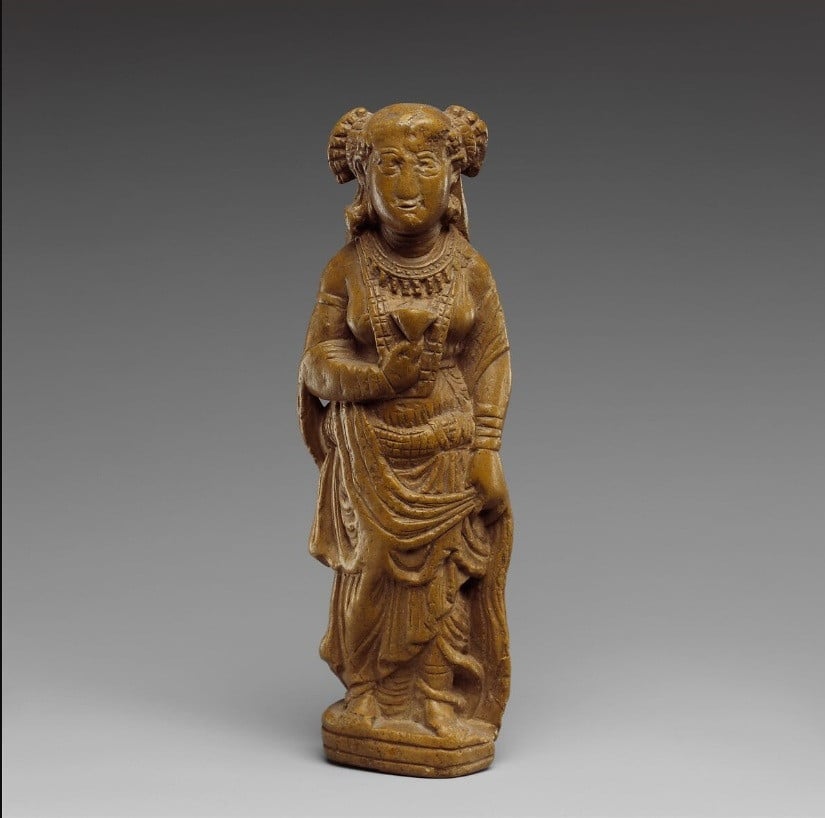
The sculptor was not so deeply interested in depicting movement or dramatic action but rather calm elegance. This is characteristic of Gandharan art, which emphasised restraint to suggest quietness, refinement of character, and social poise. Her attitude also may have been symbolic. Standing figures of women in ancient artworks often symbolised fertility, prosperity, abundance, beauty, or divine protection. The sculpture embodies a sense of grace and beauty in a woman, whether as a representation of a woman as a person, an idealised beauty or a symbol.
The emphasis on natural anatomy, harmonious proportions, and lyrical pose indicates awareness of artistic traditions brought to the region by Hellenistic influence, as well as strong regional aesthetic interests.
While archaeology can only provide bits and pieces of daily life, items like this mirror handle can give us insight into the status of women in Gandharan society.
Micro-finds such as personal grooming items (e.g., combs), jewellery, cosmetics, textiles and mirrors are common finds in ancient South Asia. Clothing, jewellery, and other items indicate that visuality was a significant component of the social identities of women of wealthy families. It is, however, not just vanity that is beauty in ancient Gandhara. Clothing frequently was a symbol of family honour, marital status, ritual purity, prosperity, and community life. Elaborate dress and ornamentation were necessary for festivals, religious ceremonies, marriages and seasonal celebrations.
An artistically carved mirror is a sign of ownership of luxury items and the ability to appreciate fine craftsmanship. It also reflects the wealth Gandhara enjoyed as a result of its strategic location on international trade routes. Thus, women become not only objects of sculpture but also subjects within the cultural and economic life of their communities, making their surroundings more elegant and refined.
The mirror handle thus stands for more than physical beauty; it is a symbol of cultural ideals of refinement, civility and social identity. Grooming evolved into a way of life and a cultural tradition, becoming both a necessity and a means for people to affirm their identity, style and status. The female figure on the handle might have represented an ideal and embodied elegance valued within Gandharan society.
Luxury in Gandhara was not so much a luxury as a different kind of extravagance. Art became the measure and sign of civilisation. The patrons helped nurture the skills of sculptors whose work enhanced religious monuments and enclosures as well as private property; the sculptors were highly valued and a culture of craftsmanship developed. The unique intercultural setting of Gandhara is also seen in The Mirror Handle-Standing Woman.
After Alexander the Great conquered the world and Hellenistic kingdoms were set up in Central Asia, Greek art spread eastward. These traditions were marked by natural anatomy, realistic drapery, balanced proportions and harmonious composition. The artists of Gandhara did not slavishly copy the Greek models but used them to suit the local subjects and taste. Indian notions of femininity, dress and ornamentation merged with the Mediterranean sculptural techniques.
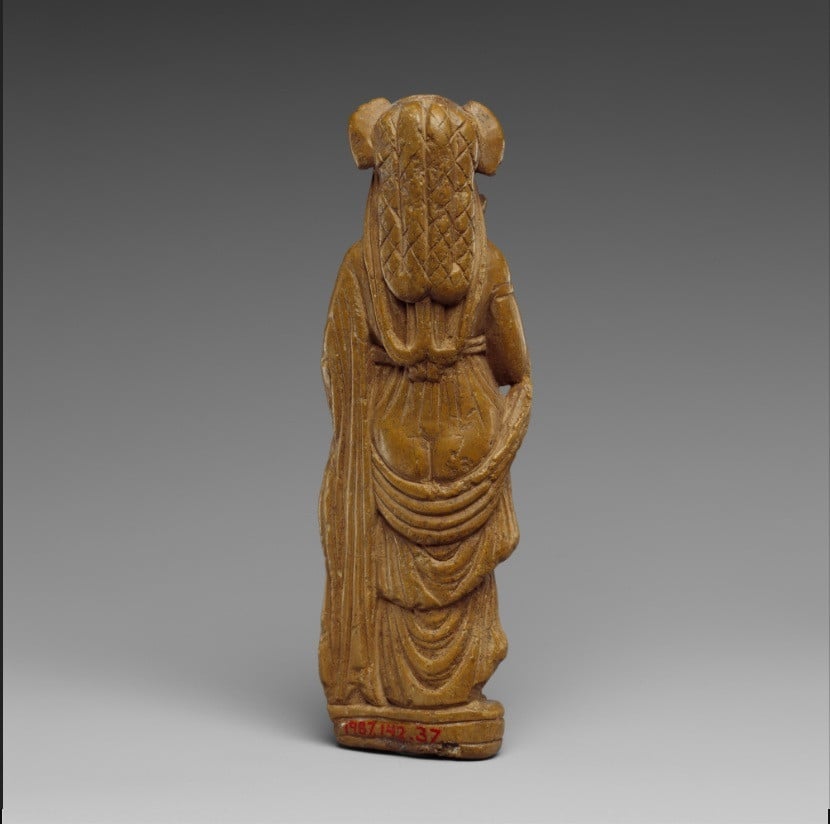
The synthesis created a completely new art vocabulary. The figure of a standing woman is a good representation of how artists in Gandhara adopted international influences and adapted them into expressions more appropriate to their own society. It is one of Gandhara's greatest historical accomplishments to embody cultural diversity without sacrificing its own identity. In many ancient civilisations, the mirror was given symbolic significance, and much more than a reflection of reality. Mirrors held a special place in Asian mythology; they were said to symbolise truth, self-knowledge and purity in South Asian traditions. They might also be seen in marriages, fertility rituals or devotional activities. In the Buddhist context, reflection sometimes came to represent the understanding of impermanence.
The meaning of this mirror is not yet clear, but its decorative artwork suggests that its owner valued it more for its artistic qualities than for its practical use. The standing female figure might have been a reminder to users not only of outward beauty but also of ideals of grace, beauty, and social refinement.
All looking in the mirror happened as a view of art, identity and cultural values at the same time. Monuments and royal inscriptions convey much of the history, but not much can be captured in the small artefacts. Grand stupas celebrate religious beliefs; palaces symbolise political power; but personal objects offer a glimpse into the everyday lives of ordinary people. Today, a contemporary viewer can catch a glimpse of the moments of daily life in ancient Pakistan through the mirror handle, a woman preparing for celebration, arranging jewellery, applying cosmetics, or partaking in family rituals.
The sensitive scenes suggest that many of the people who lived in the Gandharan world had much in common with us now: they sought to look good, were concerned with who they were, had families and sought social acceptance, and appreciated beauty. This continuity over two millennia gives us a stronger link with those who lived in this landscape.
Buddhist images are the primary elements associated with Gandharan art. Buddhist sculpture is obviously the highlight of Gandharan art, but secular objects show that Gandharan sculptors of Gandhara were very versatile artists.
In addition to monasteries, artistic traditions are evident in other objects such as mirror handles, cosmetic containers, jewellery, decorative plaques, and household ornaments, which are also found in the marketplaces. Thus, the Mirror Handle: Standing Woman enriches our knowledge and appreciation of Gandharan sculpture. It is a reminder that artists were employed not only by religious institutions but also by private patrons seeking beauty in their domestic or personal lives.
This diversity enhances our understanding of Gandhara as a complex urban culture rather than merely a place of pilgrimage for the followers of the Buddha. The Mirror Handle-Standing Woman is now a part of Pakistan's cultural heritage and a testament to the extraordinary artistic contributions of the ancient Gandharan civilisation, symbolising the main attributes of Pakistan's historical identity, including cultural diversity, artistic innovation, intercultural dialogue and outstanding craftsmanship.
Its survival over more than two thousand years accentuates the value of conserving the archaeological heritage. Each artefact adds yet another piece to the puzzle of the people who have created the cultural landscape of South Asia. The museums contribute significantly to the conservation of these objects and help people today understand the genius of ancient civilisations and take pride in Pakistan’s history.
While doing so, the artefact has the capacity to reveal the uniqueness of Gandhara as a cross-over point of civilisations, where Indian traditions, albeit not imported whole, were encountered and creatively integrated with Greek, Persian, Central Asian, and eventually Kushan traditions, to create one of the most unique art traditions in the ancient world. The result of a small sculpture at the end is that history is remembered not just by kings, battles and monuments, but also by the treasures of everyday folk. This relic still bears the image of its owner's face, as well as the culture and artistic tradition of Gandhara, which continues and will continue to endure.
Arshad Awan is a Lahore-based author, educationist, local historian, and brand strategist, and can be reached at arshadawan@msn.com
All facts and information are the sole responsibility of the writer