
Load-shedding alters the state of my consciousness. When the lights go off, I cease to be the same person I was. So if I did something wrong with that person in one of those narrow alleys of our neighbourhood that night, the electric company should be blamed for it.
I still can’t believe that I stooped low enough to corner that miserable, ugly creature. I tend to disagree with Shakir the Lame that looks become immaterial when it is dark. She was close to Lulu—a diminutive young chap with a face like a chimpanzee.
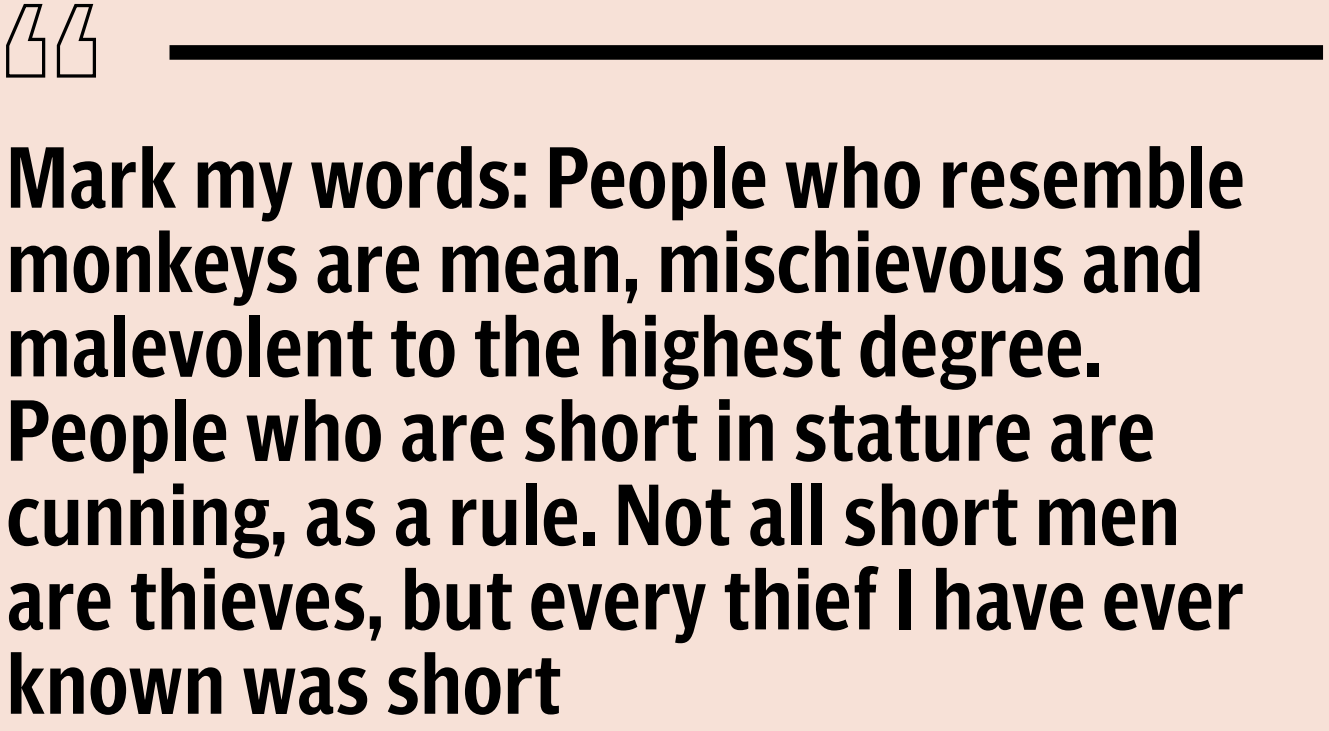
Mark my words: People who resemble monkeys are mean, mischievous and malevolent to the highest degree. People who are short in stature are cunning, as a rule. Not all short men are thieves, but every thief I have ever known was short.
Apart from being dwarfish, thieves have very alert minds and sharp eyes. It is their job to keep an eye on people—or rather their belongings—and a thief knows everything about everyone.
Most members of the Organisation, myself included, knew that Lulu, who lived in that poor neighbourhood with his mother and two unmarried sisters, was a petty thief who broke into shops. We often saw him returning on his motorcycle late at night, often with bulging bags dangling from the handlebars—the exploits of his nightly toils.
But we did not realise then that, being a thief, Lulu was also privy to all our secrets: he knew our roles in the Organisation; he knew where we ate, drank, pissed, and even where we tortured and killed our opponents and stashed our weapons.
I hated the fellow. His face always reminded me of those illustrations of our Darwinian ancestors. He also steered clear of me, though I often saw him dropping off his darling in the evening at an intersection a few streets away from her residence.
His girlfriend worked at a garment factory. She wore an abaya, but we assumed her private life was rather different from the image she presented.
In my long association with the Organisation, I had encountered only two types of people: those who began to run, weep, and beg when they saw the muzzle of a gun pointed at them, and those who turned into statues of stone—silent and cold. Lulu's lover belonged to the second category.
On that night, she had gone cold all over when I caught her hand in the dark, dingy recess outside the shuttered shop where an old butcher sold the meat of aged cows and buffalo calves.
She had not uttered a word apart from a suppressed groan in that dark corner, where the smell of her cheap perfume commingled with the rotting smell of blood and discarded meat scraps.
I was sure that she had not recognised me—it was very dark in there, and even in the shadows I could tell that she had avoided looking at me during and afterwards. Later, she hurriedly dusted off her clothes and, clutching her bag, almost ran toward her house.
As I lit a cigarette, the electricity returned, and with it my senses. I soon began cursing myself for the escapade, which I had found thoroughly distasteful. The Organisation did not approve of such behaviour, and if my conduct were discovered, it could land me in serious trouble.
I could not sleep that night, and the next evening I stationed myself near the spot where Lulu usually dropped the girl off, just to find out whether she had recognised me. The couple did not show up that evening, and I returned to the spot the following day in an even greater state of agitation.
Lulu eventually arrived. The girl alighted from the motorcycle, smiled at her lover, and turned into the alley as though nothing had transpired in its labyrinth two days earlier. As usual, neither the thief nor his companion looked in my direction. I heaved a sigh of relief and soon forgot the ugly couple altogether.
The months that followed were extremely turbulent as the government launched another crackdown, and the Organisation ordered us to go underground.
It was during this operation that the forces raided the place where I was hiding. One night in July, our neighbourhood was once again plunged into darkness by what appeared to be an unusual power failure. I was sleeping in the attic when someone kicked me in the ribs.
I was later shifted to one of their safe houses—handcuffed and blindfolded—and thrown into a dark cell. It took me a few minutes to realise that two other members of the Organisation were already groaning in that room.
We denied everything during the nightly interrogations, but at dawn, when they pushed us out of our cell, we found that they had already lined up a dozen people in the courtyard, their faces distorted by terror, torture, and lack of sleep.
Suddenly the gates were flung open. A jeep entered and pulled up right in front of the suspects. Three soldiers hopped out of the vehicle. Two of them were tall, well-built, fearsome-looking personnel, but the third was a small man whose military fatigues seemed several sizes too large for his tiny frame.
Unlike the other soldiers, his face was completely covered. He examined each of the suspects in turn while constantly whispering to the two formidable-looking officers.
When the veiled man turned to me, I recognised those monkey-like eyes blazing with hatred. In that instant, I understood everything. It was an identification parade. The veiled man was Lulu. And it was the end of the road for me.
This is a work of fiction. Any names or characters, businesses or places, events or incidents, are fictitious
The writer can be reached at farrukhkamrani@gmail.com