Microsoft develops AI tool that can diagnose 'sequentially' like a doctor
Updated 50 minutes ago

Zhuque-3 recovery brings Beijing closer to low-cost, high-frequency commercial spaceflight
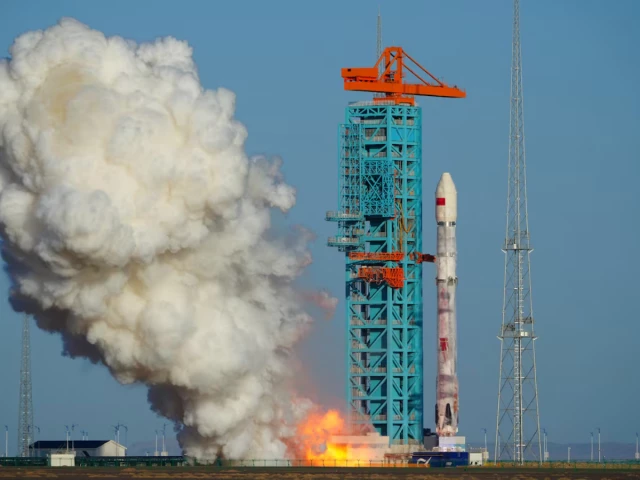
China’s commercial space industry took another important step towards making rocket launches cheaper, more frequent and more commercially viable after the successful recovery of the first stage of a Zhuque-3 reusable rocket on land.
The Zhuque-3 Y2, developed by Beijing-based private aerospace company LandSpace, lifted off from the Dongfeng Commercial Space Innovation Pilot Zone in northwest China on Wednesday morning. It successfully deployed the Honghu-03 satellite into its designated orbit before its first stage returned to Earth and made a controlled landing at a designated recovery site in Gansu province.
The landing, completed less than 10 minutes after liftoff, marked China’s first successful land-based controlled recovery of an orbital-class launch vehicle’s first stage using deployable landing legs. The achievement represents a major advance in the country’s effort to move reusable rocket technology from experimental testing towards regular commercial operations.
China launched the reusable rocket Zhuque-3 on Wednesday morning, achieving its first recovery of a rocket's first stage on land. #XinhuaNews pic.twitter.com/ctxqBY7VmG
— China Xinhua News (@XHNews) August 19, 2026
The breakthrough is particularly significant because reusable rockets are designed to fly multiple missions instead of being discarded after a single launch. This could fundamentally alter the economics of spaceflight.
#MegaProject China achieves successful land recovery of a #rocket. ZQ 3's first stage returned from high altitude and landed vertically after completing its mission. #China has now proven another way to bring rockets home. #ZQ3 #space #tech pic.twitter.com/oq9BN1x6bL
— China Daily (@ChinaDaily) August 19, 2026
According to LandSpace, the rocket itself accounts for most of the cost of a conventional expendable launch vehicle, while fuel generally represents only 1% to 3% of total launch costs. The first stage alone typically accounts for about 70% of the rocket’s cost. Recovering and repeatedly reusing that stage could therefore substantially reduce the cost of individual launches by spreading the expense of manufacturing the vehicle across multiple missions.
Historic breakthrough: Zhuque-3 Y2 rocket completes China’s first land-based recovery, paving the way for reusable rockets—both on the sea and on land—and lower costs. 🚀 pic.twitter.com/ws1OLj1TpJ
— Mao Ning 毛宁 (@SpoxCHN_MaoNing) August 19, 2026
The Zhuque-3 has been developed specifically with this model in mind. The two-stage rocket is 66.1 metres long, has a diameter of 4.5 metres and a liftoff mass of about 570 tonnes. Its first stage is powered by nine liquid oxygen-methane engines and incorporates grid fins, attitude-control systems and landing legs to enable autonomous return and a soft landing.
The Y2 mission built on lessons from an earlier flight test, with improvements aimed at enhancing recovery reliability, flight control and engine performance. LandSpace also modified the first-stage landing propulsion system and introduced an autonomous safety-control function capable of predicting the landing point and making adjustments during flight.
The mission further tested several technologies considered important for future reusable launch vehicles, including stainless-steel structures, liquid oxygen-methane propulsion and landing-leg recovery. LandSpace says stainless steel offers advantages in manufacturing cost, processing efficiency and post-flight maintenance, making it potentially well suited to rockets designed to fly repeatedly.
The successful landing also highlights the increasingly diverse nature of China’s space industry. The Zhuque-3 programme is being developed by a private company, while state-owned aerospace programmes are pursuing their own reusable launch technologies.
The latest achievement came only weeks after the Long March-10B reusable rocket successfully completed a sea-based recovery test on July 10. The parallel development of land- and sea-based recovery systems reflects what Chinese aerospace experts describe as a dual-track approach to building future low-cost and high-frequency space transportation capabilities.
China’s progress is unfolding against a broader global race to develop reusable launch systems. The United States remains the leader in the field, with companies such as SpaceX and Blue Origin pursuing different approaches to rocket recovery. Chinese experts, however, argue that the combination of state-backed programmes and rapidly developing private aerospace companies is allowing the country to explore multiple technological pathways simultaneously.
For China’s private space sector, the Zhuque-3 landing could prove particularly important. The successful test demonstrates that a commercial company can integrate the complex chain of technologies required to launch, recover and eventually reuse a large orbital-class rocket.
The commercial rationale is becoming stronger as demand for satellite launches grows. The expansion of low-Earth-orbit satellite constellations, satellite internet and space-based information networks is creating demand for launch services capable of placing large numbers of satellites into orbit at lower cost and higher frequency.
LandSpace says Zhuque-3 can support a range of commercial missions, including constellation deployment, individual satellite launches and rideshare missions.
After China's first land-based reusable rocket landed, robots immediately moved forward to conduct inspections. https://t.co/xp4ZZPWCp0 pic.twitter.com/QwONgkB8ei
— Akin💯 (@ics923) August 19, 2026
In expendable configuration, the rocket has a maximum orbital payload capacity of 14.2 tonnes, while its reusable configuration is designed with future large satellite constellations in mind. The company is now looking beyond individual successful tests towards establishing a complete operational cycle of launch, recovery, inspection and reuse. Its stated objective is to bring rocket operations closer to the frequency, reliability and safety associated with aviation.
The Zhuque-3 is not alone in this push. Other Chinese private aerospace companies are developing competing reusable vehicles. Galactic Energy is preparing its Pallas-1, while Orienspace’s Gravity-2 is undergoing final ground testing ahead of a planned maiden flight in the fourth quarter of 2026. Space Pioneer is advancing work on Yuanxingzhe-1, while i-Space’s Hyperbola-3 is expected to conduct its maiden flight around the end of the year. CAS Space is also developing the reusable Lihong-2.
Together, these programmes suggest that China’s reusable rocket ambitions extend beyond a single company or vehicle. The country is building an ecosystem in which private firms and state-owned programmes can test different propulsion, recovery and landing technologies while competing for an expanding commercial market.
Yet the successful recovery of Zhuque-3 is only an important milestone, not the end goal.
The real test will be whether the technology can be converted into reliable, repeatable and economically viable commercial operations. A rocket that lands successfully once must ultimately demonstrate that it can be inspected, refurbished and launched again safely and frequently.
If Chinese developers succeed in making that transition, reusable rockets could reshape the economics of the country’s commercial space sector, lowering launch costs while increasing the frequency of missions. The Zhuque-3 Y2 test therefore represents more than the return of a rocket stage to Earth: it marks another step towards China’s ambition for a high-frequency, lower-cost space transportation system.














This material may not be published, broadcast, rewritten, redistributed or derived from. Unless otherwise stated, all content is copyrighted © 2026 The Express Tribune.






COMMENTS
Comments are moderated and generally will be posted if they are on-topic and not abusive.
For more information, please see our Comments FAQ